
1:02:49 Webinar
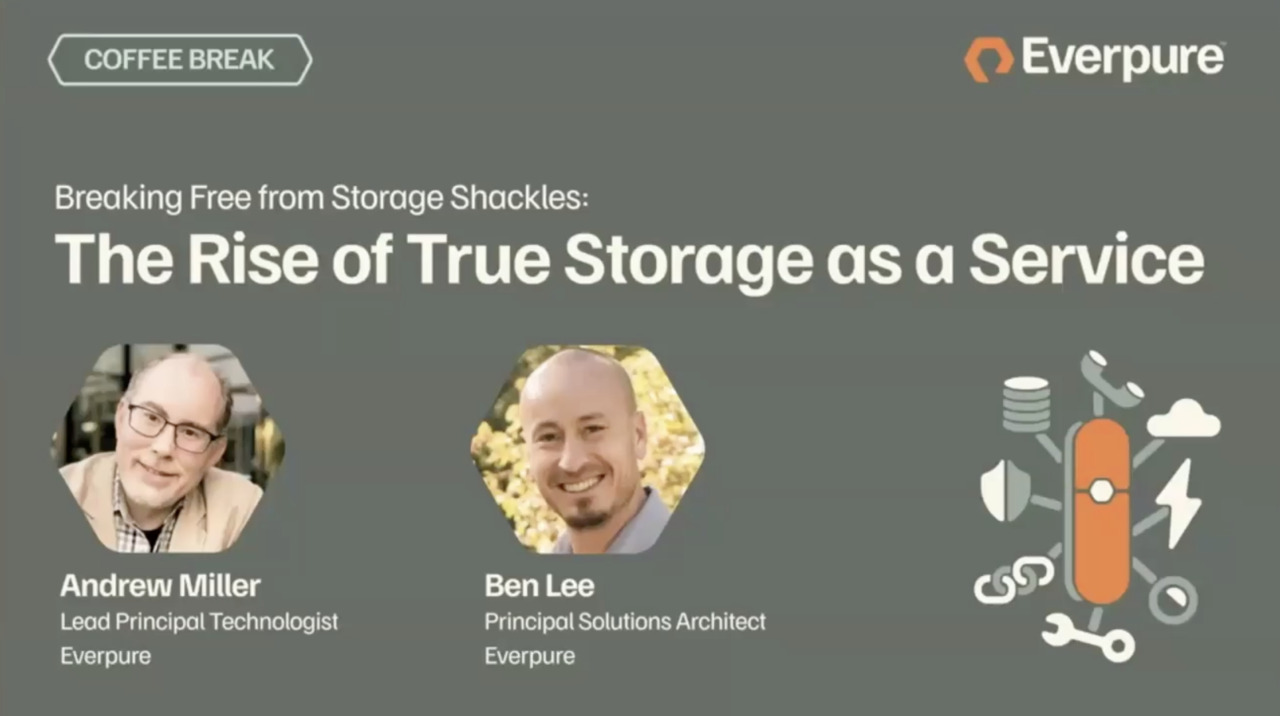
Breaking Free from Storage Shackles: The Rise of True Storage as a Service
For April 2026, host Andrew Miller invites Ben Lee from the Everpure Evergreen//One™ design team to Coffee Break.
This webinar first aired on April 14, 2026
The first 5 minute(s) of our recorded Webinars are open; however, if you are enjoying them, we’ll ask for a little information to finish watching.
Click to View Transcript
Welcome to this month's Coffee Break. It is the month of April? I think it's April, Ben. Keep me honest. The days and the weeks and months blur together, so- It's spring I, I got a yes, so thank you. So we are back with, actually, I was looking
at this. It is month 64 of the Coffee Green Series, which we started in, May, January of 2021. My name is Andrew Miller. I'm your host, and actually I'll let the music here play a little bit in the background 'cause, hey, this is the theme music. So we're gonna be talking today breaking free from storage shackles, the rise of true
storage as a service. Really appreciate Rob Lee, Principal Architect, Principal Solutions Architect, architect extraordinaire, joining today. He's been involved in this. A little bit of housekeeping as we start as always. Coffee Break is a series. As mentioned, we're on month 64.
You can find all the previous ones both at purestorage.com/events, and well as actually maintained Google Slides that are open. You can find them here. You can click them when you receive afterwards at the Bitly link. Because these are more solution-focused, as you'll see, or you know, the first half we try and talk about the industry
and be more educational. The second half, we dial in on what Pure does in the space. Next month, we'll be joined by Nathan Wood, talk about the tech survivalist toolkit. We're gonna talk about Everpure Cloud and cloud-native applications, part of your essential go bag. Going with a little bit of a, a prepper theme
there almost, if you will. As well as think about cloud dynamics in an era of scarcity, allocation, some of the classic value that Pure's had amplified in the cloud, cloud design principles, and some updates in this space, 'cause there's been more coming out since actually we renamed the products.
Always making sure to highlight our customer community. You can find it here and sign up. And maybe you either want to share an experience, or you wanna see what other customers say about us anonymously on Gartner Peer Insights. Really good resource. Last but not least from a promotion
Pure Accelerate, our yearly conference, is coming soon in just about two months in Resorts World Las Vegas, same location. Frankly, this is a smaller conference, let's be real, but in a good way. I've actually had really good hallway conversations. There's good content. There's actually great things with free
certification offerings if you show up, and free training class that you can get. There's a lot there. Just hit Pure Storage Everpure- purestorage.com/accelerate. Trying to get my URLs right versus my names right. And if you're just here for the drawing, hey, I get it.
We'll be doing that at the end with a mugger, a, a coffee lover's gift set, a Yeti mug, similar to this one, but with, hey, new branding. You'll be special. As well as a charger. I'm, as always, your host, Andrew Miller, Lead Principal Technologist here at Pure. I mean, actually, I usually don't do too much of my introduction, but I think about service
offerings and where I started with this. And what I realized as I was thinking about this and bringing Ben on, the world that I lived in when I started out of college, 2000s, almost nothing was a service, not on the consumer side, right? So there's been this amazing evolution.
But I've gone long enough. Ben, really glad to have you here. Good to be here. We'll talk about some of your history at Pure Storage, but would you mind introducing yourself? Yeah. Yeah. I am a technologist at heart.
I love technology. Happy to be here. Coffee Break is always one of my favorite things to watch, every month. Little bit about, about me. I started in infrastructure, and I've kind of just stayed in this space forever, right? There was a time where I wanted to change careers and try something new, and, and here I
am at Everpure. It's one of my favorite, places. I have had an amazing journey. Every place I've worked, I've loved. Everybody I've worked with, I've loved, and I couldn't be happier to be at Everpure today. Little bit about me. Love to hike.
If I'm not at my desk, I'm probably out hiking. I've got a, a crazy family. I've got 16, 14, and 12, going on who knows. They are, they are wild. Um- Any given hour of the day it might be a little different maybe? Exactly.
Quick answers here. But we like to spend time as, as much time at, at the beach as possible. Unfortunately, in New England, that's only about three months out of the year, but you'll find us there during that time. So those three months, if you call Ben, if he picks up, he's probably at the beach. That's right. Where he should be, 'cause it's only three
months of the year. Okay, so diving in for the month. L- as mentioned, this month we're gonna be focusing in on storage as a service, and what we wanted to wander through today is, as hopefully folks know, you've been joining with, with us for a little while, or maybe watching this later, 'cause often these syndicated and you watch them afterwards.
So you know the tagline, "What do we want? Everything. When do we want it? Now." You know, that's, that's a little bit of today's life, but maybe subscription services. So we're gonna start off with having a little bit of fun, kind of where storage as a STaaS came from, but, but the Ben version of this, 'cause actually, Ben, part of the reason he's
here was he was involved with one of the very first customers to really dive into STaaS a service with Everpure, and even maybe some career evolution tips in there. Then we're gonna hit on some core storage as a service principles. You know, why SLAs matter, exit clauses, things that you should think about as you're evaluating the space. Obviously, we have an opinion on these as Pure,
but b- believe this will actually be helpful for you whether you're an Everpure customer or not. And by the way, if anyone's taking the over under on how often Ben or I say Pure versus Everpure- you just got one on one side, I could feel it as I said it, but, you we're trying. We're trying. Third, now we'll go
into more specifically some Everpure items. But, you know, don't be that human, guy, woman, lady, whoever, right, kind of thing. But the top design tips or the top things to avoid maybe or to do for Evergreen//One, that's our subscription offering, storage as a service. And then looking ahead a little bit, what's new both in the industry and what we're doing
from an Everpure standpoint and where we're focused. So before we dive in, poll number one, Tatiana, if you would be so kind. Both, we'll, we'll share these back. Sometimes these are just fun polls, you know, for a little bit of audience even sometimes it's interesting for you all, so we always make sure to
share the answers back. About did you have a crystal ball? And anyone who says either in the poll or maybe in the chat that you totally knew that storage and NAND prices were gonna skyrocket, I don't know why you're not retired already. Or maybe you are- Oh, wow but you still like to join us. You know, that kind of thing.
That's fine, too. So we'll just leave that up there for a minute while we, while we dive into section number one. So for section one-Thinking about, where STaaS babies come from, or, or a little bit of Ben's history. So I was thinking about, this is now going back to even kind of 2019
vintage, I think, Ben. So you were, you were an SE at the time, and you had just heard about a new offering from Pure. We'd done Evergreen, it was Gold at the time, which was a, a better than average, you know, purchase offering where it gets better over time.
We even called that a subscription to innovation 'cause you got new capabilities as you upgraded your software. That was cool. But it was right about the time that we launched our very first storage as a service offering. We called it ES2, or Evergreen Storage service then, because, hey, it's fun
but do you mind kinda taking back in time a little bit to kinda what you were doing at the time, and, and then maybe even some of those first customer conversations you had where you were leaning forward a little bit, and, and it worked out fortunately. Yeah. Yeah, I'd love to. So I was, just part of the enterprise sales team at Pure at that, at that time.
And as you said, Andrew, we had just started this concept of being able to do STaaS service, right? It was in response to customers who genuinely needed this type of solution, and we were able to, to create something. Now, no joke, my very first experience with it was I had read the PDF, right, the internal product brief that we had been given.
You read your email. Congratulations. I read my email. Let's, let's call it that. And, not two days later, we had this opportunity with a, a very large customer, a l- a large, regional bank, and, they had enjoyed testing Pure's gear, but it just didn't meet their enterprise scale from a, you know, provisioning
perspective and some of those other things. And, they traditionally had had a very large managed service contract for STaaS, right? So their life was, was a little different than the average customer. And so this customer, while they enjoyed Pure, really didn't have time to get into the nitty-gritty of storage arrays and things like that.
And so he offered, instead of a full meeting in their office, he offered drinks just so we could get to know him. And, lo and behold, we sit down. He said, "Guys, I don't really wanna talk about storage," right? Let's just enjoy the evening." it was gonna be a quick 30-minute conversation.
He was gonna go home. Well, I asked. I said, "Well, what would Pure have to do to really make a difference for your company?" And he said, "Genuinely, unless you can offer STaaS to me," he's like, There's really nothing you can do to help. And not two days earlier, I had read about
this new program, right? And, it, it was enough to spark off a conversation, and we then followed up drinks with dinner, which was awesome. And, you know, fast-forward about a year, we were able to help this company not only alleviate themselves from that managed service provider, but bring some knowledge and
intelligence in-house and do something totally dramatically different with their data platforms. And this was the early days of Evergreen Storage, right? It was, It, it didn't have all of the SLAs and stuff we have today, but it was still an option that would scale over time with consumption.
You know, fast-forward to today, we have so many different things, but it was awesome to be part of that initial conversation. And genuinely, that customer experienced something brand new that they couldn't really get from other vendors. Well, and there, there's some pieces that I, I love here. One, it, it's fun to see the through lines,
like we've talked on Ali Brick, but even otherwise, per report, about the 15 architectural decisions with Pure, there's consistent things that we've, we There, as long as technology or architecture gifts that keep on giving. I look at what's here and, you know, some of the value proposition and even some of the core value. We've added a lot more onto this, as people
are gonna hear, but the core need of almost where storage as a service came from, minimizing expenses on assets on a balance sheet, align expense with usage, simplify capacity planning. You know, think about hybrid cloud. Like, even, even aside from this being a, PureSlide here, like these are still the same core principles that people
like that, that foundation is still, is there, even as, as an industry, we've lot more on. And I still remember this here, like this little true OPEX thing, even back then, that it needs to be truly OPEX and not just like a lease in disguise. And if you hear the term I did this as a customer.
Like I had a, I had a, you know, I had a NetApp system on lease, so I knew it was a dollar buyout or a fair market value. That wasn't a service. It was a lease. You know, those, those are little tips you pick up like, "Okay, what am I really getting from a vendor?" It needed to be a service, not a dressed-up lease kinda thing.
Yeah. Keep going. Back to you. Yeah, yeah. And, and, you know, to tack onto that a little bit, the, the customer, this particular customer, they didn't know what they were gonna need over the course of the next few years, right? They knew the baseline of what they had today.
Mm-hmm. They had some pretty strong ambitions to get to the cloud, right? So they really didn't want to do things like overcommit and have to completely their aging infrastructure with oversubscribed, right, solutions, and so this came at just the right time for them.
Over time, they've s- they've saved to the tune of $40 million compared to their previous contracts, and this has been a huge differentiator for them. It's allowed them to do things that they couldn't do before because of those expenditures. So it's kinda cool, right?
And, and to see where it's come, I, you know, we're gonna talk about it a little bit, to see how far we've come and how much we've added to it is, has been something that I've been really passionate about. As, really an outcome of this particular customer, right, I was able to build some skillsets around STaaS that I didn't have before, and over time, I was able
to, like, just really dig in and get really good at that, and that's why I became part of the product architecture team, right, management, because I'm so passionate this STaaS offering. So it's really, really cool to be part of that journey and genuinely do something I love.I may, I may close out this section, this section then, Ben, and not cutting you off, if
you have a final thought. Yeah. I mean, I've, I've just like, I, I feel like I hear a little bit of a It- Candidly, sometimes from a, a technologist standpoint, a practitioner, a engineer, systems engineer, whatever, it's easy to look at new things and be a little skeptical.
You may know that it's aspirational. You know, there's sharp edges, and man, I don't wanna find those out in real life. And, and we need to not do career-limiting things, okay? But there can be value in, in consciously being like, "Ooh, I see this new area. I think it's gonna be big.
Let me consciously lean into this." And for you, actually, that ended up shaping your career, like actually choosing to lean into that and being like, "No, I don't wanna say anything," you know, kind of thing to that customer. The other piece there is that Charles Giancarlo is, is, and he's posted on an earning call, talk Everpure CEO, this is the future of the company and the industry.
And I think we all know that, es- especially now, so we'll play that out. But last thought, Ben, before we move to section number two. Awesome. Cool. So okay, let me, share back the poll, if I can find the window here. Shame on me that I can't.
Tatiana, would you mind sharing back poll number one? Oh, no, I, I, I got it. I'm sorry. Yeah, you got it. You got it faster than that. Thank you. So, a, a It's tied for go down or go up, so basically I'm gonna take that as no one had a crystal ball. Good, 'cause otherwise you shouldn't be here kind of thing.
But I think there, there was Although I, I would bet if I had to take this a couple years ago, it would've been, hey, this is, the, some of these layers are commoditizing. What we do as Everpure, Pure, Pure Storage, we're providing higher value premium capabilities. But the general industry, this is a commoditizing layer.
Until it didn't, and prices spiked in the last couple months or year or so. Okay. Tatiana, if you don't mind going back and, Actually, yeah, no, I, I clicked share so people can see, see the results there. Tatiana, if you, if you don't mind launching poll number two, that'd be great. And while doing that, I was looking back here, Ben, I was listening to you, but looking back,
we had Paul Ferraro on to talk about exploring the service economy in Pure Storage in May 2021. I, I don't know if that is still online, but some of the previous ones when we had, other people on are. So number, poll number two, when you're planning for the future, STaaS
is harder, the same, easier than, than owning, et cetera? And maybe that's even, that could be your experience and what STaaS offering you've, you've used, whether it's in the cloud or on-prem or a hybrid one. There's various ones out there. 'Cause I mean, ES2, EC2 is a storage as a service. So is S3, you know?
And we think that this is gonna be cloud STaaS cloud storage. So we'll leave that up there. So think of the, thinking about then core storage as a service principles. The thought here was that we wanted to do, if anyone joined us previously about a year ago with Matthew Bednar- and then before that even with, Abe Barnes and, John Brett, some of
these principles we've hit on before, and we're choosing actually to revisit because they're somewhat timeless, even as, Ben, you've got some new facets of these. So I won't, I won't do too long of a lead in here, but I'll toss it over to start about thinking both the, the greatest hits, because these are all still valid, but I know you've got some new wrinkles in here even within the last year.
So back to you. Yeah. Yeah, I appreciate that. So, again, when you're thinking about designing, for a STaaS, right, you really want ideally the most flexibility you can possibly achieve. In general, you're using a STaaS as a service because you want somebody else to do a
lot of the work for you, right? There's a lot of other definitions of STaaS, right? But in general, that's what somebody's going to do. Now, what can you add to that, right? Where somebody's managing the storage platform, that's great, but adding
know, managed service providers really kind of build their business on building SLAs for their customers. And that's a SLA being service level agreement- Ex- for folks who know the Exactly. Yeah. Yeah. Thank you. So having some assured level of service, right?
That's a big part of what makes a real STaaS. But, you know, we find that, that's not always the case when, when other people But what's the purpose of a STaaS if you don't have some commitments, right, from that vendor? And, and I do wanna highlight that real fast. The SLO, service level objective, that's a objective or a goal, and if I'm just a little
snarky, we're still being, you know, kind of agnostic to the industry armchair analysts, like hope is not a strategy. Like an SLO, an objective, like that's good to know what the objective is, but it's not a strategy. It's not something that you can take to your boss or boss's boss.
An SLA is where there's a hard commitment from, from whoever's providing that. Yep, exactly. Exactly. And that's why understanding that differentiation is critical, right? You're looking at your contracts before you sign them. It's really important to know what the that provider is actually on the hook for.
And you'll find, again, you'll find that, unless you're using a managed service provider, most as a service offerings out there just don't really stack up and, and don't offer those things. And then you want flexibility, right? I mean, genuinely, what's the purpose of a service if you have to lock in everything?
Ideally, you, you shouldn't have to be an expert. Now, I know 41% of everybody on the call was able to project that co-storage gonna go up- right? Which is great, but the reality is most of us, at least the, the, the rest of us, would've assumed, you know, either stayed the same or gone down.
Now, the flexibility to be able to, you know, quickly adapt to change within your environment, that's an amazing feature of most services. But-What if you could also lock in price protection, right? Now, those 41% that, that said that prices were gonna go up, they probably did lock in price protection, I hope.
But for the rest of us, right, this is this unfortunately can sometimes be an afterthought. And again, if you're not careful on that STaaS, you might not be taking advantage of price lock-in that could be advantageous for you, right? Now the last thing you have to consider w- as you're first thinking about STaaS as a service is what happens at the end?
And a lot of vendors out there who offer storage as a service, right, that exit strategy has some strings attached to it. You know, they might try to provide some incentives. Again, don't wanna go too much into, to what other people do, but right, there's some complexity around what happens at the end of that term that you originally es- establish.
There's a lot of different things that happen, but generally they are not favorable for a customer. So again, ask the right questions, consider these things as you go into it. And then last but not least, and Andrew, I'd love for you to, to chime in on this, you know- what, what's the value of a service if you have to commit to everything up front?
So what do you think about on-demand? So I've, I've got a little bit of a I think it's a catchy tagline, but, you know, if you're So there's the idea of a reserved commit, okay? You've committed to this much, you know, ahead of time. I would actually argue that for, for any service, if you're always below your reserve
commit, you're overpaying, because if it's a service, there should be some level of on-demand and bursty, and if you're always below what you're paying for all the time, you're always paying more than you should be. Now it needs to be not too painful to burst, either like there's capacity on demand or there's pricing on demand. So sometimes when I'm chatting with folks, and
now this is even sometimes looking from a, an Everpure perspective, but even services in general, like if you're not bursting you're paying more than you should be, that's an opportunity for optimizing your balance sheet a little bit, you know, kind of thing. Now if I put my architect hat on, I have to make sure that when I burst there's not, unanticipated consequences.
But, but, but it actually can be a different way to design. And I'll even tag on a little bit for the what it looks like when you exit, just to when we were chatting in the first section. If, for me, the best thing that I ever learned there was just if a- I ever hear the words fair market value or dollar buyout, there's these like trigger words where you're like,
Ooh, that's actually a lease." And that's not that a lease is a bad thing. It might be what you wanna do. But if it's a lease that's pretending to be s- be, be a service, well, that's not the same thing. If we can take a great Ron Swanson quote, you know, it's skim milk that's pretending to be
milk, if you want a Parks and Rec, reference out there for anybody. You know, so just weaving in general clips. Um- That's a great one. That's a great one. Yeah, and, and there's also, you know, incentives to renew that are sometimes built into contracts, that, you know, may not even be noticed as a fee if you
choose not to renew, right? So there's lots of little things that, that happen, and, you know, why would you consciously lock yourself into something that has that type of gotcha at the end? I think, I think there was, there was one other one here, but that we talked about as well, and it's kind of reflected in here, but you know, it's drawn out a little more.
So for, for some customers when they're consuming STaaS, are there scenarios you've seen where maybe they still have to plan multiple years out and, and choose the hardware, and does that make sense or not? It, it, yeah, so I'm glad that you asked that. Again, you know, don't wanna dig too deep into, to our competitors.
You, you guys can learn about them your, on your own as well. But, in, in virtually every case, and this includes when you're working with a, a traditional MSP who, who they have to procure hardware, you're to make a selection early on that does impact your price as to what type of box you want, right?
And I'm not talking about just what of service do I need, because that's I'm talking about like how big do I will actually need by the end of this? Because if you, if you aim too low, then you typically have to do a pretty significant contract renegotiation some point during the line to get more hardware, right? So essentially, even though, even though it may be fully, you know, a consumption model
and, and things like that, you know, all the phrases you wanna hear in a STaaS service, it may ch- may, may look that way, but on the back end, that contract is built on top of a set of hardware, right, that had to be selected day one. Right. Yep, you're locked into that box, and, and, you know, it's i- in some cases, again, maybe you selected big enough and it, and you noticed the pain of, of having to go bigger.
In that case, you probably are paying more than you needed to, right? But if you did grow faster than you expected and hardware has to change, that's a real problem, right? A real service shouldn't force you to make contract changes every time you needed to grow a little bit more than you originally planned.
Easiest analogy I think of there is we, we think of purch- procuring services, maybe even infrastructure type services in the cloud, whether they're storage or servers or others. W- w- we have no, literally no idea of the underlying hardware is, nor do we even know when it changes out under the covers, nor should we need to know. That's part of the value. So if we're being constrained by the hardware
element and that driving kind of artificial decisions, I'd argue that's not as much as a service. It's more, it's more of a financing option. And, and being real, being able to accomplish that takes some really s- hard technical underpinnings.
Like you have to have designed the architecture under the covers for that. I mean, that's what AWS did. That's what Azure did. That's what Everpure has done, right? I'm not trying to harp on us, but, like, this actually takes engineering chops under the covers to be able to offerNot being constrained by the hardware if you haven't
planned that ahead of time. Right. Right. Well, and somebody, somebody brought up in chat, thank you for, for mentioning this, what happens if you have to restore a large database, right? What happens if you, if you need to do something that includes a dramatic amount of change to your, your storage infrastructure?
Again, if you're not on the right service, you're gonna be limited by whatever's physically there, and that can be, that can be dramatic. Whereas again, if you're, if you're, you're on a true STaaS that allows you to consume as much as you need to, right, type of emergency restores or other can be happen could- can happen very quickly, and it becomes the vendor's
my responsibility, to make sure you have room to grow over time above and beyond that reserve commitment. Love that. So we'll talk a little bit more about that, but thanks for, thanks for the question. That de-risking. Yeah. I'm, I'm gonna cheat a little bit and go out- out of order.
If you actually go back, we've actually talked about in the past some of the from a, app- Everpure standpoint, with Justin Emerson. That was probably the most recent one. But I'm I was trying to scan here That, that's actually really good taking Flash from niche to mainstream, and actually the underpinnings from an
architectural standpoint. So even though we're focused on the as a service standpoint, you can't kind of pull that away from the architectural and technical underpinnings to actually make those promises more true than just on a slide. Closing up this section though, we do also have a Again, it's meant to be a helpful guide.
Obviously, it focuses on things that we, we believe matter in this space. But you can actually still find a STaaS a service RFP guide, 'cause sometimes there's RFPs involved here. I'll actually go and find that link. I thought I had it in this slide, but I don't.
But you can actually just Google on STaaS Everpure guide. You'll find this. It's like a f- I mean, as you can see here, it's not a super long PDF, and it's pretty comprehensible as far as the factors to be looking at and thinking about, and maybe even questions that you wanna put in your RFP just to, just to make sure, right?
Kind of thing. But with that, I think I'd, I will go back and share poll number two, 'cause we're moving into section three. But as always, we'll end the poll and share the results back. So planning for the future does seem like at least both the, I'm gonna presume, perception and/or experience is that STaaS is easier to plan for than ownership. Good.
That, that, that is the goal. It should rele- relax some of the boundaries that you've been stuck with from an ownership standpoint kind of thing, know, in the cloud or on-prem, either way. Tatiana, if you don't mind sharing poll number three. Thank you. So this, this is gonna
go a little more general. Actually, so Ben, I, I'm, I'm, I'm not gonna assume that your answering will slant the results, so I'll answer this, but you answer first. When you travel, do you use Uber, Lyft, or do you rent a car for work? What is it on your end right now?
There's some variability, right? Really? Oh, good. I, I genuinely believe that there's, there's a right solution for each offering. However- Agreed. Both however, I lean towards Uber, Lyft for simplicity, right? If I know I'm gonna travel a ton, sure, maybe
renting a car, but how many times have you rented that car and not used it more than a, a day or two? For, for me, it is truly for the last five years since COVID, I have not rented a car for work. Wow. It's been Just, just being real. Maybe it means I'm boring. When I'm traveling for work,
I'm traveling for work. I'm working in the hotel in the evening or there's customer dinners, et cetera. I'm not necessarily there to go explore the city on my own kind of thing. But there are other people who like to do that, and they have time to do that. It's great. So for me it's always just been I don't wanna
take the time at the airport. I wanna get to the airport an hour ahead of time. Be able to get on board, not drop off my rental car and figure all that out kind of thing, so yeah. That's, that's exactly right. That, that drop off process is the worst.
Again, end of, end of contract problems, right? You gotta figure out where to go. It's like one extra thing to figure out. You fill up that gas. Yeah. Okay. All right. Now, now transitioning into a little bit of, of Pure focused items.
So don't be that guy, human, person. Top design tips for Evergreen//One. But this is gonna include a little bit of an overview of the Evergreen//One of today, 'cause maybe you've been looking at this, at P- what Pure's been doing, and some of the foundational pieces here you're not as familiar with.
So I think I'll, I'll turn back to you, Ben. We're just gonna kinda continue diving into what we think about for STaaS, that is Evergreen//One. And I even wanna preface this to anyone who's listening, and if you have What I've had referred to m- I've had people say, "Oh, I have some adversarial vendors that are forcing
me into subscription only." We are not doing that, right? There's some really unique things about our subscription offering and our STaaS service offering, but we're not saying you want it 'cause you can have any color you want as long as it's black on your Ford Model T right kind of thing. Mm-hmm. There's still really great things about the other offerings that we have.
So Ben, back to you to kind of walk us through a little bit of the focus on Evergreen//One, and then even kind of how it plays with we continue to have a diversity of offerings. Yeah. Yeah. Thank you. So again, right, I've been at Pure nearly 10 years. Evergreen is the foundation of everything that we do, and what really differentiates us
compared to everybody else. And so it's an It's great that you emphasize, Andrew, there's never in time where Pure forces a customer to choose the STaaS option, because we definitely believe and understand that there are use cases for each of the solutions. So the Everything below the line, right, that's where you own the hardware.
You pay up front for the actual hardware and some amount of that subscription. Evergreen//Forever, you pay for access to all of the storage, and you have the entire system a- available to you, right? And you pay for that up front. Flex is a little bit different.
You pay a lower price for hardware because you don't intend to consume all of that, and then as you consume, you, you get, some on-demand consumption, or you can change reserve. So those two, again, you own the hardware, right? At the end of the day, you can throw that hardware, shred it, do whatever you want with it. But we found that a lot of customers Again,
let's jump over to Evergreen//One. A lot of customers are They wanna be out of-Planning, managing, and disposing of hardware over time, right? Now, obviously with Evergreen, you don't always have to dispose of things like you do all of our competition. And I'm hoping that many of you guys are
already Pure customers and satisfied with the solution you're on. I'd love that. But if you're ready to look at STaaS if your business needs flexibility, if you don't want to have to plan around every single edge case for your future, Evergreen//One starts to fill in that gap.
And so what we do is we design your service not around boxes, but instead guaranteed outcomes, right? That might mean, you know, hey, I need a compliance system that is isolated from everything else, and that's one of your outcomes, and we make sure that that's there. Or maybe you need a, a very specific IOPS in order to reach your
business objectives, right? That report that needs to be completed within a certain amount of time, etc. Maybe you just need, you know, to, to have that guarantee that hey, I can switch from an on-prem model to a cloud model consuming Everpure, right, all in one contract. Maybe that's the, the business outcome that makes that big driver.
But for all of our Evergreen//One customers, it's a business outcome that they're working toward achieving that traditional ownership just doesn't quite allow you to do, right? So flexibility, unplanned growth, all of those things. Those are some of the most important elements, and, and I can't tell you how many customers have already benefited from this and, right now in this market, how many are very
interested in being able to take advantage of these guarantees. Andrew, is there a specific, a specific element there that you would like to highlight? Look at this slide. I think I'd like to, I think I'd like to dig in. This is a heavy slide, so folks are like, "Ooh, I'm gonna stop listening and start reading." hopefully you can do both at the same time.
So what I actually wanna dial in on is, let's talk about guaranteed SLA-based outcomes. It is the top item. And so if we go back, this is the magic of using a, you know, a presentation view. Can go back here. The number of SLAs that we had back here was relatively low. We, we There were ones that we did have, you
know, kinda thing. And I And by the way, if, for, I do see a great question related to Flex. We'll answer that at the end here. Actually I'll put that in there. But so we've added quite a few SLAs, and some of these are even kind of fun ones in that, for example, one of these you may see, like,
no data migration. If you've been an Everpure customer for a while, you'd be like, "They've always done that." You're right. We have. That's actually been the one of the core Evergreen technical capabilities, whether you're purchasing the equipment or it's a subscription service. But we put it into a service level agreement
that we've committed to legally that you can take to your boss or your boss's boss or your CTO or your CFO. That's valuable beyond just the track record, which is amazing, that we have, but that we a- we're actually willing to commit to it. And sometimes I'll even be a little bit like, "Hey, you should make sure to ask whoever else
you're looking at in their service, can they put a no data migration, you know, get SLA in there?" kinda thing. With that, though, there's, there's a bunch of SLAs here, Ben. If you had to, I mean, I know I saw three kids. For me, it's two. We never have a favorite kid, ever.
We, we love them all. But if you had to pick your favorite SLA or two, maybe three, I'll let you cheat, but which ones would you like to highlight here? I appreciate that. So, so first off, I wanna talk about one of the more recent ones that we added- Mm-hmm which is that cyber recovery and resilience. Now, that is an add-on SLA, but we created a couple add-ons because we believe that there
are some above and beyond options that we can offer. So thanks, this is a great slide to, to represent it. So, imagine data center floods or, worse, ransomware attack, right? If you're stuck trying to provision new storage out of the gate at the time of that emergency, you're really going to be at, you know, potentially at a loss, and it may take a
while- It's- especially if you're on a competitor's system, right? But it may take a real long time to actually get a, a replacement FlashArray usually, especially if it's a ransomware attack, you can't touch that array until maybe the feds or somebody have had a chance to actually go in and, and review it, right? So Andrew, that's a, that's a real problem.
What do we see in the market right now for kind of a traditional, amount of time to get a new array? I would say it's the uncertainty. Yeah. Because I know it's the- That's a good point it can be days to weeks to months, but if you're thinking of a Cyber Recovery plan or a DR plan, having a range of time in there, that's not a great look up to your boss.
You wanna say, "I know it is this range," or, "Is this a specific were spot on. Like, that idea of virtual police tape sometimes around the crime scene, around the, the, the system that has ransomware encrypted data on it. We had customers that literally they had their system, but they couldn't recover to it, because there was some This is, this is locked
down for an insurance team for investigation. Yep. Yep. And so this, this SLA actually provides a guarantee from Pure that you'll get a replacement array that is able to exceed the SLAs, the performance SLAs and space and things like that, not only have that delivered in 48 hours, but you'll also sort things out on your own. You're gonna get a dedicated engineer that
will come on site and help recover the data from the affected system, right? So that's where things like SafeMode start to really shine. If your original data set is protected by Pure SafeMode, we can find the right, snapshot set and bring those over at a fast rate and get your business back. So, you know, one of the questions the chat was, you know, what about
to recover a database, right? Businesses run on data today. Mm-hmm. And that's gonna be how you get there the fastest.Maybe other, are there any other ones you wanna highlight here, Ben? Or should I toss some in?
I do. Yeah. If you don't mind. Please. If you, there's one more that I, that I think is really important. Do it. Our performance SLA is unique in the market. We, we believe strongly that when you select Everpure, you shouldn't be on the hook to plan for performance growth, right?
And so we do things a little bit differently, I think, than, than some Remember, we were talking before, you gotta kinda pick the upper end of that performance that you may need throughout your entire contract because ultimately you're selecting a box. So typically you buy a box that has, you know, way more performance than maybe you need on day one.
But we believe that, that it's our responsibility to grow your performance directly connected to your, your data size. That allows you to take advantage of only paying for the amount of performance you need, and then over time paying for more performance i- as you have more data, right? So you get advan- all the advantages of not having to pay for the entire hardware up front,
and Pure can actually go out and provide more infrastructure on day one and throughout as you grow, in order to accommodate and guarantee those SLAs, right? So as a, as a business operator, you can rest assured that, hey, if your SLA is 10 GB/s, there's not gonna be a minute during that day where we're not gonna provide that absolute performance throughput.
And the last one I'll, I'll toss in here just 'cause I have fun with this a little bit sometimes. There's, down here where it says paid power and rack-and-stack. This is the idea that this is a service. It's an on-prem service. There is physical equipment involved that you have in your data center, and we-
you hosting our service. I mean, you're paying us for the service, but we're providing the service, so it's very kind of you, to actually host that in your data center. So most, storage providers, STaaS providers on-prem, expect that you will just happily put that in your data center.
For Pure, we look at it as, hey, this is the service that we're providing you, and if you had it in, in a cloud, in a cloud location, you wouldn't actually have underlying power and rack. Paying power and rack, that's the classic thing. So we will actually either cut a check or a rebate, and this is like normalized for power
rates, et cetera, kind of thing around the country, to actually pay you for the data center space that you are providing to host Evergreen//One. So very intentional thing. And, and then if I get a little bit cheeky, I say, "Well, I know that almost always Pure equipment is way more power efficient and way smaller from a physical footprint standpoint," so that's a smaller
think about. So you really should ask a, a competitor, if you're looking at competitive offerings, you should ask them to do the same thing. It, it might be challenging for them to do so, or they may or may not have that program, but either way, you should absolutely make sure to ask them about that 'cause Pure- Everpure can offer that. Shouldn't everybody?
I like that. Closing up the section. I like that. So again, back to the, remember that STaaS design- Yeah conversation that we were thinking of. Again, ask the right questions. Consider what is important to you and your business. In most cases, right, you and your management would prefer to have more
service level guarantees. Take that risk away from your business and turn that into, an opportunity for you to basically set it and forget it, right? To me, in my life, I try to do that as much as possible, and I assume that you in your business, you also want to essentially hand off all the work that you don't have to think
about, right? And, and give that to somebody else, who you can trust. This is here as a reference, just to think about. Obviously, we're putting this up, it's gonna be green for us. But even if you just even ignore the check boxes here, would recommend, just like that
storage as a service RFP guide, look items here and think about, is that in the storage as a service offering that I'm looking at? And just be intentional about, is this something that matters to me? Maybe there's some- something in here that is not as important to you, but that should be an, an intentional choice versus just a, "I didn't think about it until later when my boss asked
me about it a year down the road" kinda thing. Exactly. Gonna be, gonna be helpful. We work for Everpure, but the goal is to be helpful from an industry perspective. That's right. That's right. So we are almost on the home stretch. We have one section left.
We're roughly on time. There's a great question that we're gonna be coming back to around Evergreen//Flex, so I actually was answering a little bit, 'cause, you know, this is a little bit relaxed. Hopefully you get, have had the feel for that. So let me find the Oh, where is my poll window again?
I have to go find it 'cause sometimes it gets behind other windows. There we go. So we will, end this poll and share it back, and then start the fourth one. But if you're sharing back, you're thinking, it actually feels like it's, it's both. It depends on the city. There's no clear winner here, I think.
It's, it's a relatively evenly split kinda thing. Cause if you only take a couple trips, Uber or Lyft is less expensive. You do more than a couple trips, man, the economics change pretty quickly, so. Yeah. Yeah. I actually love the results here, if you don't mind me- Yeah I, like, I genuinely believe, right, Pure Storage still offers o- our ownership
models, and there's reasons for that. There's value there, right? And that's where you and your account team, as you discuss the projects that you have and the future of your business, right, you're gonna find the right solution. And, and whatever one is the right one for you is, is right.
Yep. It is a more complex world than let's force everybody to subscriptions. Tatiana, if you don't mind launching poll number four. That'll bring, bring us home. This one we're just having a little more fun with. So if you've joined p- joined in the past for
Coffee Break or otherwise, you've probably heard the acronym EDC. That does mean Enterprise Data Cloud, as you've seen question number two. But we decided not just to ask the straight-up question, but, you know, hey, what does EDC mean to you? Wrong answers only. If you have a wrong answer that, that's, work appropriate, please feel free to put it in the
chat 'cause when we were playing around with some of the answers, you can come up with some, uh-Some really fun options that we didn't put in, put in the answers kind of thing. As well as what does Enterprise Data Cloud mean to you a little bit more practically. So going to the last section, and we're, we're roughly on time, maybe running a little behind, but always we try and let, let these breathe a little bit.
And, and if anything, we spend sometimes a little bit less time on what's new with Pure, cause obviously we can spend more time on that than we have, and if you wanna know more than we cover in this up- upcoming section of looking forward, what's new with the industry and Everpure's offerings, you can reach out to your Pure Everpure account team, and I know they'd be happy to come in and tell you more about this.
But, you know, keeping it going. There's been new things that have been happening, in Pure1. There's been new things that are happening, which is kind of the online management platform that's historically read-only, but doing more over time. There's new ha- things happening in Evergreen service offerings.
So this is a little bit of a, a greatest hits, if you will. So I'll let you take it away with some of the top items on Pure1, and then we'll keep wandering to Evergreen then. Yeah, thank you. So I'm excited. Part of my, passion is giving customers data that's useful to them, right?
Obviously today we don't, we don't dive into your actual data on your arrays, right? There might be a future where we can even help there. But today what we're do- looking to do is give you as many decision-making data points that you can possibly have to help chart the right course for you and your business, right? Whether it's, understanding the type of
protection you have today, understanding maybe some of the workloads or the profiles of, of data that you have, understanding whether or not Pure is meeting their SLAs. These are all kinds of things that Pure1 as a dashboard gives you a huge amount of advantage to. And the cool thing about Pure1 is because it's our offering in the cloud, we can release features continuously.
Every month we're releasing new features that you as a customer can take advantage of. Some of the most recent ones are the data intelligent plane, right? So now we can go out there and help you gather some information about, you know, how many SQL- how much SQL databases do I have running, right? I- we can start to see that kind of information.
Security assessment. Who doesn't want a great report card that you can show your management and say, "Hey look, we're doing everything we possibly can in junct- in conjunction and partnership with Pure Storage to make sure that our data is safe"? And, you know, you can go out there and actually see that security assessment. And then AI Copilot, if you haven't played around with it, give it a whirl.
It can answer any of your knowledge-based questions, it can help with scripting, some basic things like that, as well as some fleet assessment as, if you, if you need some help across multiple arrays. So some, these are some of the coolest things with, I would say, one of the greatest features that most of you have probably not have ever thought of is what if Pure could
help you automate some of your workflows, right? W- again, there was some chat about database restores. What if you could build- Mm-hmm a workflow that restores databases for your end users, right? You could do all of that within Pure1 and have that be automated, and it's something that
your database admin could call and Pure would make all of that happen for them. So these are the kinds of things that Pure1 is bringing to the table that make us be part of your solution rather than just, just a way to look into your environment with a, with a new magnifying glass. We're trying to make your life better.
So th- there's a little bit of a theme here that I find interesting, is I, I actually go back to actually the 15 architectural decisions, kind of founding engineering principle of Pure Storage. The first one was around simplicity, and there's a slide that I can kind of see in my head that I call the no slide. It's like no RAID groups, no pr- like all these things that were decision tree items you
have to do, and any time you make those decisions you're introducing a degree of risk. Here we're doing things to help remove various ways, giving higher visibility, giving visibility around security or even, "Hey, here's how I'm performing the SLAs. Here's how much performance I'm consuming against my tier." And, and I think that that's actually to me this interesting callback and
lens, and, and you and I were chatting about this, Ben, so hey, this is why we had it planned out from a slide standpoint. But it literally came up yesterday, is like we look at each of the SLAs, and it's actually whether I, I go back here, and I feel if we, if we had more time- we could talk about every single one of these from the standpoint of not even saying the name.
Yep. But this is the kind of risk that it removes or reduces for you as a customer, and that's really valuable. Less risk, less things to think about, less things to plan for. I, I know that you even cho- you even kind of called it out here, Ben, a little bit from a performance and capacity technology, like the, the flavor of risk that it's evolving.
Back to you. Yeah. Yeah, yeah. And again, if the service isn't doing more for Nutanix, a traditional ownership model does, right? What's the purpose- of that service? And, and ultimately these are some of the core foundational ones.
These three are really the very first ones that our STaaS platform offered, and they're still just as valid today, right? Why should you have to plan for expensive hardware upgrades over time? Whether that's adding more performance as you add more workloads, as your data set grows, do you really wanna have to figure out do I buy four FlashArray or do I
buy a new shelf, et cetera? These are types of, you know, decision points that add a huge amount of burden as a decision-maker. So with these SLAs, you pass that decision-making process and that risk on to Pure, 'cause I have to, for you as the customer, I have to maintain additional space so that you can grow into it.
Give me that risk, right? It's a 25% buffer, like it says. Minimum 25% buffer, right? And as you grow above and beyond your reserve commitment, we grow that buffer. It's not a capped buffer, and that's something that I love.
Same with performance, right? You might only want to commit to, an SLA, which is, again, our SLA is designed around MB/Sec per TiB.You might only wanna commit to an SLA that gives you two GB/s, but as you add data out there and your data set goes above and beyond that reserve commitment, you may need more performance, and I'm on the hook to make sure
that performance is made available as you grow beyond that reserve. So these are, these are some things that genuinely are part of that, you know, Uber experience, right? If I need to add in a stop, I shouldn't have to get out of the car and get another, get another car, right? These are the kinds of things
that make a big difference. And then of course, every Everpure, every, And I almost, I was almost a Pure- only through reference. Every Everpure customer- gets that technology advantage when they're subscribed to Evergreen//Forever. But with the STaaS, we take one step further, right?
We'll do those upgrades as you need them throughout your contract, not just at maintenance renewal. So again, you need more performance, we're gonna get more performance. You need a new feature set maybe that new technology, that's available to you as well. You don't have to wait or manually purchase these upgrades to make them.
So that, to me, is again, three core foundational risks that we've always taken away, plus all of those other ones. I think if, if folks stay till the very end, we'll get Ben to say every Everpure customer 10 times fast- and we'll see how he does, and then maybe I'll try it too. Maybe not. Practically speaking though, there, there's a
fun architectural note here because I was planning them, this is like the spreadsheets, and that's actually a lot of what Pure1 provides now, is that you'd plan for your buffer, and you knew that you paid for that, and depending on the platform, there are different amounts of buffer. On Pure, you can actually run up to 100% of the capacity on the system without having a performance impact.
That's a classic Pure characteristic. But you knew that you had some buffer just 'cause your workloads will be bur- bursty in different capacity ways if you don't, you don't, you don't control every single DBA or application admin. So this is the world now where that buffer is included, and you're not paying for it until
you use it, and that's where then on-demand becomes not like this gotcha thing, but this thing that you can bake into your architectural planning in positive ways where you have these small unknown bursts. I mean, not 100% burst, but you know, normal types of bursts, and you don't have to have created the, the buffer to plan for that.
We take care of that for you. Exactly. Exactly. One added thing- One there that I, I'd love to just add- Yeah is we'll, we as well, right? Your customer success manager, again, every Everpure Evergreen//One customer has a customer success manager. Your customer success manager can be the point person to provide even additional, beyond 25%,
headroom if you need to have bigger bursts, right? We have c- some customers taking a huge amount of on-demand because needs that they don't want to have to make a big commitment to. It's pretty cool. I think there's, one last new item you wanted to highlight? Yeah. And then we'll bring it home for folks
saying, "I have eight minutes." Yes, we do. We've got a little bit left, and we'll do a drawing, and we'll still have time for Q&A. So- Awesome what's the last new item? So, since last Pure//Accelerate, many of you may not know this, but we have customers love our snapshot technology, right?
But true with all snapshots, with any sort of data protection, you may not to accommodate that, those, the amount of protection your business needs. So- Or even know what the space is. Exactly. In most cases, you, you kind of, you your finger in the air and hope that the right amount of change rates or, heaven forbid, your business needs to take
more snapshots, more granular snapshots, right? And now you've gotta account for that in your space planning. And it can be a, a real, you know, PhD, science experiment there to, to make sure you get that right. So- Yeah we invite our customers to select a retention duration that matches what their business needs.
We offer 14, 90, and 365 days at very, very good rates. And now you can literally protect all of the data within your subscription with the same protection policy. You no longer have to plan for, you that database is important, so I'll keep, you know, six days of that one, less important and I'm gonna only do s- two days of that, right?
Because you're having to think about space. Now you can just think about how much protection is important to my business and offload that risk to Pure. To me, that's a, that's a huge game changer. We have lots of customers protecting, you know, double, triple their total production data
size with SafeMode Snapshots and having a flat and fair fee for that. It's not based on the actual consumption of those snapshots. So many questions over the years about how much STaaS space do snapshots take. Yep. You tell me your change rate in your applications, I can help you figure that out.
And of course, there's tooling to do that, but even if you figure it out accurately, it can change over time 'cause applications- Yep change. I think, I think the last future looking item, and I may just a I'll give you a, a final word, is that, if you're thinking, "Are they doing more?" Why, yes, of course. And if you're even thinking, maybe, maybe if I
d- joined, attended Pure//Accelerate, would I hear some new Evergreen//One announcements? Why, yes, you might. Or, or you can listen online, but, but hopefully you can attend. Because if you take the principles that we've been talking about and even re- reflected here on performance and uptime and downtime, there's more coming that continues to be about
removing risk and, and candidly, a lot of that is based on what you, customers, future customers, what you're asking for, 'cause we continue innovating, adding stuff in the service where there's opportunity, where there's, where there's demand. Ben, it's been- Well, I'm gonna I, I gotta s- amazingly fast time, but Final thoughts. I gotta add one more plug, Andrew. Exactly.
Anyone who's on this call or has the opportunity to watch y- the recording, if they find me at Accelerate, I'll have a pretty cool prize. I hope that all of you can at- can join us there. It, it really is a special experience if you haven't gone. But I wanna highlight, just tease a little bit of the future that's coming
for Evergreen//One, right? Everything we add is designed to give us the risk and allow you to rest easy. The stuff that we'll be announcing this year at Pure//Accelerate only extends that further. The idea of, you know, "Hey, I've always been able to maybe consume more capacity on demand than I had originally planned for,
Well, what if we could extend that into other areas and make things even less risky for you and your business? For those times when, "Oh my goodness, I have to do a giant restore of a bunch of data, and I need more maybe performance," or, you know, Hey, I just brought on 10 more compute nodes, right, for our training systems, and I need a lot more performance now," right?
Those are the types of things that we Pure can help adopt the risk that you have to take in your, in your planning. So anyway, just a little bit of a thought of, of what might be in our future. Join us at Accelerate. Yes. Vegas in June. Pretty hot question.
Yep, part of it. It is Vegas in June. Okay, so you may be thinking, "Wow, has the time gone fast?" Maybe it's just me, maybe it's just Ben. It always feels like it goes fast. We cover a lot. Hopefully you got a sense of some principles that you can use, both from a general standpoint and, and even as a current
future Everpure customer, 'cause there's a good bit to unpack here. It's not I mean, even complexity, it's like these are complex environments, and you haven't had a conversation about, for instance, the snapshot retention add-on, and that would fit for you kind of thing. If you did stay around just for the drawing, I gotcha, and I appreciate it.
So the drawing winner is Ricardo Arenas. Actually, that was out before Ricardo, you asked about Ricardo A., so I try good- with only the, only the first letter last name. That was out before you asked about Vegas in June. Hopefully you'll be there and joining us.
This is, as always, a series, so please make sure to join us next month, May 2026, Nathan Wood. We'll actually have ability out fairly soon, I believe, to be able to subscribe and be able to get these every month. But you can always find them. I put them on LinkedIn. You can find it purestorage.com/events and be able to sign up.
This is gonna be digging into cloud and cloud-native applications. I'm gonna go ahead and share back the last poll question, and there was one question that I wanted to just for you and I to kinda take on a little bit then, 'cause it was just a good meaty one in the Q&A, and hopefully folks can stay with us a minute longer, are in general done. You know, we're kinda hanging out here a
little bit at this point. So, poll four, having fun, apparently engineers drinking coffee is the top answer. Hey, cool. That's, I guess, what Well, I was drinking coffee. You were drinking water. You're, you're- you're a better man than I am, but still, at least I follow that.
And, at least I've heard about it, but I haven't made plans on implementing it, so, you know, you'll be hearing more about it. Keep joining Coffee Break. Keep watching for Pure as far as what Enterprise Data Cloud means. The one question that I wanted to kinda pull out and give a little bit of, bit
billing, was there was a great question, from around with Flex. Mm-hmm. Can you go down, so Flex being you, you procure the hardware, you choose the hardware, and then you have subscription-based for capacity, and then the other capabilities at performance levels. Can you go down on capacity licensing if a workload leaves in the middle of the current
contract, or do we have to wait until the first term ends? And then this could also apply. The reason I wanted to unpack this, so apologies, Ben, I'll take a little bit of first crack, and I know you'll add on, you know, really good stuff, deep stuff, is there's this balance of any time that you commit to a term, the reason you do that is
because you get reduced pricing in exchange for that commitment, right? So there's a value of saying, "Hey, if I commit to a term, it's 'cause I get this." Now, and so if you commit to a certain amount, that means you got a price break. So maybe if you think this is gonna happen, you might wanna have a shorter the end of a term you could reduce your reserved commit, so you might do a one-year
instead of a three-year or five-year. But you might balance out and say, "Hey, that price break is worth it more," or "I'm gonna just have my reserve commit relatively lower and let things be kinda bursty." So there is a sense of, yeah, no, you cannot, to be very direct, you can't reduce your reserved commit in the middle of a, in the middle of a contract, but there are levers that you pull,
and we think about and we talked to you about, you know, do you wanna be more on Do you wanna have shorter terms to be able to address that? Ben, help me out with what I left out there. I wanted to kinda play out the dynamics a little bit. No, I love that. Actually, there's a, there's a little bit more
that I'd love to highlight. So not only is it important to, you know, set a reserve commitment that you feel comfortable with for that entire term, right? That does drive a, a discounting fa- function, so it's, you know, the more you commit to, the better. That's great.
But take advantage of that on demand, and it's true both for Flex and for Evergreen//One. A lot of times on demand, even if you start your subscription in on demand, over time you might find that that helps save you money, right? So if you know you have data that moves a lot, that's a great, function to use. There's one other thing, Andrew, that you didn't, you, you didn't call out, and it's not,
it's not true in every case, but I do wanna highlight this. Evergreen//Flex, because you own the hardware, you actually get a chance around, right? Mm-hmm. So in a situation where you had multiple licenses, again, remember you're picking a box. So let's say you have, an X50 license and an X70 license, or two X70 licenses.
Well, if you have data that leaves that system for one reason or another, right, and it drops your consumption dramatically, if you can actually take advantage of moving that Flash to another system, you have that flexibility. Again, remember you own that, that hardware. Your subscription for that FlashArray chi- will, will adopt whatever system you move
that to. So you maybe move it to another data center, right? Again, maybe a different tier of service, and that does allow you, again, to take advantage of those economics of data mobility, right? It doesn't always mean that you're necessarily saving money immediately, but it gives you
that flexibility to, to move data where you need to, and I think that's huge, not only in the industry but also great for a customer who wants flexibility. We have something like it in Evergreen//One called Site Rebalance add-on. We didn't talk about that. So- But if you know that your data, is g- you know, potentially gonna move around between
data centers, or maybe you have a data you're gonna close, or maybe you have a data center you're gonna open throughout your term, you can add that Site Rebalance function, and it allows you to do all of those things without having to actually change your cost during your contract. So again, trying to make things as flexible and easy for a customer, and that is an, an
optional add-on that I highly recommend for any customer that wants to lock in, like, that five-year price advantage, right? Especially right now. Yeah, exactly. Yeah. You can lock in a unit rate for five years right now, and you may not know where that
data is necessarily gonna be. That Rebalance function or that Flex function, right, if you're gonna buy that Site Rebalance function gives you that ability to move things around between data centers or between licenses in a, in a really cool way. Love it, and, and hopefully the, the being raised an anonymous question, all good that
you were anonymous, or maybe it was like, eh, I don't know. But, but hopefully they get the sense that whether you asked the question or not, is we've actually given a good bit of thought and had a lot of interactive back-and-forth discussions with customers around, okay, how do we plan for these kind of things and provide flexibility in the service?
Not adding complexity, but, like, the real world's complex. We need to have the simplest relative way to be able to respond to this and help you. Yep. There is so much more that we could unpack there. But I think we're at time, and I know that you have places to go, Ben, literally, literally later today. You know- Yes so you're, you're heading out on
vacation if I'm not mistaken, so thank you for Thank you so much for being here. With that, please make sure to join us next month, May 2026, when Nathan Wood will be diving into Everpure Cloud, part of your essential go bag. I'm, as always, your host, Andrew Miller. On behalf of Ben Lee, thank you, Ben, and the entire Coffee Break team, hope you have a
great day, week, month. We'll look forward to seeing you next month on Coffee Break, as well as hopefully two months or so at P- at Everpure Accelerate in Las Vegas. Thanks. Have a great day.

Andrew Miller
Lead Principal Technologist, Everpure

Ben Lee
Principal Solutions Architect, Everpure
As customers attempt to deal with dramatic RAM and NAND (SSD) price increases, Storage as a Service (STaaS) is a more relevant topic than ever and the Everpure STaaS offers unique benefits.
For April 2026, host Andrew Miller invites Ben Lee from the Everpure Evergreen//One™ design team to Coffee Break. Ben has personally lived through the evolution of the STaaS market and now helps design the future.
We’ll wander through:
- Ben’s history with early STaaS offerings from Everpure, and tips from a career evolution that many of us are going through
- Core STaaS principles - why SLAs matter, exit clauses, on-demand and bursting (don’t get overcharged!), and more
- Evergreen//One top design tips - how Ben helps SEs and customers understand how best to leverage the Everpure STaaS offerings
- Looking ahead - what’s new with Everpure STaas offerings (Evergreen//One and Evergreen//Flex™), where the industry is going, and the Everpure vision
Whether you’re a "recovering" storage admin or a platform engineer architecting the future, grab a brew and join the conversation.
Overview of Coffee Break by Everpure. Who knew that the best coffee break conversations would happen online? Each month for the last five years, the Everpure Coffee Break series invites experts in technology and business to chat about the themes driving today’s IT agenda—much more podcast than webinar. This is no training session, either; it’s a freewheeling conversation that’s as fun as it is informative and the perfect way to break up your day. While we’ll wander into Everpure technology, our goal is to educate and entertain rather than sell.
We Also Recommend...
Personalize for Me
My Updates
No updates at this time.