
1:01:02 Webinar
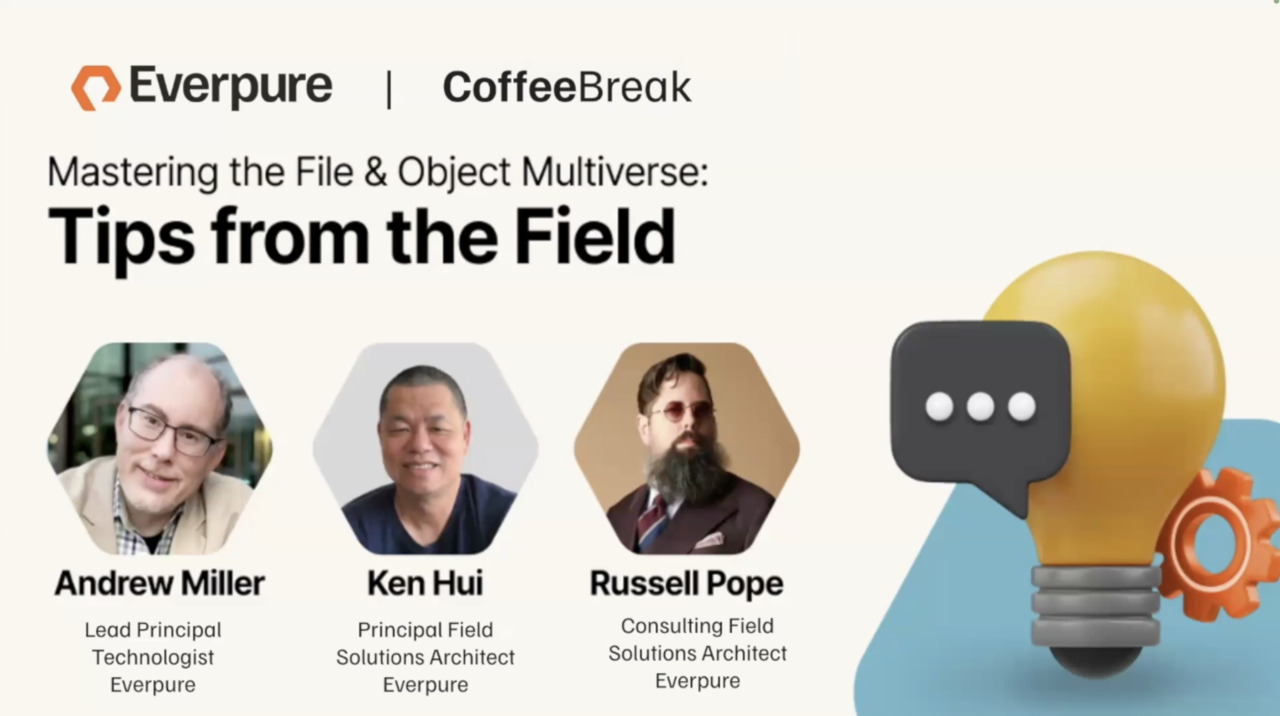
Mastering the File & Object Multiverse: Tips from the Field
For March 2026, host Andrew Miller invites Kenneth Hui and Russell Pope from the Everpure Unstructured Data Field Solutions Architect team. They’ll distill their many, many customer discussions around file and object platforms into what’s most valuable for you.
This webinar first aired on March 10, 2026
The first 5 minute(s) of our recorded Webinars are open; however, if you are enjoying them, we’ll ask for a little information to finish watching.
Click to View Transcript
Awesome. As you noticed, you may be like, "Hey, is this the Coffee Break that I expected?"? Yes, it is. It's the same Coffee Break, but we all, you know, got fired two weeks ago and we got hired by a new company, or the company name changed. Wh- whichever way sounds more dramatic or more interesting.
So welcome to this month's Coffee Break, now sponsored by Everpure. I'm, as always, your host, Andrew Miller, Lead Principal Technologist here at Everpure. Still working at it, you know, kind of thing. I think my, my coffee mug's still here. Maybe, maybe totally vintage at this point, you know.
But really appreciate both Ken and Russell being kind enough to join me today. I will introduce them in a minute, but thank you so much for the time, for the preparation, for joining us today. As always, this is the Coffee Break series. We are on year number five, believe it or not. You can find all the previous Coffee Breaks, I think actually, Ken, if I
folks who've joined your team, sometimes you send out previous episodes for folks to listen to, to learn about, like, hey, they wanna, they wanna interview well, so, That's something we do, yep. So you can see the last, you know, oh, two years here, give or take, but you can find all of them here and, and actually, sort by solution area or kind of by industry topic.
You can also find them, of course, at purestorage.com/events. That will la- That URL will later change over time. You can find previous ones. Next month, gonna be joined by Ben Lee, from the Storage as a Service team, sometimes they call it Evergreen//One. We're gonna talk about breaking free from
storage shackles, the rise of true STaaS as a service, wandering through some of Ben's history with early STaaS offerings from, from Everpure, some core principles in the storage as a service area. Some STaaS specific design tips that he brought from being an SE to what he does now and building, helping build the product, and some looking ahead.
If you've not signed up for the Pure Community yet, the Everpure community, hey, make sure to do so. I was actually answering a question there earlier this week. Or either share your experience on Gartner Peer Insights, or you may find some value in seeing what customers say about Pure, and it is anonymous.
Al- although, although authenticated and validated. And maybe, maybe you're just here for the drawing. If so, you, and you, and you went, stay around till the end. One lucky person will be, will, will, will receive a coffee lover's gift set, and you will actually potentially be one of the first folks to have Everpure swag, so, you know, w-
with the new logo and brand, et cetera. So, hey, look at that kind of thing. As always, I'm your host, Andrew Miller. I don't tend to reintroduce myself every month, just because that I wanna give, leave more time for the guests. But in this topic, so we are talking this time about mastering the file and object multiverse, tips from the field.
Super practical stuff, as you'll hear, given Ken and Russell's role. For me, though, if I think about kinda file and object, I decided I'd throw two things out there. When I was worked help desk, I ran a Macintosh file server, and it was amazing was at the time, because you do the copy s- copy operation client side, and it would
execute server side and just update the progress bar. I was like, "Wow, that's so neat," as you're, like I'm in college and I'm learning this stuff. And then later, if you have network certifications, they never expire. RWCEMFA for your, for your permissions.
I think that will always be in my head. But maybe just as a, as a, as a friendly tip, you probably should drop off the network certifications from your resume at this point. With that, actually, I'll jump over to Ken and then Russell. Ken, thanks so much for joining.
It's been a, it's been a pleasure knowing each other for a little while, but if you don't mind introducing yourself to the audience. Yeah, sure. Well, first of all, thanks for having me on, Andrew, on Coffee Break. Been a, been, as they say, long time first time caller, or guest, whatever
wanna call it. So, as Andrew mentioned, my name's Ken, or Kenneth, but not Kenny. Hoy. And that you can see my, a- X or Twitter handle, whatever you like. So I've been at Pure, Everpure now for just a little over a year.
And on the unstructured data field solutions architect team. Where, which is Russell is a part of as well. We help customers with any of their file and object use cases and helping solution. So, prior to being at, at Everpure, I spent five years at AWS and a number of years in various storage companies.
In fact, I was on, the Pure Report with, that we run with Rob Whitman, and, one of the things we talked about was, ha- having spent a lot of time doing file at a lot of these other storage companies, I actually swore off ever doing file again 10 years ago. And then somehow found myself back, doing file again. But having a good experience, and we'll talk more about that later.
And that's just some of my hobbies is, just a lot of food. I love, s- trying new food, trying new restaurants, and giving suggestions, and then just re- watching good movies and reading history. Love it. Thank you, Ken. Russell, over to you.
That is a Does that actually compile? I don't know. That does compile. That will compile. It won't do much, but it does compile. M- my name is Russell Pope, and I'm an unstructured data specialist here at, Everpure. Andrew, thanks again for, bringing us on to get a chance to wax about, all things cool.
I spent the better part of the last 20 years working for various consultancies and integrators, and, y- you know, that, gives me a lot of time to learn and with new things. And so I've been doing a lot of, like, Python work and automation work. I've recently picked up Go, as you can see here, if anybody recognizes that syntax.
You know, I've, I've been, Extensive background, VMware helped me pay off my 20s, which was nice. And I've always had a strong background in data center networking. And so I, one of the few folks on the planet that has both the VCDX and the CCIE, whi- which is kinda cool. And you know, I like to tinker and play.
I also like to eat, and I've, recently taken up cooking as a hobby so that my kids can enjoy a good home-cooked meal and not just, enjoy the splendors of takeout, all the time, which is nice. And, I also like to drink, coffee, beer, whiskey-Tea, you name it. Yes. This is- The answer is yes. Yes.
I drink and I know things, to quote, Tyrion Lannister. That's, I think that may be the first, Game of Thrones quote on. And, and actually, as you were saying that, I was remembering we had, had Rob Quast on previously. So he was, you were the second VCDX on, so good for you.
And maybe it means a little less, but still, that was, that was a, those were a lot of work. I have a lot of friends who are VCDXs in the defense process and all that. So good for you. Those were the good old days. Yeah. Okay. So we are here to talk about file and object, multiverse.
It sounded like a cool title. I'm not sure how we're gonna, how much we're gonna play out the multiverse theme. We'll see. But we're definitely gonna play out the tips from the field aspect, given what Ken and Russell do day in, day out, is talk with you. You, if you're a customer, a future customer, et cetera.
So as always, want to organize it into a couple different spots so you kinda have a sense of what we're, where we're gonna be going throughout today. First, a little bit of just lay-of-the-land notes from the field. Some new and interesting use cases from recent customer conversations. A little bit of kinda distilling down what Ken and Russell have been hearing recently.
Then making sure to walk through a little bit of foundational, but you know, updated, around Everpure's object and file philosophy. Philosophy sounds a little bit grand, but I don't think it's overselling it. Third, getting prac- very practical again. You know, the don't wish I'd known list, to helping you avoid problems, things we've seen
that hopefully if you think about this stuff sooner than later, or maybe than not at all, you'll be far better off. And then last but not least, going into what there was actually already a question about, which I typed the answer in while you were, you were waxing eloquent there, Russell, from James, about is there gonna be object on anything other than FlashBlade?
Why, yes, there is, along with some things as it relates to file and object at Everpure, even maybe your, your last migration Everpure. So before we dive in, as always like to do polling. Nicole, if you don't mind launching poll number one, that would be great. And this is a pretty easy one, to be honest.
One, do you What's the first file server that you used? Obviously, I gave away my roots a little bit with, talking about AFP as a protocol. But also, do you look for file and object in the same platform? Cause sometimes that answer can vary based on, you know, who you are. So we'll leave that up there.
That's one of the magic, that's part of the magic of using Zoom as a webinar platform. We don't have to play, oh, 10 more seconds for the poll. We can just dive right into section number one, which is the lay of the land, notes from the field. So to kinda set this up a little bit, and I appreciate, giving credit where
I think, I think you provided this, but you know, you got it from IDC, so you know, good for you. Right. Around, unstructured data, I think the reason we're talking about this today, and actually talked about this a year ago, we'll refer to that later with Justin Emerson, is because unstructured data, there's, there's no question, like I don't think we need a lot of interpretation of the bar here
yes, the blue is growing, but unstructured is far, far outpacing out. There's so many pieces there. So, so that's why we're focusing in on unstructured data, a combination of file and object, for today's, today's coffee break. But I think maybe I'll, thinking about what conversations you've had recently, and even
maybe some kind of themes that you've been seeing. So Russell, if you don't mind, I'll, I'll toss it over to you first. What, what recent themes you've been seeing that you think worth, you know, talking about today? Yeah. I think, you know, a big one has been, fast and simple.
Uh- you know, and, and I've run into customers that are like managed service cloud providers that are looking to offer unstructured data as a service, and this could be NFS, it could be object storage. Mm-hmm. And you know, and RDMA is an important piece of that. And so, you know, we wanna make sure we support both of those options, on our products.
And, and we do support on FlashBlade today both RDMA over NFS and RDMA S3. And because we're easy to deal with, I mean, operationally simplistic, you know, we've got our non-disruptive upgrades. Everything d- we do is API first, which you kinda look at this from, through the lens of a managed service provider or a cloud provider, a lot of these folks have homegrown
tools and cloud management platforms that they wanna integrate in with, systems like ours, to deliver services to their customers and do like the day two operations and things like that. And so all that stuff kind of created a nice, easy to use, highly performant platform for, folks to use. That, that, that's one big thing I'm starting to see, talking to a lot of these folks.
Another thing is security is kinda coming to the forefront. And- Mm-hmm you know, if you've ever dealt with object storage, you know, traditionally, you know, you get your little, your access key and your secret access key, and you stuff it someplace SafeMode or whatever. Keep it SafeMode. Yeah, keep it SafeMode. but that's not really, you
know, super great, right? And so we're starting to see an uptick of folks using tools like, Polaris, and o- and other tools to sort of catalog all of their data and apply security policies and Kontxtual to that. And so we have, what we call secure token services baked into the FlashBlade to allow us to use third-party identity providers like
Okta or Entra ID or AD FS or whatever, to generate scoped-down, credentials that can access the specific pieces of data that are stored off in object storage, on a temporary basis, so that, that key pair is basically only good for an hour, as opposed to being something that lives in perpetuity until somebody closes it out. And so, you know, starting to see a lot of that, out there in the wild, with respect to
security, on object. I'm, I'm gonna do a little bit of a new acronym alert for anyone listening in. So you said secure token service, right? Or did I totally mishear it? So- Secure token service, or STaaS as we'll call it, Boom.
So, and, and I love that Apache This actually started with Apache, like as a web server 25 years ago. I'm showing my age, you know. But so Apache Polaris, Polaris part of that, and STaaS, and we're in, like when you mentioned, we're actually investing in that and looking at that as far as what we do up here, 'cause it is a trend. It was stuff that we keep an eye on, and like
you give input on it. The other piece here, and you were really nice here, but this was, I'll just kinda tease it out a little bit for when we're seeing some managed service and Neo cloud providers, we're actually seeing in some cases they've been offering services-Uh, via platforms that were majorly more complex. And if they're gonna- Boy scale like they need to, they need to be dramatically simpler.
Is that a teaser for talking about Pure Storage stuff later? Yes, but we're trying to stay, as we often do in this first section, kind of agnostic. Not, "Here's our stuff," but, you know, what are we seeing in the industry, so. Cool. I think with that, Ken, I'll, I'll, I'll bounce it over to you. What are you even seeing?
Yeah, so- What you've been coming on Russell's stuff, too. You know? Yeah. Well, I, one comment I would make on the whole using the security token services, one of the great things about it is avoiding having to use that access key, security approach to STaaS or credentials. I remember AWS, I had a customer who accidentally took those secret key and access
key for his SU buckets and, well, accidentally stored them in an applicat- file object in a bucket that he inadvertently made public. Whereupon within, within an eight-hour period, someone had spun up enough, VMs to do, to do, Bitcoin mining and ran up, like, a couple hundred thousand dollar bill over the course of that- That's seriously creative, as well as very distressing all at
the same time. That's right. So, but, a couple of things I wanna talk about, I think along these lines in the field, so. One, and one first thing I'll mention is kind of the, the increase of using object storage, in places where s- you might historically have seen file storage.
So I actually talked about this a bit, when I was on that podcast, Pure Report with Rob Lee, and he asked me about some trends we're seeing. So one of the things I am seeing, in the analytics space, is people, not just using, like, a Hadoop file system natively, but using an object storage because it gives you much more scalability, than you could.
And I'm talking about cust- with the, telecoms for example, that we, that we have as customers who are running a farm of Hadoop servers. And having to manage individual file systems or even a set of file systems very difficult to scale and manage. So they've moved on to using, object storage, in our case with FlashBlade,
look, kind of swap out that back end and made life easier for them. The other thing I'm seeing is, you know, is as we're talking more with customers about file, one of the things that have come up is because of the growth of unstructured data, they want things to be simpler. And because that unstructured data is now becoming more important than ever, the
non-disruptive upgrades becomes more important than ever. So we had a, for example, I had a customer where we were doing a bake-off with- some other, file vendors. And, the thing that we got called out for was just how simple it was for us to set up and manage our file systems.
And then kind of what closed the deal in a sense was, while they were running their performance benchmarks, we actually did a deduplication, we did an upgrade in the background, and the customer never saw He, he, they didn't even know that an upgrade had been completed until they got the email from us telling us that we had just upgraded their POC system.
So I, I'm thinking there, there, there's classic thing, and sometimes I kind of joke about this if I'm, if I'm talking with customers, people listening, that, you know, Hey, w- w- we all know the data's growing, so I'm not gonna tell you that, 'cause of course you know that." But in this case, it's growing so much, and I'm gonna key off I think what both you and Russell said of simplicity moves from a nice to have, 'cause who
stuff isn't simple, but into an actual need to have. Coz at, at a certain scale point, you don't survive unless it's simple, or the cost economics break down 'cause you gotta hire so many people to manage it and doesn't work, so. Awesome. Yeah. Thank you. Okay.
With that, as always, we try and keep it moving a little bit. Thank you, Ken, Russell. I'm actually gonna go back and I will share back the first poll here. So let me end this poll, and I will share it out so we can see. So everyone, 'cause you know, hey, thank you for responding to the poll, and this is part
of what we do too. You know, so we let you see what, what everyone else said. So, Windows for work groups by f- is the winner easily. After that, U- Unix, but Network shows, still makes a decent showing. Makes me happy. File and object, yes, but it's not a majority in the same platform, so, you know.
Sometimes a no winner it out. Okay, with that, Nicole, if you don't mind launching poll number two, and we'll leave that sitting up here again, as we usually do while we go through here. Poll number two, how many file platforms have you had over 10 years? This is a little bit of interest.
And also, what, what types of applications or use cases do you run on file? Now, that is a laundry list. It is at least alphabetized, but that's why we're gonna leave this sitting up here while we go through the next section, 'cause actually, Ken, you and I were chatting, I was like, "We ought to have four options," and it's like, how do we do four?
There's so many things you, you use file for, so. We'll leave that out there. Okay. Continuing into section number two. So first section, little bit more agnostic. Second, but more just, like, what we're hearing, although of course we all, we all
work for, Everpure. I'm gonna keep getting, I'm gonna keep seeing if I get it right as we go along the way today. But thinking actually as well, I, I remember, Ken, you, when you and I were together at a EBC- I think there, there were, there were, like, two days where through a sessions you literally did not even pull out, you didn't even, you didn't
even pull out any slides. You just white-boarded the whole time. So we almost wanted the feel of this while we go through a little bit of object and file philosophy, a little bit as if kind of imagine as if Ken was white-boarding. Sure. The one thing I'll put out here before even we kinda, you know, hit on this is Evergreen architecture, is if you're here listening, now
this is a little bit of a teaser, but if you're here listening, what about, you know, scale up versus scale out? From a Pure Storage perspective, the answer is yes. We believe there's a need for both of them.And especially, frankly, if you've been doing this for a while, you've found a case where sometimes you really need a scale-up
architecture, you really need a scale-out architecture. That's more to set it up so that Ken can kinda walk through, you know, pretending is a whiteboard. So Ken, I'll, I'll turn it back to you, and I'll see if I can click at the right spots to advance the animation, so Yeah. No worries, yeah. So, so, what I try to kind of explain to
customers to give them a, some context to what, our f- our approach to storage in general, but, file and ob- and structured data in particular, is, this idea of, there are some things that we've created that are very new to the industry, right? Starting with our DirectFlash. I'm not gonna get into whole detail on that, but that is, in one sense
our secret sauce, right? Our ability to address FlashArray natively with no involving translation layer, giving, allowing us to get the maximum benefits, efficiency, and performance out of Flash. And then we do that by layering our own, for our own software, right? The Purity OS that lets us address that Flash Storage.
And in using that as our base, I then, you know, will talk about this global storage pool, the idea that, as you're addressing the Flash, the NANDs through Purity, we actually, present that not as like, individual volumes but as a global pool, right? And then on top of that, we're then able to layer on, these, the native protocols so that you can address that storage i- in, in any way you need, without having to, you know,
switch to using like v- like gateways, or l- layering s- you know, one protocol on top of the other. But you're actually addressing that global storage pool directly, which is also and then directly addressing our Flash storage, getting, again, getting the maximum performance and efficiency that you need. Thank you.
So that's basically the outline of that architecture slide, diagram. I could, I could feel like you wanted to draw that, but you were good. You just waved your hands like you did. So, so okay, so continuing this section then. We, we were thinking about like, okay, we, we've in the past, and I'll refer back to
previous Coffee Breaks, we've gone through a lot more of even like, I think with Brian Gold it was like, we, we talked about not your grandma's file system, you know, kind of thing, or not your grand- grandfather's filer. But here instead we wanna take a little bit of a different approach and really just talk about like four themes that go to the philosophy, that's why we're
using the word philosophy. So with that I think I'll kick it over. I, and actually I'm looking here, I believe maybe start with well, actually, I, I should say the theme, shouldn't we? So the first theme is around Evergreen. What is that? We'll tell you. Simplicity, standards-based approach, number three, and then four, scalability.
So Russell, you mind, do you mind sharing a little bit of what, what Evergreen is to you? Yeah. Evergreen to me is just one of the most awesome things, ever. It's actually one of the things that when I worked for a channel partner years ago and I learned about Evergreen and I was like, can't believe this is like a real thing.
Uh- that's so awesome." and, and for me it's, you know, staying modern. You know, as we release all these cool innovative features, and we may have some really cool stuff coming out here in the next month or so that I think folks will be interested in, like, you're just gonna get it, like, as a part of a software update, and I think that's like really, really, really cool.
You know, we have our controller up- upgrade cycles. You know, we'll replace out your DFMs and upgrade those things. We'll upgrade other components as necessary. It just, it, it's, it's super awesome. But then to enable that you need a few things, and I think part of the
having this DirectFlash with a global pool and the way we've architected Purity is a key piece to enabling a lot of those features, like our non-disruptive upgrades. You know, we don't measure Like when we measure six nines availability or whatever the number is, we, we include planned downtime because we don't believe in planned downtime. It's just not a thing. And, to Ken's point, I've run into other
customers where, you know, their manager's like, "Hey, let me know when you start the upgrade of our Pure box, so that way I can keep an eye on it," and they forget to notify the manager until after it's done. They're like, "Oh, sorry boss, we upgraded it." And he's like, "Oh, I didn't even see anything go down." Great.
That's the power of non-disruptive upgrades. And when you couple that with things like SMB CA, which is continuous availability, like a lot of users aren't even gonna notice anything, from their perspective, even a, a, a failure. So to me that, that, that's a big piece, right?
That, that Evergreen is really the, the super secret sauce that we bring to the table, to keep our customers happy and delighted and make sure that, you know, we're always, able to give them, the innovations we, we come up with in, in, in our big, big brain box. Yeah. That's great, Russell. And I think what you're calling out, right, is it's kind of a near-term benefit that you can
see right away that, that's ongoing. But I, the long-term benefits I see in that is, so I, you know, y- I used to who would run their storage system, file or otherwise, and they've been using the same system for five years. And I would go and they would complain to me like, "Boy, this box is so old.
It doesn't perform well. It doesn't have all the features I need." And I would say, "Well, why don't you move to a new s- you know, upgrade to a new box?" And they'd be like, "The mi- we have so much data, and the migration is so painful that we would rather stay on this platform that really like than to take the risk or the time required to move, to a new
platform." And one of the great benefits of Evergreen long-term is, we like to say this is, this is the last time that data migration you'll ever do once you're on a, on a Pure Storage platform. So now you get, as we're upgrading hardware and software, you get, you can get all the benefits of that without actually having to do that painful data migration every few years.
Yeah. Yeah. I, I like to liken it to the Ship of Theseus. It starts off as that trireme, and as it sails- Mm-hmm across the ocean, by the time it arrives at the other port, it's the USS Nimitz. And, and the other- That'd be a more radical.
Yeah. And the crew doesn't know. They're just floating along, peaceful and calm.I was thinking about it's, it's really bad to have data gravity working against you in the case of migration, so awesome. Okay. Evergreen, what about simplicity, Ken? Yeah. So, what, obviously if you're a Everpure f-
customer or follower, you hear us talk about simplicity all the time. And one of the things I like to tell cust- talk to customers is the fact that, actually none of this stuff is simple. But the, the diff key is, we're doing all the stuff in the background that are hard and complex so that what the customer has to deal with is simple.
And a great example here is, and I talked a little bit earlier about how we do the native, protocols directly onto our software stack. That's actually a hard thing to do, right? It's much easier, f- as I've, you in the past in other companies where you wanted to do file.
Well, let's just put a little VM gateway in front of- Mm-hmm my block storage and then serve out in, say, SMB that way. It, it w- that's simple in a sense, right? Because, that's simple for the vendor 'cause they don't have, we didn't have to create new code. We just basically spun up a VM.
But it was difficult for the customer they would have to deal with yet another management point. They would have to deal with the performance bottleneck that comes with having a, everything go through a single VM or maybe a cl- a cluster VM that they have to manage. We, by, not doing gateway and building the native, file protocol right into the stack,
we simpli- we make Hard thing we do to make it simple for customers to manage same thing with object, right? It's, a, a typical way that some vendors approach object is I've got file, let me just stick a layer, an abstraction layer on top of the file to make it look like object. Again, simpler for the, vendor, but now v- now I've dealt with some customers who, were
trying to use the, those object store and it didn't behave the way they thought it would cause it wasn't really a native, S3 protocol. So in our case, again, we done the hard work of doing that so that when you talk to our object store, it is the same as if you were talking to Pretty much the same as if you were talking to an S3, Amazon S3 object store.
Russell, I'm, I'm pretty sure you love the power of no, if I remember right. Oh, my. So many things not to do, you don't have to do anymore. Yeah. Like, y- you're not managing disk groups, you're not creating RAID groups. You don't have to worry about like, like aggregates and putting them in volumes or
anything like that. When you create a file system, you don't have to sort of say, "Oh, how many inodes to put on this file system, and do I expand that?" you know, one of the nice is y- you know, we look at the middle of slide there, that global storage pool. All the all-flash is available to everybody to use.
And that really makes it easy for us to take advantage of all the cool things we do in Purity. And one of the cool things that like really makes a lot of our customers, our ears perk up, is we think about something as simple as deduplication, right? And if they're doing a FlashArray with, you know, say, Fibre Channel and SMB on the same,
same platform, and I'm like, "Hey, listen, the way we store the bytes, it's the same in that KVDB." We don't lay down an XFS file system or something like that, and then to Ken's point, spin up like an SMB VM to, to export it out. It's all natively embedded into our product. And so what that means is if I take five terabytes of data on an iSCSI line and copy it
into that SMB volume, it's all gonna deduplicate down to the same bytes anyway. And that's some cool stuff that's, I think, unique to us, to be able to do that, and see like all of our storage, all of our FlashArray as one big global storage opposed to having to carve it up into different protocols or, or features or performance tiers or things like that.
Mm-hmm. Yeah, along those lines, one of the lights on moments that I had with a customer was I was walking through, them through setting up their first FlashArray file, file system and he asked me, "Is there something wrong with the GUI, the dashboard? I, I can't put down what the size of the file system should be." "I don't see that
anywhere." And I, and I had to explain to him, "Well, because of the way we, we deal with the global pool, you don't actually have ahead of time how big that file system is. You can set a quota so it doesn't grow- In limit. Mm-hmm unlimited. But- Mm-hmm in theory, you could, have a file system that is ex- the s-
entire capacity of your array. And the ven- and he, and he instantly got it, because up to then he had been used to this idea is I gotta pre-allocate everything ahead of time. And then if different files, one file system was underutilized, another one's overutilized, there was no easy way to ma- you know, move data around and make sure that every file
system had the capacity it need. And I told And he got it. Like in this case, he didn't have to worry about that anymore, right? He would- Yeah the growth problem would grow as the need, as he needed to, not because he had And he didn't have to guess what he had to do, like, you know, months in advance.
I knew it would come because otherwise I'd be relaxed. So I think we'll try and wrap up this section, but Ken, you mind giving a the standards-based approach, number three? Yeah. And then Russell, a couple thoughts on scalability, 'cause man, you've done some cool things there, so. Yeah.
So qui- very quickly, I think as, as part of this native approach, and I'll use, blo- object as example, we really, worked to, built the, kind of the native protocols and the APIs. So when, again, w- we've had customers who were using S- Amazon S3 and then ne- needed to move their object store on-prem, and they literally did not change the
application and the APIs-They were using, they used the exact same APIs and it worked right out of the box. So again, that's called taking a standards-based approach. It also means that we have, feature compatibility, things like Object Lock that Amazon S3 has, again, making it easier for customers to go either way or to make the
transition from one to the other. Very cool. Yeah, and I, I, I kind of, kind of to that, getting into the notion of, scalability, right? Especially when it pertains to object. You know, there is no limit, to how many objects we could store on
like a FlashBlade, right? We have a, a documented limit of something like 70 quadrillion files if we're doing file on FlashBlade. You know, 4CommaClub, though has been tested in, in object storage, for us. We had a customer, they said, "Hey, we need to make sure you guys can support 480 billion-ish
objects." And I was like, "Well, I'm sure we can. Let's, let's push this as far as we can go." you know, we, we were able to, you know, 3.7 trillion objects and there was no change in the response time of the FlashBlade or anything like that. And, and there is no upper bound.
You know, the other thing is, we don't have a maximum object size. I think we've tested up to something like 80 TiB for a single object, but you could potentially go bigger. I'm not sure if anybody's ever gonna have like a 80 terabyte object to upload, but you never know. Somebody maybe like does like a 40K version of Star Wars or something
upload to object storage. We're, we're more than happy to catch that. The other thing is, when we think about scalability is, you know, we have FlashArray where it's, you know, thousands of clients, and we have FlashBlade where it's hundreds of thousands of clients and like hundreds of GB of throughput. So, you know, when we think about visually kind of speaking of like the Enterprise Data
cloud and our sort of desire to run any application anywhere you need to run it and, and keep that simplicity, being able to scale to those levels and having the two different platforms to address those different use cases, I think it's like super critical. I'm going back to where you started out with, service providers and people. That feels like those are the people that may go to the trillions of objects or may push- Oh,
yeah you to a quadrillion or even, I, I feel like you dream of the day when you get to say quintillion of customers. There we go. So, you know, someday. Okay. Wrap into section two. Let that go a little bit, but want this helpful, and hopefully it's more philosophical
than it is even like, "Hey, here, here's what we do." But like there's a, there's a purpose behind it. So let me go ahead and share back poll number two. I'll end this one and I will share it back. How many file platforms have you had over the la- last 10 years?
Two to four. Actually, the majority is more than five. Man, that's a lot of file di- file I'm sorry. Like, I, I feel for the 36% of people who have had more than five file platforms. Then what types of applications for file?
I think there's three that are easily out in front. Home directories, user shares, we know you, we love you. Document con- management and content repository and backup and archive, but everything's in there. You know, everything's got a couple folks doing it, so PAC sometimes is a little bit lower down 'cause But every hospital
so every hospital has medical imaging. If you don't mind, Nicole, I should have put it here to poll three. If you don't mind launching poll three, and then we'll dive back into just some very practical stuff. So what's the longest file migration you've seen, either yourself or heard about?
And then changing gears, what's the most important features when you're looking at an object solution? So for section three, wanted to go back a little bit practical to things that you, you know, "Hey, I, I wish I'd known this ahead of time." I'm sure we've all had that, you're doing a home improvement project, you're doing something with your car, or whatever else.
It's like, yes, the, the price of knowledge is time. So if we can help you with a little bit of that, that, that was what we wanted to do, the goal out of this section. So, w- almost what people might, might, regret six months into a big unstructured data project. So I think, Russell, I'll just toss it back to you.
This is just like totally out of no- nowhere and hopefully not throwing you But, you know, we're in the middle of craziness and it's like, "Oh, this is fine. The fire's just warming my coffee cup, not melting me yet." If you go find the later panels of this, comic, it's a little disturbing, so that's why we only use these two here. So what have you seen, Russell, that people,
people wish they'd known before? You know, it's, it's, it's funny. I, I got into a conversation with a customer, and w- what they were trying to do is, you know, they had a massive volume of data. We're, we're talking like petabytes. And they had an air-gapped, archive.
And what they were doing with their solution is periodically they would the drawbridge and open up the firewall or whatever so that they could- send data into the archive over NFS. And they got tired of like supporting this homegrown solution, so like, "We want to make sure that a FlashBlade does NFS well," and all this other stuff.
And I was like, "It Yeah, we could, we could certainly support this use case, but let's talk about approaching the problem from a different angle." and you know, I, I basically spent some time educating them, like kind of the pros and the cons of object storage. You know, with NFS you've got this TCP session that's always needs to be out to whatever the storage is, and when that
drawbridge goes back up, we cut off all the network access, which means now you've got these zombie mounts on the servers and somebody has to go in and, and, and, and correct that, you know, or you could end up with like a kernel panic or something down the road. And it just wasn't a good experience. And so I was like, "Why don't we consider object storage, to address this use case?" And
the customer was like, "Well, help me understand it." And I was like, "Listen, it's an HTTP connection, through the drawbridge. Firewalls are used to managing these connections. It doesn't need to stay persistent. And, you know, one of the cool things is like, let's say even if you're uploading a bunch of
data and the drawbridge "Because they don't have control over when that drawbridge goes backup. So when, when it comes backup and shuts, we can resume that last transfer from where it left off with multipart uploads as a part of the S3 APIs that we support. So they're like, "Huh." And so now they're able to approach this problem in a new way.
It went from being an NFS conversation to now it's an object conversation, and they're getting a better experience. And it was really one of those things where it's like, man, I, I wish I would've thinking of this problem in this way before. But, you know, that's, that's what's great about having FlashArrays, show up at your
help you, help, help you solve problems like this.You're there to dig into what we're really trying to do, not just hide. And be, be respectful about it, but, what are you really trying to solve for? Cause we may have different things in our toolkit than you expected. Yeah. Like, that, that's our value. So, cool.
Ken, what are you seeing? Yeah. So a couple of things I call And these are, by the way, fairly generic, so not, necessarily just Everpure customer- Oldies but goodies maybe. Greatest hits. Yeah. Yeah. And to be honest, the first one is one that, you have to Customers will be more conc- ca-
concerned about if they're not an Everpure customer, and that is data migration. So, you know, I talked about, you know, Everpure, we like to say when you After you migrate to, when you migrate to Everpure, that should be your last data migration, but that's not the f- life of your, of a f- storage admin in other places. So one of the things I, often see is, you know, you, co- c- people put together their
big plans for how they're going to adopt a new platform or move to a new system, and then kind of three-quarters of the way through someone goes, "How are we gonna actually move that data?" And then they realize they- And will it be instant, or will it take a while? I don't know. Yeah. They realize, "Oh, we hadn't thought through how we're gonna budget this thing." Yeah.
You know, when, are we actually doing it at the right time? How do we schedule it so it minimizes downtime for our business? So the, the big kind of I wish, customers would know, think about more plan your data migration n- at the beginning of a file project, not at the end. So that, and, and that migration should be part of your entire PL- project.
In fact, I would My recommendation is sometimes you may even wanna put that into your test plan to say, you know, "Let's test doing some data migrations, make sure it works the way, that we expect it to." That's one. Second one is, everyone has a DR plan. How many of you have actually tested it before, and not wait for an actual
outage to see if it works? And that's, And I think the latest show most people have not done, enough So I'll give you two kind of stories. I had one customer who, wanted, yeah, the, the gap. Um- Mm-hmm they wanna do, they wanted to test failing over their, their, QA and
lab environment, from one data center to, secondary data center, and as they were doing it they realized, that the way, the network had been, configured, it was They couldn't just fail over the lab environment. They would have to fail over the production environment as well, 'cause it was all part of the same layer two network.
So- Right that's like an example where caught something that would've potentially been disastrous if they really just had to fail over that one application. Um- Yeah then the second story is I had a customer who, had, did backup to their file systems. Never tested it, just assumed it would
And then when they actually had a, an outage- Sure and they then need to restore their file servers, which is their production system, they found out that it would actually take them 30 days to restore each server. And which meant that business was down for that entire, m- for most of that 30 days. They actually had to, hire people to, re-type, retype in all,
everything that was by hand so they could try to recreate enough of the data so they wouldn't have to wait for the entire, the restore to be completed to get back on business. Not, not what you want to see happen. Mm-mm. I'll, I'll do one here as a dealer's choice, and then we'll move on to the, you know, last section.
So I think the one that I've seen 'Cause obviously I'm here to be a host, a producer a little bit, and here to make Ken Russell look good, which doesn't take a lot of work fortunately. But, you know, there's stuff that I, I do to do it at Pure too. So the one that I, I will sometimes put in is I've spent a lot of time over the years, discussing the needs between scale-out systems
and scale-up systems. And especially in the file space, but also in the object space too, especially file, sometimes there's this belief or this desire or you hear from a vendor like, "Hey, there's a silver bullet. There's one architecture that will solve for everything." And then you get to enough scale or enough use cases or otherwise and you
realize like, ooh, like there are things certain applications that fundamentally fit better with a scale-out approach at the data layer or the storage layer, whichever. Some fundamentally fit better with a scale-up approach. And so for me, this is We even talked about this when I had John Karns on Coffee Break like three years ago. Like, he learned this in some challenging ways
as a customer, 'cause he kinda drank the Kool-Aid. Like, "Oh, this is the only one thing you need." And it's like, then you realize, no. There's So we've embraced that from a Pure standpoint of scale up and scale out with protocol support that fits both of those kind of things. So more of a just, sometimes drinking a bit of Kool-Aid and, and believing that,
know, there's a silver bullet here, when actually both approaches exist for a very real reason. Although at smaller scale points it may not make a difference, but you get large enough, it does. In hopefully ways that won't be too painful to find out. Okay.
Let's go and I'll end poll number three, and we'll share it back. Longest file migration is months. Nobody chose the infinity option though, 'cause I, I've seen that, where sometimes you don't finish it. Somebody's got it in seven. Cause, like, it just never finishes- and then the next platform rolls in, you know?
I, I could feel your frustration, Russell. Most important features when looking at object solution. Man, performance far and away. Then replication. But everything's kinda showing there, so look at that. And Nicole, if you don't mind launching poll
number four, that'd be great. Awesome. This is pretty simple, but, you know, what's your biggest challenge in your file landscape? So last section. What's new from a Pure Storage standpoint? Cause there was actually a really good question.
Ooh, and I already answered this, but we have one or two that we're gonna at the end, but it was, you know, basically about, you know, some, they did some testing a couple years back. We have been doing a lot of investing from an engineering standpoint here. So if you go So this section, final one, there's kinda three big areas we're gonna talk
about, but there are so many smaller things. So if you remember-Last year, it was March last year, actually, Ken and peer, coworker, teammate, whatever the right term is, Justin. He was actually on Time for an Orange Sports Car: File Hits Its Midlife Crisis, so we were talking about some of the philosophy then, too, and we dialed in toward the end on this idea
of real-time enterprise file, that we had been doing a, a large amount of engineering investment in file because we had that Evergreen foundation and that data pool and Direct Flash that actually was why customers kept coming, saying, like, give us the file experience on top stuff that we live about, love about Pure?" So it was, you know, we have all these things that are, you know, the downsides of
potentially, you know, classic approaches to file, and when Pure, it can be, you know, this instead. Before we go to the three big items, though, I feel like, Ken, there, there's I, I know for me, when I w- when I was a customer, 'cause I was a customer, in case you were wondering, I would sometimes find, like, this small item in a release note and be like, "Ah, that's what
I've been waiting for for, like, two years. It's finally here," you know, kind of thing. So before we go to the big-ticket items, are there any kinda smaller to medium items you wanna make, you wanna highlight? Yeah. I, I think, Thanks, Andrew.
I'll call a c- couple of quick ones. One is, you know, one of the things that you, key things when doing home user directories is you, you need to s- set quotas, right? To make sure that no one user's eating up all the capacity. Too many cat videos. So, so oft- so recently we, had, added
enhancement in our dashboard for FlashArray file where you can now set user and group quotas, on your home dir- for example, your home directories. It was something we had already, but it was through the CLI, but now y- you can, it's making it simpler for you to set back quotas, using a dashboard if that's your preferred way of doing them. So, the other thing that's coming is,
sometimes we'll get, you know, we, our customers audit who's done what, especially on the Windows- SMB file system. And we d- we basically, let you do that today, where we'll show you this, is doing what on the file system. So one of the enhancements we're adding is the ability to, in FlashArray file, is to
automatically s- map that ID to a username, so you can look in our event logs and just say, Oh, Joe. Joe, did this thing he was, they weren't supposed to, the other day, and that's the problem." Or, or more importantly, "Hey, this unknown user, that we didn't know was in the system is deleting files or copying files out of the system." So those are, those are s- you know, small enhancements in
the dashboard that we think will have big benefits for customers. I'm sure the example you meant to use is Russell, but, you know- you're being too nice. That's right. Okay, first big, f- first big-ticket item. We talked about this some last year. There's even a Q&A question, but- Yeah what does Object Everywhere mean?
Yeah, so, custom- you know, if you're an Everpure customer, you know we've had Object on FlashArray for a while now. What's, what we announced, last year, and it's, imminent, is the ability to have Object also on FlashArray. And some people might be going, "Well, why do we need that if I have Object on FlashArray?"
Well, it turns out there are a couple of use cases, that we, that our customers came to tell us about. One is, "Hey, I've got, this smaller environment, you know, an offi- several offices. We wanna use Object maybe for as a c- as a content repository. It doesn't need a, we don't need a whole FlashArray system in there, right?
But maybe a small-" Just a little bit. Yeah. So maybe a small FlashArray that runs Object, you know, you can do that. The other big use case we have, is, you know, we have Well, we think, Andrew, you mentioned FlashArray, FlashArray.
Uh- Mm-hmm we have a platform to meet any, workload that we need. We do have customers that because of the workload types they have today, they have a FlashArray but not a FlashBlade, and running maybe block and file, and they go, You know, I do have a small use case here for Object. I may look at a FlashArray in the future, but I don't need to look at one now, and I, and
I'm very comfortable with the FlashArray." Easy starting point. What Yep. What if I had a unified system, right? Where I can run Object on that system as well? And so we're gonna address that use ca- we're addressing that use case, and that's what we mean here by Object Everywhere.
So now we'll be able to meet, your Object needs, whether it's, you know, in a small office, in a large data center, and, or you can, interoperate with the cloud. Awesome. Thank you. That's a wonderful summary of what was a really big announcement, so, you know, good job. Next big item. So, hey, Russell, this is your turn to
summarize, you know, big stuff down. So we think about, sometimes I would hear people say, secure multi-tenancy, and my first response is, "Tell me what you mean by that." Yeah. So maybe you wanna tell me what you, what you mean by that or, or what Pure means by that, you know? Y- yeah, absolutely.
You know, and, and spending a lot of time working with different folks that behave like service providers or cloud providers, I also do a lot of work in public sector, you'll have, like, a centralized agency in, like, a county or in a, in a state that's responsible for providing service for everybody out there in the state. And so they need to be able to do have what we call realms, and for us,
are our ability to allow us to delegate authority out to specific admins, so they could manage their unstructured data resources, apply quotas, and things like that. And, and, you know, our design principle is basically you should be able to put Coke and Pepsi on the same physical piece of hardware and never do the two meet, in Uh- A classic illustration there.
Love it. Ex- exactly. Coke, Pepsi, and Mr. Pibb all living in beautiful harmony on the same, platform.Um, and so that's our, our means to delegate authority and allocate resources out to individual tenants. Now, we have this contract we call servers, which is I love DR.
Pepper too, but I think they're owned by Coke, so or- Yeah they're owned by one of the big- Yeah. Servers allow us to basically, isolate the data and the network, path. And so this is where the clients would come in and connect. So I could have Coke on a Coke, server, and Pepsi on a Pepsi server.
Coke can talk to Coke's AD, Pepsi can talk to Pepsi's AD, so those guys can authenticate with their users. And then we could share out file systems, SMB, NFS, multi-protocol, et cetera, or S3 out to those organizations, and we can control the network path as well. And so we can make sure, for example, if we, if we wanna have some shares that are
available out to the, DMZ network, going on a different set of VLANs or interfaces, and, you know, a primary set of shares coming into the inside network, or Coke and Pepsi, we could do that through servers. So that's, that's some, cool stuff we have today around, secure multi-tenancy. And we're, we're, we're seeing a, a big uptick of, of that, and, a lot of creative use cases
around, those, those two feature sets in, in particular. One thing I wanna highlight here, and if you're thinking, "Hey, we're gonna do the drawing," yes, stay around. We're, we're, we're, we're, we're gonna land the plane on time. Is that we have r- not wrapped these features together doing it the same way that some other
companies have in the past. We've thought about the use cases. A little bit back to your story act- actually, Russell, so I'm from file to object. We thought about what was needed, and build it in a way that makes sense Hey, let's just shove all these things together into a, I don't know, into a virtual, into a virtual server," you know, for example.
Yeah, and I, I think that when I talk to customers too, again, back to this, and they tell me multi-tenancy, there's a percentage of users whose, thinking data isolation and also delegated admin. I also have a lot of customers go, "I just needed the data isolation. I'm not looking to delegate out anything." Mm-hmm.
So by us separating out those two things into two different ca- features, it li- customers flexibility, you know, to do one or the other. And on the realm side, w- just talk a bit quickly about that, is it's really this ability of being able to do role, role-based, access control, for, for adminis- m- you can actually say, "This tenant," right?
And, administer their resources and not every resource inside the system. And the, and the other thing it allows us to do is the scope management. So one of the things you can look forward to is things like, "Hey, what if I don't wanna rep- replicate everything in the system or every file system? I wanna replicate only the resources that are part of this particular tenant." Mm-hmm.
Right? And we've, because of this realm concept, we are gonna be able to deliver that for customers where they can manage their own replication. Final item here. Big-ticket items. Yeah.
So this is just words on the slide, but if you've been l- watching what as Pure, if I say the word Fusion, you should hopefully already know what that is. It's being able to do fleet level management, but also even manage one more simply due to like what's called presets. So you know analogy to set you up, Russell.
Presets are templates. If you know you're taking a vacation, preset would be the vacation package. You don't have to go book all the things individually, which man, that warms my heart cause I'm the travel planner in the family, and I figure all that stuff out 1touch. But doing it all together, man, sometimes that's appealing.
Maybe if you don't mind, Russell, I'll toss it back to you to bring us home around presets and the value as it relates to file. Hoping I didn't set you up for a failure here by having lots of words on the slide, but this gives a feel, I think, of the structure. You know, the, the, the SafeMode thing do is ignore the, the words on the slide and
just kinda talk through it. Boom. You know, and if you're, if you haven't talked to anybody at Everpure about Fusion, you really need to go talk to people at Everpure about Fusion and how that's gonna make your life a lot easier. Mm-hmm. Presets for us allow us to package up a lot of things about how we provision data or make
data available to our customers. When we think about, you know, file data in particular, you know, we, we think about, Okay, when I provision this, I need to think about how often I need to snapshot this. Do I need a replication policy? Is there a performance requirement that I have for this that I need to make sure that it
lands on an appropriate array?" or for example, if I'm doing things like file auditing or, hey, my, my template for a VMware NFS data store is gonna have an auditor policy on it. Te- presets allow us to sort of bake all these things out, and even apply tags, to our unstructured data workloads so that we can actually now use those as part of a, a querying and reporting, engine to make our lives easier from a CSI admin perspective.
So when somebody comes in and says, "Oh, I need three more NFS VMware data stores," you go click on that, that preset, and you, deploy that as workloads, and we will the placement of that stuff, and we will configure the file systems and apply all the policies and the, the, the data protection and all that stuff that, that's inherent to the array as a part of one big flow so you don't have to go through and create the file system
and then go add your policies by hand and things like that. We're, we're trying to get your, your mean time to beer number, from here to here, and presets are a great way to do that. Love it. So if you're thinking, "Hey, has 55 minutes gone by?" Yes, it has.
We wandered through a lot of the stuff you see here. A mix of practical stuff, a mix of how we're thinking about from a Pure Storage We actually, as you probably figured out, we try, try not to dial in too hard into the products because FlashArray is a scale-up platform to this file block and object coming soon.
FlashBlade does object and file, right? But with a different scaling characteristics kinda thing. Some practical tips, and then what's new. Before we do the last poll and the drawing and a little bit of promotion for next month, and I think we'll do two Q&A questions maybe, Ken or Russell, I'll toss it to I'll just go
alphabetical order. Ken, any thoughts to bring us home? Thanks for being a great guest. And then Russell, the same.Yeah, I think, you know, you've heard over and over unstructured data is where all the growth, well, much of the growth is coming from. So, you know, the question I would really pose for anyone who's on this, who's listening, who may be, not even a Everpure customer, but
maybe Or maybe you are an Everpure customer, but you've only really explored the block side of the house. Mm-hmm. Mm-hmm. We would, we would wanna say, we've got, maybe a cousin to the block, that is just as good. And that, you know, our goal is to take everything we do around simplicity, scalability, and security, and apply that to
unstructured data in the same way we've applied that to the block side of the world. Cool. Russell? Yeah, I think, to kinda echo, you know, what Ken's saying, you know, I think unstructured data has evolved from Linux ISOs and cat pictures to now it's become an imperative part to, how people do business today.
And, you know, I think we've been making some significant investments here, and we got a lotta cool stuff, coming this year, that I'm pretty excited about. It's kinda the reason you're here, Ken- Yeah I think. It's what you do, so. Yeah. And by the way, we, we, we somehow got almost an hour without yous- without either
one of us saying AI. Amazing. I think- ooh, it was in one of the but I didn't read that one, so hey, look at that. Yeah. It's amazing. AI DR. Yeah. So again, thank you so much, Ken, Russell.
As, as hopefully you can feel, like, we spend the time preparing for this, but it's not scripted. We've got loosely planned, but then even, like, we roll some stuff. I think I saw Russell smile when I put in the AFP story at the very beginning, 'cause I don't think he'd heard that one. So, let's do, to bring it home, couple things.
Poll number four, let me end this and share it back, so you can see that the top item there, biggest challenge in your file landscape, migrations. Hey, it feels like that was worth the one, two, three, five, 10 times we kinda hit on that idea. Just a couple, you know, 'cause it matters so much, but it reflected in the poll.
From a next month standpoint, please, join us next month for Breaking Free from Storage Shackles: The Rise of True STaaS, a Service, some practical tips from Ben Lee, who was both an SE previously at, at Everpure, now helps build some of the R- STaaS products and principles in this, in this landscape. The drawing. If you were waiting for this, and I know you
were, the winner, obviously the first name and last initial just in case, you want it to be heard later. So James W, thank you so much for joining us today, for some great questions in chat, and you are the winner of the Everpure coffee lover set. You know, you've got a, you've got a mug in there, you've got a charger so you can while you drink your coffee, 'cause I guess
that's what we do when we drink coffee. Eh, yeah, something like that. So I actually wanted to try and get here, 'cause there were a couple questions that I wanted We've been answering some live, and I even saw, I think, Russell, y- it wasn't a question, but you caught the DR. Pepper, you know, the love for DR.
Pepper, you know, live on the fly like that in, like, 10 seconds from the chat, Oh, good for you. Yeah. But I think there's two that I wanna toss out here, and if we don't get to your question, please, feel free to reach out to myself, Ken, Russell. There's a- they- they're on a team of eight people now, I wanna say, that cover- Oh.
10 people. 10. They cover the US and MAP regionally. So there's a Ken or, there's a Ken or a Russell for you wherever you are in, in the country, that kinda thing. I think the first one I was gonna throw out is, was a good question, but
an honest one from Manas. All right, hopefully I got Manas or Manas, about multicloud distribution of object replicas for disaster recovery. I know that there's some stuff here that we're working and planning on. There's some stuff that we can do now.
So more just, a- and if any of this wanders into roadmap, of course we're not gonna go there, Manas. Hopefully I got your name right. But, Ken or Russell, any thoughts about kinda multigeo distribution of object replicas in general, but also for disaster recovery? Cause I'm sure you get this question.
You're, you're muted, Russell, with the amazing things you're saying. I, I cough, and I've been trying not to do that. On FlashBlade we have what we call multisite writable buckets, and the when I upload into a site, it will eventually be consistent with the other site will be eventually consistent with the p- the primary location.
And so we have customers that are using this either to have multiple ActiveCluster sites or even doing cascaded replication where, you I maybe I have a FlashBlade in Chicago FlashBlade in Dallas, and they're replicating between each other. And then from Dallas, I might go out to another S3 object target to, archive that data long term. So we have that capability and platform today
on the FlashBlade. And, yeah. Awesome. Yeah, and, I will say there are, we have customers with use cases where they said, multi-writable geo, you know, replication, great. Would love it if you it was strongly consistent and not eventual consistency.
And the only, I think the only thing I would say about that is we, we hear you. Let's talk. Let, let's talk outside of the webinar. Yeah. Awesome. I think the last question, and I'm just gonna highlight this, there was someone, asked about, you know, comments on automation and APIs, especially with presets, and the
answer is yes, yes, yes, yes, yes, everything with Fusion can be done via API. Presets fall within Pure Fusion. And yes, we love APIs and automation, 'cause that ties to a different version of simplicity. Not that typing your profile slide in Go is the easiest version of that, Russell, but actually in some things when you wanna do some stuff, you don't wanna do it in a GUI.
It's far simpler to do it in other, more automated ways that just happen, that are more declarative than imperative, shall we say. Absolutely. With that, I think I will, I'll spin the music up here again. But thank you all so much for joining us. Ken, Russell, thanks for being great guests.
Nicole- Yeah Laura, Tatiana, there's, there's folks behind the scenes that make all of this possible. Thank you so much from the entire Coffee Break team, and we will see you next month. Thanks. Yeah. Thanks, everyone. Have a
great day.

Andrew Miller
Lead Principal Technologist, Everpure

Russell Pope
Consulting Field Solutions Architect, Everpure

Ken Hui
Principal Field Solutions Architect, Everpure
For March 2026, host Andrew Miller invites Kenneth Hui and Russell Pope from the Everpure Unstructured Data Field Solutions Architect team. They’ll distill their many, many customer discussions around file and object platforms into what’s most valuable for you.
We’ll wander through:
- Lay of the land in notes from the field: New and interesting use cases from customer discussions.
- Everpure File and Object philosophy: Why (and how) does Everpure treat File and Object as a first-class citizen? We’ll break down the Everpure approach and why consolidating silos is the only way to stay sane at scale.
- The "I Wish I’d Known" list: What do most organizations regret six months into a big, unstructured data project? We’ll share Ken and Russell’s top tips for avoiding the "complexity tax" before you commit to an architecture.
- What’s new: Product developments and features for File and Object within the Everpure FlashArray™ and FlashBlade® portfolio.
Whether you’re a "recovering" storage admin or a platform engineer architecting the future, grab a brew and join the conversation.
Overview of Coffee Break by Everpure. Who knew that the best coffee break conversations would happen online? Each month, the Everpure Coffee Break series invites experts in technology and business to chat about the themes driving today’s IT agenda—much more podcast than webinar. This is no training session, either; it’s a freewheeling conversation that’s as fun as it is informative and the perfect way to break up your day. While we’ll wander into Everpure technology, our goal is to educate and entertain rather than sell.
We Also Recommend...
Personalize for Me
My Updates
No updates at this time.