
59:57 Webinar
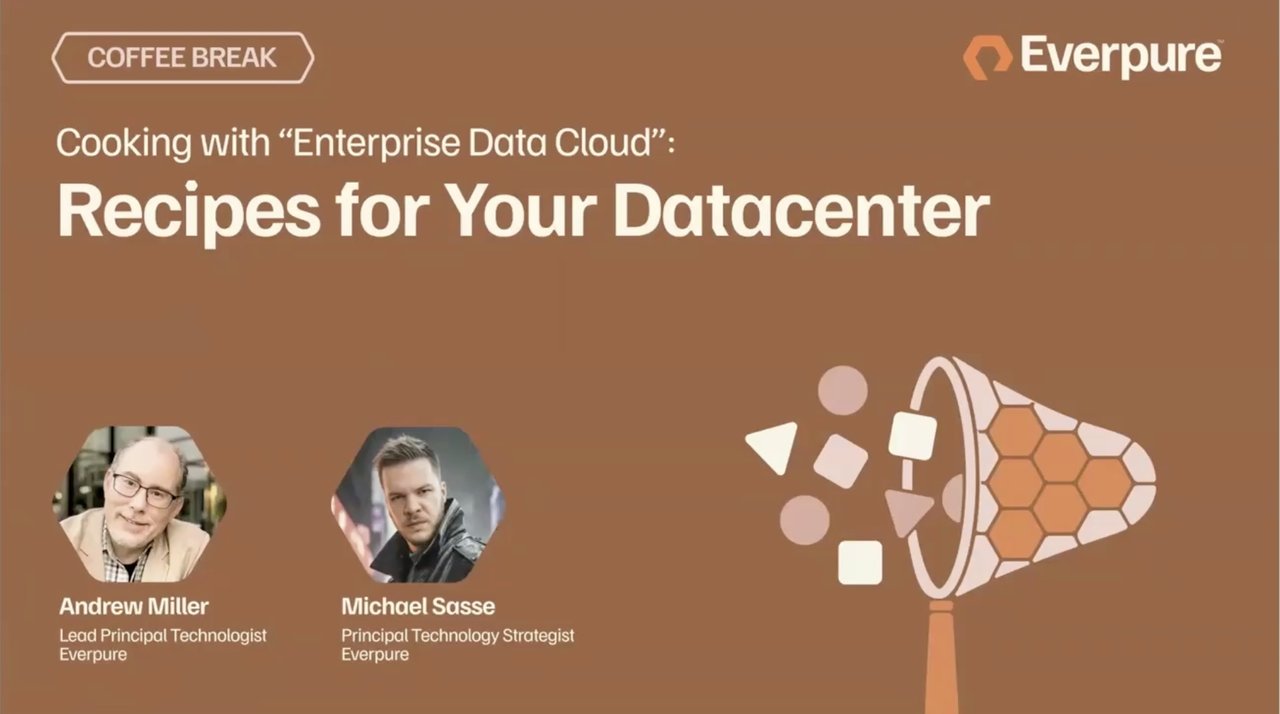
Cooking with “Enterprise Data Cloud”: Recipes for Your Datacenter
Following up from last September’s episode, “Cloud - A Place or a Strategy? Unpacking the Everpure Enterprise Data Cloud” (EDC) with JD Wallace, host Andrew Miller invites Michael Sasse (Principal Technology Strategist with Everpure for 11 years) to discuss how to make EDC real for YOU in the midst of the many industry changes from even just 12 months ago.
This webinar first aired on September 24, 2026
The first 5 minute(s) of our recorded Webinars are open; however, if you are enjoying them, we’ll ask for a little information to finish watching.
Click to View Transcript
Welcome to this month's Coffee Break: Cooking with Enterprise Data Cloud Recipes. We're gonna have fun with that. Recipes for your data center. My name is Andrew Miller, as always, your host for, I don't know, going on five-plus years now for the Coffee Break series. More like a podcast than a webinar, but we've already got that feel.
I'm joined today by Michael Sass. Mike, thanks so much for joining, for the prep ahead of time. Principal Technology Strategist at Everpure, and part of the reason to have him on today as the expert on this topic is he just talks to customers a lot about. So we're gonna wander through the agenda in a little bit here around changing customer needs
and what EDC, Enterprise Data Cloud, is, and have some fun cooking analogies, you know, that kind of thing. But as always, because this is a series, I will, Ooh, we're right at the music ending there. So we will go ahead and dive into a little bit of the housekeeping. Coffee Break, about five years now.
You can find all the previous episodes either on everpuredata.com/events, as well as you can find them, we actually maintain a Google Slide that you can find at this link, which actually I'm gonna update that to say Everpure Coffee Break recordings, or something that, that feels more Everpure. Because these have aged better than average, candidly, 'cause they're more solution and industry-focused than just like, "Here's our
stuff at a product level." So I often find myself sending these to customers or partners or new SEs. Next month, Joe Ferguson will be joining us. We feel like it's cyber month, so therefore, hey, we're gonna cover, hit on that topic, the changing CISO mandate, looking at how both there's What Joe is hearing, and even we're gonna look at some Gartner's, Gartner information around how the mandate, how m-
CISO m- responsibilities are changing, and even the mature, the forcing functions around maturing security organizations challenging. I hit someone, asymmetric warfare and the end of if versus when you will get attacked. It's not a question of if, but when. How much business could you run without your data?
It's an interesting thing to think about minimum viable company. And then last but not least, of course, what we're doing in this space and how it keeps evolving. For those of you who joined us, some of my first blog posts on this were eight years ago, but we keep doing more in this space.
I don't wanna pretend we are a cyber company, but we do a lot of stuff that is uniquely differentiated and helpful in this, in the cyber stack, especially when you, when it comes to your last line of defense, but even further than that, connected detection as well. If you haven't already, please join the Everpure customer community. You can see the, the link down there.
You can hang out and chat with other customers. This is private for customers intentionally. And if you are here just for the drawing, okay, I get it. That's fine. We'll do a drawing at the end, for a lucky winner to ha- get a Yeti mug, as well as a charging device, 'cause you charge your phone
while you drink coffee, I guess. Cool, sure. Winding down, 'cause hey, we're gonna introduce Michael in a second. As always, I am your host. I'm actually thinking back to, well, for each of these, I don't try and introduce myself. And please, yes, thank you, Robert and Timothy, please feel free to toss in the chat where
you're joining us from, what you're looking forward to hearing about today. I usually say it at the beginning. I forgot, but I see the chat, and you remembered to do that, so good for you. When I think about cyber, I actually started all the way back with actually being responsible for the f- a pair of Pix firewalls and doing firewall rules and even internal
border router stuff. And the way that you think about cleaning that stuff up was every month you'd go and remove some of the rules from the ACLs or from the firewall that you didn't think were used. And then until you got someone who yelled at you, and then you stopped, and you were done your monthly cleanup at that point, you know, kind of thing, until, like, you go back next
month and do it. I'm really happy, though, to have Mike here, because man, there's so much background, but I'll let you introduce yourself if you don't mind, Mike. Sure. Yeah, like you said, I'm the, Principal Technology Strategist for Everpure in, Central Enterprise.
I live in Minneapolis, Minnesota, and, I've been at the company now for over 11 years. So I've seen a lot of different things kind of come and go and change over that time. Previous experience, I did a lot in the virtualization storage, you know, industry. Worked with a lot of partners. This is actually the first ever vendor I've worked for, and it's been absolutely amazing.
I love doing conference speaking. I work a lot on automation, so this Enterprise Data Cloud concept is really near and dear to my heart. And, I love using, burning up tokens, like I'm sure a lot of the people do that are on, uh- on the podcast. And, just fun fact about me, I'm a gigantic wine nerd.
I actually took some professional wine certifications during COVID and had to do blind tastings and all the fun stuff, and, absolutely love wine. Very cool. I'm actually thinking of, so, you and I see each other regularly for an SE boot camp where, there's someone else who does this stuff, Michael Chudzik, and, Dan Kobe and Riley Sass, for some time, like 30 years of Everpure
experience in the room. Okay, so diving in this month. Recipes for your data center, Enterprise Data Cloud. What are we actually gonna talk about? If you've joined us before, you know there's a formula. It varies every time a little bit.
But hey, you know, y- you stick with what works so that, hopefully as you come, there's this kind of sense of continuity. So as always, these are when we th- start to think about data center automation, these are, this is a huge topic, right, kind of thing. And even just, even doing things in your data center, whether it is, presenting to your executives and how do you justify things.
So how do you eat an elephant? Big topics, one bite at a time. Easy jokes. So four areas. As always, for the first half, it's gonna be a little bit more agnostic, to kind of what peers, and then we'll dive in. Though this is a little bit of an
interestingly blended topic. So first gonna start off with some c- some, exploring some of what conversations that Mike has had recently with customers, and I may ta- tag in there a little bit too. Both the acceleration of the pace of change. There is real risk around being There's increasing risk around being the department of
no, right? I'm saying that, like, I used to be in IT, and I'd hear peers, "Oh, you're the department of no." It's like, "I Kind of, yes. I gotta make sure it's done well," but you're just trying to get stuff done. Next, what is Enterprise Data Cloud? Like, how do you actually ta- How does Mike actually talk about it?
And yes, there's gonna be some dog analogies in here. No, that has no connection to the cooking thing. It's just the way he likes to talk about it. It's great. Then what is this actually? What are the technical building blocks?
Like, someone says, like, "So what is it really? What would you say you do here, really?" Like, at, at this level. And then we'll up level it to what your CIO cares about, or if you're a CIO, what you care about. Or you'll give us feedback in the chat, please, around what CIOs care about, presenting to the
ex- exec table, continuing the cooking theme a little bit. Before we go there, Tatiana, if you don't mind launching poll number one. This is both, a little bit of discovery for us to understand who's joining us, so, you know, thank you for joining us. So all about you, what's your role or focus? You can put it in the chat if it doesn't quite fit, that's totally cool.
And then, just having a little bit of fun, hopefully not too goofy. What does And what does EDC mean to you? Wrong answers only, and I'll, I'll say later what my favorite one is there. You know, I w- I won't say it now 'cause I'm not trying to slant the, slant the, slant the poll here. But we'll leave that up as we keep going.
So Mike, part of the reason I wanted to have you on is that you've been, in your role, principal technology strategist, there's a, there's a real technical hands-on background, but there's also a level of looking at the business and/or strategic level. So I know recently you've been hearing, I think, speed and efficiency matters more than ever. Challenges with the Department of No, but
maybe kind of just take us into some recent conversations that you've had, if you don't mind. Sure. Yeah, I, I talk to- With customers. With customers. Yeah. I, I talk to customers a lot about this. It comes up a lot. You know, like, we've always been passionate
about, you know, automation and IT, and finding ways to do things better and things like that. But what I hear m- the most often now when I talk to, customers, especially in the leadership area, is that they're always saying one thing and one thing over and over again, and it's usually autonomous infrastructure. Mm-hmm. And they want things to kind of, you know,
self-heal, self-provision, you know, different things like that. They want the humans doing higher value tasks so they can get a better return on investment in, in the technology, right, and the people that they have- working in IT. And a lot of them too, I hear from CIOs, they're like, "Okay, the way I've gotta think of myself is I'm basically like the CEO of a managed services
provider that provides services to the business that I work for." Mm-hmm. And it's a really interesting dynamic to think of it that way because it really allows you to kind of Number one, you get to tie yourself to outcomes on the business side. And secondly, you have to think about the way you do IT in a little bit different way, because you've almost got to think of it as like, well, if we're a managed services
provider providing services to the business, could we be swapped out with a different one? Who's the competition? Right. Right. So we gotta find ways to, like, make sure that we're constantly benchmark- marking ourselves against, like, other things that might be out there, and being able to prove that we are the better option.
You should absolutely be using us, and we've got the metrics that prove it. So those are the things I hear quite a bit from people, but where the kind of disconnect is, is like, well, how do we really do that? You know? There's- Mm-hmm you know, a lot of things we do in IT have been the same way for years, and we've gotta change and evolve if we wanna kind
of adopt that mindset. The, There's even a piece that I think there, there's, as you We wanna be an MSP, and so we wanna automate and standardize, and then we're gonna go a little bit of a different direction, and we'll pull back. But, like, when we, when I So for everyone joining us, I think you know this is not scripted, but we do plan ahead some of what we're gonna talk about, and then sometimes we
think of stuff on the fly too. That's what makes it interesting. Mm-hmm. Is that, having been in organizations times where there was way too much process, it's like all the creativity gets stamped out. So finding that right balance of like, hey, we have to be able to compete and have the right metrics, but also not, like, stamp out internal creativity and avoid even kind of
least common denominator syndrome, if you will. Like, everything gets pulled down to this level 'cause that's the only thing we can automate or have any- anybody on the team. Like, if everybody on the team is wholly replaceable, then we pull down to the level of, like, what the lowest capable person could do, and that's not good from
a competitive standpoint. So there's this interesting balance there to me of even at kind of the human level not being pulled, losing creativity unintentionally. So back to you. And I, I can go to the next topic or if you wanna riff there more please, either way.
Yeah. And I mean, I think when I come in to talk to a lot of customers, there, there's different levels of maturity they're all at when it comes to this. Mm-hmm. And I think one of the things I see the most is that they're very mature in, like, one area about trying to adopt this mindset, whether like, "Yeah, we've got a ton of automation."
Like, "We've got a automation platform-" Mm-hmm "to standardize on," but maybe they don't have great observability. You know, and there's just all these different parts, like, all these different ingredients that are part of the recipe that, really need to work together. So it's really about, you know, trying to help them along with, well, let's look at all the
different pillars that we need then to really get you to where you wanna go. The next dynamic is, so we think about MSP. Mm-hmm. Think about how, how do we actually know how we're doing, and that how do we know and how do we report or guarantee, which is, like I just said, the definition in reverse for observability and SLAs.
So do you mind- Yeah unpacking that a little more too? It links off of the first topic. Yeah. Well, observability comes in a lot of forms. Like, we have used very simple observability in IT forever, where, like, I can look at graphs of how this piece of infrastructure is performing or that.
And then you eventually get to a point where it's like, well, I wanna bring all of that together to one centralized location so I can really quickly see what's the network doing, what's the storage doing, what's the compute doing. I want a dashboard. A dashboard. Give me the big dashboard- Yeah with the graphs, right? Yeah.
But then the next step is, but just because I saw, like, a spike in latency on my storage array for a second, that doesn't mean that there was a business impact. Like, we're looking at everything from an infrastructure standpoint when we're looking at those graphs. If instead we can have actual SLAs that we monitor, record, and measure against from the business, the actual people that run the
applications on the business side, well, cool, then I can see things like, hey, our website responsiveness is slow. Okay, well, then we need to go look at the infrastructure, find out why, you know- Things like that. So once you get to that level, the observability, now you've got full end to end, like business outcomes, SLAs, all the way down
to the infrastructure. And sometimes that is also missing when I talk to customers, and it's usually a work in progress, like everyone's trying to build it, but the problem is- Right. Yeah, like- everything's changing all the time too. Well, I feel like that, that pulls us into the degree of we think about automating or
autonomy, maybe autonomy- Yeah is the, the fancier word for automate, but that they're linked, and then we think about, like you're saying, things are changing all the time. Yeah. And if the underpinnings are changing, unless we're able to somehow imbue, fancy word, imbue intent of- Yeah what we're trying to accomplish into the systems, it actually doesn't work.
So again, back to you, if you don't mind kind of unpacking the idea of autonomy and intent, a- and maybe if that, if it helps, we just put it in declarative versus imperative, 'cause th- that relates in there too. It does. Yeah. I So like when I, I talk to folks about their automation journey too, like, I, we all do scripts, right?
Everybody's got scripts. I, I loved scripting everything back when I was first starting in IT, and it's really good about like, you know, making simple tasks automatable and, you know- Mm-hmm they, they get done very, very quickly, and you can even build a little bit of smarts into it, like look for this, and if that, then this, and that type of stuff. But we've also gotta start thinking about
automation as it needs to understand the intent and the end goal of what it is that you wanna do with your Enterprise Data Cloud. So like if I am provisioning something, like, okay, well instead of like all these different steps about building exactly this or that, really we should be starting with the business outcomes we want to achieve, and the automation understands how to achieve those
business outcomes, 'cause that's my intent, and then it just goes and does the things. Mm-hmm. And that's where I think we need to get to when it comes to autonomy. And, and being very real, that does lead down as you're thinking about selection crite- criteria for platforms and products, et cetera.
Mm-hmm. It goes with that selection criteria, but it doesn't start with I'm looking for products. It starts with I- I'm looking to run my organization, my business, my internal MSP this way- Yeah versus another way, and that may be something I can do with the existing product keywords I have, or I go to a new version, or I add something else in the
portfolio, or it may mean I need to switch out some of the underpinnings to be able to accomplish that- Mm-hmm either way. Yeah. If you follow that architecturally. Yeah. Yeah. And then considering too, how does that impact the automation as things change under your feet, right?
I mean, that, then you've got, you're rewriting automation, you're redoing stuff. Something breaks, doesn't work. That's one of the main problems with it, is that it can be really hard to maintain, and especially if you've got a lot of stuff changing in the environment. We build, this will be my last here, so I've thought about we build layers of complexity.
We do- we add a new layer of abstraction on top. For me, that first really clicked when it was like DNS, which is- Yeah way back, right? So, you know, you don't remember IP numbers or MAC addresses, but eventually that collapses away. Like there's so many layers up here that the lower layers just do, through sheer weight,
end up compressing down. We remember about it when you have to go troubleshoot or look for security vulnerabilities, but otherwise you don't Like they've just become invisible down here in the lower layers. Yeah. I would hate having to memorize MAC addresses.
Ugh. ARP, ARP-A. Okay. So, finishing up section number one, Tatiana, if you don't mind, sharing back poll number one, we'll, we'll riff on that a little bit and also just let everybody see. So we, we do have actually right about half of people that are joining with an infrastructure background, but actually, got some folks that are IT executives. Cool.
Thank you for being with us. As well as architects, also cool. We're trying to, as always, kind of, what I, what I think of is that Coffee Break is often built for a technical audience or people who have technical background, but then we try and up level ideas, or maybe a recovering engineer, if you want, if, if you identify with that. And, I'm very sad that every duck counts did not get the highest one- because, that is the
one that just, for some reason, it just makes me happy. I don't know if you have any thoughts there, Mike, before we keep going, so Hey, who, who doesn't love ducks? Come on. Tatiana, if you don't mind launching poll number two, and we'll get, just a touch more serious here. So what challenges, as we're walking through
that a little bit, what challenges most apply to you of what we put in there? And obviously there's lots of stuff out there, but we're, w- we chose some meaty categories there, I think. So, one of those, or if it's something else, please put it in the chat and we might even leverage it into the conversation as we go. So because of, and I'll just go back here for a second, because of these challenges, this is
some of the groundwork, and, and, and being real, we did not just pick each one of these because they must link to the stuff we're gonna talk about later. It's generally like, "Mike, what have you been talking about recently?" What I've been talking about, just put in. But they do link into what is an Enterprise Data Cloud. But before we did some of like the building
blocks, part of the reason that I wanted to have Mike here is he's got a great analogy. Now, you might be thinking, "I joined Coffee Break a year ago, and I heard this guy named JD talk about it," and JD's still here and doing amazing things. Mm-hmm. And amazing things at EverPeers. So we talked about this actually about a year ago.
We were kind of looking at it's like cloud, is it a place or a strategy? Maybe you, maybe you've heard signs, the joke is, you know, someone else's data center. Eh, maybe-ish. It's a different operating model. It could be a location. Okay, fine. And we covered stuff like this a month ago, you know, the definitional debate, thinking
about control planes, what is an Enterprise Data Cloud as we're defining it and trying to make it real. We did some demos too. So if you're, if you find some of that interesting, and actually Tatiana may be able to grab the link and put that in, otherwise I'll find it later and we'll send it in the follow-up email here. So back from literally a year ago.
But that has evolved now, from where we were a g- year ago, even as you can see the branding, 'cause hey, this says, Peer Store- Yeah or EverPeers, but I didn't change it 'cause this was the one a year ago, truly. So this is how we think about it a little bit now. So Enterprise Data Cloud, and there's, it's built on evergreen architecture.
There's some of the layers here, but we almost didn't wanna start with defining the layers, um- There's a way that you, you talk about it that has really resonated for customers, Mike. Before I go there, any opening commentary you wanna give on EDC before we jump to the story? In all honesty, in my 11 years here at Pure, it's the marketing, kinda messaging and corporate vision that I'm, I think I'm the most excited about ever.
It really kind of lends itself well to all the things that we do really good at, here at Everpure. And, it's really fun and engaging to have that kind of a higher level conversation, you know, with customers, and not just talk about, like, "How do I get a box in here," right? It's an amazing box. It's a wonderful box, but it's- I have the
orange box. You want the orange box, right? Yeah. Okay, everybody's got a box. Let's talk about solving real problems, you know? Yep. So we'll come back to this, actually. But, but let's just start with And, and I, I, I b- I know you've even done this overseas too,
where, images work better than words sometimes depending on the language. Yeah. So, so how do you often start talking about Enterprise Data Cloud? Well, I, I love to tell stories and tie tech stuff into metaphors and experience. So this came about 'cause I was overseas talking to non-English speakers, and I'm like,
I can't have a slide like that up. That doesn't make any sense, right? This is a little harder to wander through. But it's great. Right. Exactly. It's a good climb, but harder. Yeah. Yeah. Yeah. So I just came up with this, and
I'm like, listen. Imagine, like I'm the end user, I've got a photo of my dog up in the cloud, and I've got outcomes that I want to achieve by having that photo pulled up. It- I expect it to be up immediately, I expect it to always be available, and I have outcomes that I want. I want oohs and aahs, and I want people to
smile when they see that dog, right? But there's no humans at Apple or Google that are going, "What node should we put Mike's dog picture on?" Nobody's doing math or has a spreadsheet or anything like that. There is autonomy that understands intent, that knows that it should be on this node because this is the place that we put pictures
like this, you know, that, end consumers are storing up in the cloud. And- For someone based in America maybe, so yeah. Right. Yeah. Yep, based on geography. We know where it's gonna go. It's gonna make sure to meet the SLAs that an end user expects for their photos.
And if it has to move somewhere because the hardware is being retired or something like that, there's not really a disruption to the end user, and it's totally invisible to them. So as the consumer of the service, I just get to focus on what I want, and that's, I want smiles. I want people, you know, to feel good.
And the infrastructure itself is making decisions on its own based on autonomy and intent built into that system to make sure that I get those outcomes. So when I talk to customers, and it's like, "What is EDC?" That's why I just lead with this, 'cause it's like we all understand this, right, as an end user of this technology stack, and that's exactly how an Enterprise Data Cloud should behave.
Love it. And just dogs are fun too. I was thinking cat pictures- Dogs are awesome I'm thinking kid pictures. What- whichever ones get you oohs and aahs you like to shoot for. Yeah. So let, let's go a little bit more to, to what the layers are in general.
Ironically, and I always kind of just makes me smile, like in this slide, the, the foundation is Evergreen. Mm-hmm. But it's first, 'cause it, it should be if you're gonna walk through it. But you mind just kind of walking us through the layers and how you describe them? 'Cause there are layers here- Mm-hmm and there's intentionality to them.
And sometimes people be like, "So, so where are your, where do your actually products live?" Like I know, I know that you do FlashArray, right? We do. Yeah. And we still are investing in it, and it lives in this layer, but we don't start by saying, "FlashArray this," or "FlashBlade//S." So maybe kind of walk us through the layers here, if you would.
Yeah. I, I think what it really The, the layers here that are really, really important are you need, number one, a unified data plane is really important, and that doesn't just mean like buy one product for everything. It means that whatever it is that you're using for different workloads, different protocols, whatever in your environment, it should work very similar.
And if you know how to use one, you know how to use the others. You shouldn't really have like a million different products, and they all have to be managed differently- Yeah and they all have different capabilities, and it just, the sprawl and complexity that comes with that is, can be overwhelming. There's a philosophical alignment, even if the interfaces are a little different if they have
different protocols. But yeah. Mm-hmm. Yeah, exactly. And the other part too, having an intelligent control plane, the automation piece, we'll talk more about in a little bit, but I mean, you've gotta have something over top of it, almost like another abstraction layer over the actual infrastructure itself that you can
interact with and it can make decisions for you, it can give you predictive analytics. You can filter, you know, monitoring and management through it and things like that, and it can understand your intent. So that's a really important piece. But the reason that we always put Evergreen on the bottom is that, you know, I used to write
scripts all the time when I was in IT. But we'd make a decision to move from one platform to another, and then all my scripts are garbage. They don't work. I gotta change, it's talking to this endpoint now, and the way it did snaps and clones is completely different than the previous product that we had.
Um- Six months planning for the migration, six months cleaning up after it. Six months rewriting scripts. That's productive. So we think that's really important too, because you gotta get an ROI in actually building something like this, otherwise why do it?
And if you're having to reinvent the wheel over and over and over again because the infrastructure is shifting under your feet all the time, it's really hard to get a return on it. And, we think that's absolutely crucial to have at the foundation of what your Enterprise Data Cloud is. I think I'll tag on a little bit for the, the
as a service and data intelligence, then toss back to you. So- Yeah eh, the world is moving toward as a service. We know this. One thing I appreciate about what we're doing at EverPeer is we are not forcing people there, we're offering And, and we'll drop names in here, so Evergreen//One is the as a service, true storage as a service offering, not a
dressed up lease. But that actually when it comes down to start delivering outcomes, yes. But even- not predicting the future has always been really, really hard. So like, what am I gonna need in one, two, three, five years? We would guess at it, and we'd hope we didn't guess too high or too low, but we knew we
weren't gonna be right. So having as a service, on demand, with SLAs behind it. And if you're thinking, "Hey, have they talked about this in the past?" Why, yes, they have. This is where we're gonna use the m- the magic of, slides to say, "Hey, go back and listen to Breaking Free from Storage Shackles: The Rise of True Storage as a Service
with Ben Lee." Mm-hmm. Where we actually go through what that means. But in this context, I, I really do think about it as we can't predict the future, and we need the infrastructure to data and storage layer to be as a service responsive to what we need.
But all of that then frees us up to potentially to think about, well, what is the actual data? And maybe I'll toss back to you, Mike, for kind of the- the last layer here before we finish up the section. Yeah. Understanding, like you said, Andrew, like what is in my data?
What do I actually have here, and where does it live? And the, is it actually conforming to what our auditors require of certain sensitive data? Or is, do we have many different copies of the same data all over the place and we don't need to? Who has access to it and who shouldn't?
And so we think too, like having some intelligence about the data itself is also crucial, because at the end of the day, you gotta know what you got, you gotta know where it lives, and you need to know if it's supposed to be where it's supposed to be and do the right people have access to it, not just based on like simple, like ACLs and stuff, but even like what's in the data.
And if I know that, I can better control who should really be seeing it and where it should be stored. This, this interestingly, I wanna say it's just this natural progression, but if you simplify all these other layers, well, you don't have to migrate, and you have continuity from a product and capability standpoint, and you have a control plane that can help with policy-driven automation and it's as a service,
you naturally can think more about at this level, which is why we made a notable acquisition, and we'd already been doing engineering work to accelerate- Mm-hmm that vision too. Like, we'd actually done things in Pure1. Okay. Yeah. Anything else you wanna add here before
we, go to the next poll and jump to the next section? I think, just I think really quickly too, just to double-click on the, delivered as a service. Mm-hmm. I think what's really critical about that too, is the fact that it's so much easier to understand your costs. Right? 'Cause you know now I've got this many
TiB that I'm writing, it costs me this in my contract, and I'm guaranteed this performance and uptime, and et cetera, et cetera. And it's way easier to track what everything costs. Or even possible to track at all. Yeah, yeah.
We're into the world of maybe chargeback, maybe showback, maybe scareback. All of them fit in here, right? But just visibility- Yeah on the financial impact and requirement. Yeah. So Tatiana, if you don't mind sharing back poll number two, and everyone can see.
So what's actually interesting, so very fascinating. So in- Wow internal MSP dynamics, zero. Cool. All good. Like, this is why we do it. Observability and SLAs, autonomy and intent, and a couple people said something else. I'll toss in the chat.
Hey, toss it in the chat, whoever that was. I don't see it in the chat yet. Put it in the chat, 'cause we're I'm genuinely curious what it is, but observability and SLAs by far, easily- Yeah. If you don't mind launching poll number three, Tatiana. And this is about what building block is missing in your, maybe it's EDC kitchen or
your, I was gonna say data center architecture. Would it be IT? 'Cause you may be fully in the public cloud or in hybrid or whatever else. So you know, which of these is missing for you today, or would you say is maybe the most missing?
Maybe you have all of them, but you know, which do you need to add the most? I think the only one we didn't talk about here a little bit was, agentic AI and MCP servers, but that just felt like we had to put that in, 'cause that's a priority that everyone's getting from their board. Yeah. And then related, what building block is your highest strategic priority?
So maybe, hey, what, what, what gaps do I have to shore up? Cool. But also, what am I getting asked to do at a strategic level the most? So we will leave that up there, as we always do, so we can kinda hang on, keep chatting. So number three, so we've talked about customer discussions, the pressures folks are
seeing, how we think about this at an architecture level with Enterprise Data Cloud, which is kind of about pure, but hopefully you can feel like this is still almost more of a, these are the, the layers that we believe are worthwhile to build. And you could actually- let's pretend you're on the call, on, on Zoom here, and you're not even, you're not an Everpure customer, at, at least yet maybe.
I'd argue that you could benefit from looking at these as kind of architectural criteria to say like, "Do I have these things?" Like, this, this approach would help me regardless of the product mix that you have. But how do we actually make it real, from an Everpure standpoint? So cooking the souffle.
I always feel like I'm gonna say that wrong, but I, I don't think I did. Hopefully not. You nailed it. Okay. And I chose souffle on purpose 'cause it's really, really hard to make. All right. Even better.
So what are the actual If we just say, so a, a little bit of the shades of like, what would you say you do here in office space? Or just like, so what is this actually? So there, there's a couple building blocks, and I don't wanna say that what we're gonna cover in the next couple minutes here is every single building block, 'cause there's a bunch.
I wanted to pick some that are big enough, meaty enough. That doesn't fit with the souffle, maybe. Oh, well. There's enough to them that we can talk about. So let's start off with thinking about at a, a kind of a regional level and an architecture topology standpoint.
Back to you. Take it away. Yeah. I think what's really important, let's, this is going back to the intelligent control plane now, is one of the things that you can do with our products now is leverage a feature called Fusion. It's just, it's built into our products.
You can connect your, all of your arrays, whether they're- block, file, object, physical in your data center, even virtual stuff in the cloud as a fleet. And that's really cool for, like, I can, you know, manage one array from another. It doesn't matter which one I log into. But we've recently added a thing called topology groups.
So you can actually start to build some intent and intelligence now within that fleet instead of it having it just be a flat hierarchy. So think of this like, like a kitchen, right? Like, I've got these different kitchens around the world, and I'm gonna define within these kitchens, like, where they are, like a region, for example, like an availability zone similar
to the public cloud. I got a kitchen in Minneapolis. I've got one here, there, whatever, right? And then I can start defining underneath of there, like, what the different parts of my infrastructure are, what are their purpose, what runs on them, and things like that.
And I can start to control things at an abstraction layer above the physical assets. So like, if I've got a group of technology together, like a bunch of FlashArrays or FlashBlade or whatever, and they're, like, in a specific location that I've defined, and I call that an availability zone. That's my kitchen, right?
And then I've got all this stuff in here. I can say, like, "Okay, boom, here are my bakers," right? Or, "These are my arrays for SQL-" For example for example. For example. Yeah. Yeah. I've got my team of stuff, right? And I can delegate responsibility based on what I want the assets to do, or maybe there's
some assets that have multiple purposes, and that's cool, too. But, like, I can now start to actually organize and control from a provisioning and management and availability standpoint things based on an abstraction layer that's a level higher. So I talk to customers a lot.
Like, "Okay, we've got your arrays. Cool. Now let's figure out a way, like, how do we organize and group these so we can start driving towards outcomes with this hierarchical structure of topology grouping that we wanna build?" And then it's kind of like with your kitchen, like, if I needed to make a change in the kitchen, I wouldn't go
into the kitchen itself and then talk directly to one of the people that's, like, busy, you know, flipping around, you know, some vegetables in a pan or whatever. I'd talk to the kitchen manager. I would talk to a layer up- Mm-hmm from the people where the actual work is happening. That's kind of like a topology group.
That's kind of a good way to think about them. Okay. Yeah. It makes it a lot easier to automate, too. Matches your needs even as the units are in flux. And actually, let's talk about layers of abstraction.
It's a layer of abstraction for a logical reason. Right. Right. So you said the keyword, or what I heard is it's a keyword, of provisioning. So if you've got this, a, a setup like this, and whether it's one location or multiple, you know, kind of thing, 'cause you may even have different groupings within a location, then we
think about either the, an example being around provisioning potentially, and how would that apply here? So walk us through that anyway. Mm-hmm. Yeah. This is a I- inside of Fusion, you can build presets. So you can think of them almost as like recipe books.
Mm-hmm. So I've got in my kitchen, like, say, chicken Parmesan is, like, something that our- we're really great at making. I wanna make it over and over again, and I wanna make sure that it's made the same way every time, and it shouldn't deviate, and it should just be boom. 'Cause, I mean, if we put chicken Parmesan on the menu and everybody gets something
different every single time they order it, that's, that's a fail. Challenging. Challenging. So these presets allow you, like, on your infrastructure side, well, we know as an organization what, like, a tier one Oracle database should look like. We know that it should be this number of volumes.
It should get this type of performance. It should be on this kind of an array to get that level of performance. It should be in my Minneapolis kitchen. Mm-hmm. It should be made by, you know, my group of, like, really high-powered, amazing French chefs, you know, that reside in that kitchen.
And instead of having to build the chicken parm from scratch, where, like, okay, I've I need to go to the cupboard and get this and get that, instead I've got that recipe right there. So how to do it is consistent. It's done the same every time. So I can make sure that, like, I can configure protection.
So, like, if I'm gonna deploy in Minneapolis, it's a tier one database. That means I have to protect it and have cross-availability zone or maybe even cross-region- Mm-hmm protection for the workload. So because I've got the groupings set up, I don't have to think about, like, okay, that it has to go on this individual array, and then I need to make sure that I configure that array
to talk to this array over here, 'cause I know that that one is over there. Instead, you're just like, "Hey, build me a tier one Oracle database in my Minneapolis data center. Make sure it's replicated to a different availability zone," which could maybe be Seattle or something, right? Mm-hmm. And then it understands what it means for your
organization to build a tier one Oracle database, and it does all the things to make sure that that chicken parm turns out exactly the same every single time. But one of the things that's really cool when we talk about what's, what we're building with Fusion is there's even gonna be stuff around compliance to make sure that we can do things like, all right, so we've been making chicken parm this way forever.
It's great. Everybody loves it. But we found a way to tweak the recipe to make it better- Mm-hmm or make it cheaper. So when something like that happens, you can just tweak the recipe, right? You can do the same thing with the preset. You can say, "All right.
Well, we've been making chicken parm like this. Going forward, I wanna make a revision to the preset," and now everything's gonna get made like that every single time. But if I want, I can even update the preset with some new change, and the compliance engine can say, "Hey, there's a chicken parm or an Oracle database out there that doesn't
conform to the new recipe, to the new preset." The business policy changed. You wanna fix that. The criticality of the application changed. Yeah. The new line of business that has a higher priority than another line. Mm-hmm. Then how do we make sure to effect that change
back at scale and make sure that we did? Right. So imagine, like, if something does change internally, where suddenly I've gotta protect, like, a tier one Oracle database, instead of snapping hourly, it's gotta be every 15 minutes. You could change the p- the preset, the recipe, to update, and then have the infrastructure
tell you, "Hey, all of your Oracle Database are out of compliance. You want me to fix that and just remediate them all to match the new preset?" Yeah, of course I do. Go, just do it, right? So what if, what if we then say, "Okay, we have new applications coming online. A lot of business grows more than..." Maybe not anticipated, just, just we didn't know,
like, how much this is gonna sell. There's a projection, then there's reality kind of thing. So what if we get in a scenario where we actually have uneven utilization, and we have to think about how to remediate, optimize? I feel like we have an answer there. Maybe?
So think I love using these, cooking analogies, 'cause what goes better with wine than food? So imagine in your kitchen, right? You've got people doing different tasks, just like you'd have different FlashArrays and FlashBlades doing different tasks and running different workloads. Well, if there was a new order that came in, you wouldn't go to the busiest person and tell
them that you need to be doing that, and suddenly you've got, you know, two chefs that are just sort of sitting there twiddling their thumbs and one is really crazy busy. You wanna be able to, like, not only on a provisioning aspect, make sure the new orders go into the person that can has the most bandwidth to handle it. But as things are changing and people are getting more and more busy and priorities
shift, you also wanna be able to say, "Hey, I want this person to be able to hand off this pan to the less busy chef, and to have them start cooking on it." Mm-hmm. And that's the rebalance feature that we're adding, too. So the infrastructure itself will actually look at, like, what if scenarios and forecasting and things like that and go, "Hmm.
You know that guy over there is really busy. He's cooking all these different things. I'm gonna move this one order from him over to a different, less busy chef, so that we can actually get that out in time, meet our SLAs. We're not gonna run into burnout from that one person." We can do that with the arrays.
So it could say to you, like, "You've got a really busy workload running on one FlashArray. And you know what? I think there's another FlashArray that's in the same topology group, it is for the same purpose. If I move that non-disruptively to the other FlashArray, we're gonna have way more balance, and we're gonna avoid this kind of cliff that I'm seeing coming in the future if things keep
going the way they're going." Or let's say, uh- So we can proactively get ahead of those things and move things on your behalf. Or let's say the, the, the secret fo- food reviewer walks into the dining room. Suddenly his order gets sent to the best person you have in the kitchen, who offloads some of it to somebody junior, you know, kind of thing.
Just- Yeah. Yeah, that's a great analogy. Yeah. I'm, I'm thinking back of actually Ratatouille. I've got that in my head somehow- with the scene where, where the I can't remember his name. This is awful. Anyway. Okay. We do have one bonus item in this section.
So we've actually tried to be really good and not say AI, AI, AI, AI, agentic AI, yada. But we'd be We wouldn't be We'd be doing you a disservice if we didn't at least allude to briefly, "Hey, we should be thinking of this from an agentic standpoint," connecting agents in, being able to see it. Mm-hmm. Do you mind giving the, the audience a little bit of a bonus item around how we think about
this from an MCP standpoint? Yeah, 'cause agentic AI is gonna absolutely have to be some component of the Enterprise Data Cloud. one of the reasons why is just because, when working with things like observability, it's really good at just getting you information really quickly. So that by the time there's a problem, you not
only know about it as quick as possible, but you have a lot of information at your fingertips to allow you to figure out what to do. Mm-hmm. Having an MCP server, so Fusion does have its own MCP server, allows you to have your agentic AI in your organization, whichever one you're subscribing to, just talk to the infrastructure.
So if you wanted to ask a question like, "What's my busiest Oracle database that is assigned to the marketing department in the entire fleet?" It'll g- your agentic AI can talk to the Fusion MCP server. It can give it the information and context that it needs to get that answer without your AI having to go just blast every single, like, API endpoint, all the different arrays, and,
like, do a whole bunch of searching and filtering and It can get that information faster, more reliably, and without burning so many tokens as well. So it's a really good addition to an Enterprise Data Cloud because it just makes your AI that much more effective in helping you get to the outcomes that you want. And for anyone wondering, by the way, if you're a Pure customer and been doing this for
a while, there's a Fusion MCP. That's because Fusion is on-prem. It's built, or where it's built into the, into the physical systems kind of thing, and it can of course have read, write, modify type privileges. There's also a Pure1 MCP that is focused more on being, as Pure1 often is, about large data
aggregation, read-only some piece. So we have embraced the MCP in both locations, and if you wanna know more about that, reach out to your account team and we can kind of like, "Hey, here's what makes sense here, what's making sense here." But both exist for a reason. But if you're using Pure1, yes, there's MCP there, too.
Okay, we're in the home stretch. Now, we still got almost everybody with us, so if we could share back thank you, Tatiana, poll number three. We'll see where we fell. So, um- Wow building block is missing. So no one is missing evergreen architecture, which I'm assuming I'm gonna just take that to
mean that everybody here is a customer- 'cause it, it's hard to have an evergreen architecture without being on Everpure. And then there's a mix here of all the rest of them, to be honest. And then if we go to the building blocks as the highest strategic, strategic I can't talk. Strategic priority. Ha.
Data intelligence in the lead. Any- anything in here that surprises you, Mike? I, I do like the attention that data intelligence is getting from, from the folks, 'cause that is really becoming a, a hot topic. Especially since we, you know, have acquired, now have Everpure Data Intelligence.
We think about it. It's important. But we, we think about it and made that acquisition for a reason. So- Cool. Point number four, if you'd be so kind, Tatiana, and then we'll get into the final section. So the last one here.
So which building block is most worthwhile of the ones, things that we just talked about? So just trying to kind of tailor back to so that those are the five things that we just talked about. Let's take those though and put those through a little bit of a framing from an exec standpoint. If you're thinking like, ooh, they're almost at the 45-minute mark, you're right.
We probably got about five or six minutes left I think content-wise, but we'll, we're always done before the top of the hour. But I'll, I'll put something sooner, and we'll get to the drawing. Don't worry. But there were actually two things that we wanted to do here. Before we jump to, okay, let's go back and
actually look at some of the same things we just hit on, but kind of put a executive outcome-focused lens on the capabilities, which we, we started to do. We can never help ourselves, but you know, go that direction fully. I think, Mike, for, for you, there was the sense of even how do you talk or help even sometimes people that you're talking to and even coach them- Mm-hmm into how they talk to
their CIO, their CTO, what they care about. So just being real, wanna do a little bit of kind of almost career coaching here, if you will. Or maybe you're like, "Hey," like put it in the chat like, "I'm a CIO and I don't agree with what Mike's about to say." We'll see, but I think But this is some of the conversation
that you've learned yourself, I've learned, in how you help people. So maybe kind of start walking through that a little bit of, of, of- Yeah how to frame things. Yeah. When I'm coaching customers and I'm talking to, you know, whether it's engineers, architects, managers, directors, whoever, about like how,
how would we present this to like executive leadership and get some buy-in to actually build something like this? One of the first things I say is you've got to mature your observability as much as you possibly can. 'Cause l- leaders are, are data-driven, metric-driven people. They wanna know that if we're going to make an investment in something, I wanna sh- see what
were things like before, what were like, were things like after, and there should be a definitive ROI. Like, we did it and it saved us this or it made us this much money. So I think it's critical to build that. Now, that means you've gotta do more than just build like the infrastructure metrics and
stuff like that. We gotta have conversations with the, the actual business units, the people running the applications, and say, "Hey, what metric matters to you in your application stack? Is there a way that I can measure it and make that part of my observability platform? You've probably got your own dashboards and things that you're watching.
I need to bring that together, and I wanna understand the context of what matters to you, what's good and what's bad when it comes to this application, so I can better support it and get you better outcomes." So I think building that right away is the first thing, and it also gives you a ton of connectivity to other parts of the business, and just makes you seem a lot more valuable and grows your own network within your own organization.
The, the reason I changed this slide, by the way, and I, I left this out, so this is the version of EDC, that it's kind of about what the layers are and what it is. But then this is obviously basically the same graphic, but like here are the things that would more map to, like a CTO would care about. Am I protecting data across all of my environments?
There might be a, an even higher level business reason. So wanted to leave this up 'cause trying to frame EDC in terms of what your CTO and maybe CIO cares about, but okay, keep going. I just wanted to, highlight why I was, uh- changing the slide. So I know there's more there. Yeah, 'cause this one really drives to the
outcomes now, and that's exactly what your leadership is gonna care about is you say like, "I'm gonna get a fast- faster backups." It's like, what does that mean? Cool. Right? It's like, let me guess. You want millions of dollars again, right? N- what I wanna do is I wanna improve our prot- protection of our important data sets
and make it so that we go from this for a restore point to this, or, you know, it's gonna have a real impact to the business. The amount of data lost in between restores, that's less time to Yeah. Yeah. Yeah. And that observability and metrics is really important because as you start to think about and pitch and then build an enterprise
data cloud, you've got the real data to show that the investments that we're making here are paying off in this way, and here's how things used to be and here's how they are now, and this is way better. Like, we're faster meantime to resolution. We're saving money. We're whatever.
All the things that like, you know, those business leaders love to hear. That's what you gotta be- make sure that you can measure, so that way you can build it, show it, and prove it to them that it works and we're getting a return on it. There were two things when we were chatting about this made me think about. One is the, the ability to potentially even be proactive here, that you might see, if you
have good observability. I think you Again, you get a gold star for saying observability at least 10 times so far, but, like, for the right reasons. That if you ha- if we actually have good observability, we may actually be able to see a metric be- breach before the business customer is impacted by it. Now, actually, don't just go fix it and not say anything and they don't even know.
Like, it's good to message like, "We saw this and we resolved it proactively before it had an impact." That's a good thing to roll up your org chart. Yeah. The other thing I think about here is maybe you're in a small to medium shop and you're just like, "Mm, this is kinda heavy and big," but still there has to be justification for your role, my role, the
systems that you're buying. So even if you're not doing this as thoroughly as maybe someone in enterprise or a global organization is, still thinking about it this way is, I'd argue, the right way to do it, even for your career going forward. And m- but also in your organization right now, don't get things too heavy with tracking all the metrics, but being aware that this is how people think about it eventually- Yeah is
actually really worthwhile. So back to you- Be your own advocate. Yeah, be your own advocate. Be an internal salesperson at your own organization The best thing you can ever do Like, here's the value that I'm bringing. And this is very interesting- Mm-hmm line, 'cause I, I struggle with this as a customer.
Like, I don't wanna, like, brag on all the stuff that I'm doing. Well, I kinda do, 'cause I think it's cool, but I'm not just, like, trying to be, like, a jerk, like, "Look at me, I'm so wonderful." But, like, if you're not doing that, people don't realize. That's the definition sometimes of a utility. When am I- Yeah when am I happy about my electric company?
I'm actually only ever unhappy because - Yeah the power goes out. Otherwise, I just assume it's all running, 'cause I don't know anything, anything that's going on. Okay. All right, to dive into the kind of the exact flavor on each of the previous topics, or anything else here before we keep going?
No. No, let's keep going. Cool. Okay. So we're gonna go back through the same four, minus the bonus item, MCP. So array topology, what's the, what's the exact flavor here? And, and realizing that- we couldn't help ourselves, we did a little bit of that in the
past, but we'll just do that here, so back to you. Yeah. Well, it The way you can explain something like this to, to, like, a leader, to executive leadership, is what we're building now is we're upleveling. Instead of focusing on infrastructure, we're now focusing on outcomes that the infrastructure's gonna provide.
And in order to do that, I've got to have defined zones, I've gotta have defined groupings in terms of, provisioning boundaries and management boundaries and stuff like that, because this is gonna enable us to scale up and down. So, like, if I'm pointing, for example, like the dog photo, for example, if I've got that going to a cluster of storage somewhere, if I'm just pointing at the grouping, the
topology group in Fusion, not individual systems, that means I can go from one array in that group out to 100, back down to 10. It's completely irrelevant because- Yeah I'm always talking to the abstraction. Being responsive to the business. Right. Exactly.
Serves the business. Mm-hmm. Cool. That, that feels like it links in then a little bit to provisioning. Mm-hmm. And potentially, dare I even say, consistency of provisioning, and I've got a story, but I'll hold it.
You go first- All right and then I'll, and then I'll go with a story on this one. So. Yeah. Not only the predictability here, but I think one of the things that leaders love to hear is that we can build The compliance that we're gonna build into this means that we can give ourselves the warm fuzzies knowing that every tier one Oracle database, for example, is following all of the different SLAs that
we've agreed to with the business. And it's auditable, 'cause Fusion has its own API set, so if you wanted to do, like, an audit or give the security teams the ability to audit something or whatever- Mm-hmm they can do that. Yeah, they can really dive in and get some auditing information out of your environment at any time they want.
Because you've got the compliance, the presets tied to all the workloads and stuff, it's easy to prove. Like, yeah, we are doing everything exactly the way we're supposed to be. Audit me any time you want. It's all there. Like, everything checks the box. Everybody feels good. And now I've got the ability to, with auditing
and building things with these presets, I can now really create some cool metrics. Like, here's how long it used to take to build something. Here's how long it takes now. Here is how we used to have things, where there was configuration drift, there was compliance drift. Now everything is on lockdown and is exactly
the way it's supposed to be. And those are those other things that you can use to toot your own horn and really impress those leaders that we're building something that is really truly an Enterprise Data Cloud. It's not just individual, you know, like, click actions and stuff like that. 'Cause we're all human. We can make mistakes, right?
Mm-hmm. Mm-hmm. I'm, I'm a professional, and I'm building systems that are, I'm gonna repeat myself from a minute ago, that are responsive to the business in different ways. We have this many more provisioning requests coming in- Yeah systems to stand up. The, the story I was thinking of, there was a bank that's actually, actually outside the US,
and folks listening here are largely inside the US, I realize, but they actually leaned forward a little bit to an earlier version of Fusion, 'cause they were actually getting hit from an auditor who was going in and looking at the snapshot policies. Okay, so I'm given You know, that's the more technical term, but basically, how often was th- were things protected with point in time-based synthetic metadata
only snapshots, okay? And they were finding the, the policies were all over the place kind of thing. So they actually leaned forward into Fusion so they could use presets to make sure that they were always deploying based on what their audited, enforced, needed to be or else there was financial impact policy was.
And then of course, then this goes into, well, are people still doing it outside of that maybe? We can see that. Mm-hmm. Stay tuned. There's actually more. We keep developing more stuff along these lines.
Some of it might even be announced next, next WEKA, Pure//Accelerate in London. So we keep, we keep actually investing in these areas, but it's following these themes for the reasons we've just stated. I think that brings us all the way back here, which is hopefully once we see, EDC aligned to executive outcomes, these kinds of things.
Last but not least, so you may be at home or in your office, either way. Work from home, work from office, thinking like, "Okay, sounds great." Hopefully. Well, that, that's our job. We're here to make it sound worthwhile and explain the why of the why we're doing it. But you may wonder, "How could I get started with this practically?" So there, there's a
couple pieces here, especially, the workshop, and I know you've been involved in a couple of these already, Mike. So if you don't mind kind of giving folks a sense as the, the last item for the, for the whole time, then we'll do the drawing too, of, uh- Sure. Yeah how, how could they get started? Yeah. This is actually a free thing that we do with
customers now, where we just come in and say, "Hey, where do you, where do you wanna get to in terms of an Enterprise Data Cloud journey? Talk, talk to us about outcomes, the things that you measure, the things that matter to you. Let's do some discovery together and workshop, and let's actually map out." You know?
If, if we're looking at things like operational efficiency, looks like you're at a maturity level two when it comes to that, and you wanna get to a four. That's your desired goal. That's how you grade yourself. Yeah. Mm-hmm. With, yeah, with your own information about your infrastructure and people and processes, what are the steps to get from
maturity two to three to four? So it'll actually have, like, actual prescriptive recommendations that you can use, and they're not pure recommendations. There'll be stuff in there about ticketing and observability, and, and the specific ticketing and observability doesn't matter.
It's just that you have it, and it's delivering the outcomes that you want. So it's a really cool just- workshop. We get to work together and build a blueprint for you and your business to get you from where you are to where you wanna go, and what are the steps in between. Very cool. And actually, I was sending this, 'cause I
actually had the link to the workshop, but I was I failed and I sent it wrong. There we go. So if anyone's curious about that, and you'll get this in the follow-up email too, but this is actually something we launched at Accelerate in June, and it's been a lot of investment internally. Yeah. So I think with that, we are, we are at the
end, if I can get that to There we go. So, as always, time flies by. Thank you so much, Mike. I'm not even gonna recap. We had some chat. I don't think I see any questions in Q&A, 'cause we always like to make time for that.
So, hopefully you got a sense of what we're doing and why we're doing it around Enterprise Data Cloud. There was actually, and this is a Mike special, we have a fifth poll before the drawing. Tatiana, could you, share back the fourth poll first, and then we'll do the fifth poll, 'cause we really wanted to, wanted to hear from you.
I'm, I'm extra. So the fourth poll results. Yeah, you're extra. You're bonus. So which, which building block is the most worthwhile? Ah, compliance. Interesting. So that's where- Yeah sometimes there's teeth behind it.
So like, I, I may not want it to be the most worthwhile, but it is. Or, or may- maybe you just love compliance. So, so that's cool too. MCP actually lowest down. And, Tatiana, if you could launch poll number five. This is the bonus one, but we, we really wanted to hear this from you.
So how confident are you in describing these outcomes? So we just went through kind of an exact flavor of the same, the same slides, right? In describing these outcomes to your leadership. Very comfortable, somewhat, not very comfortable, wholly uncomfortable. That is definitely a Mike special.
I'd rather drink awful wine, 'cause maybe depending on who you are, you're like- "I, I, I don't care. It's still..." Okay. We'll leave that up for a minute. Next month, please make sure to join us with Joe Ferguson, the changing CISO mandate and EverPeer's evolving cyber strategy.
Some of what we're hearing from Gartner, from customers, asymmetric warfare. And even how much business could you run without your data? Do you have a minimum viable company, and how long to get that back online? But if you waited for this, hey, here we are. The winner of today's Coffee Break Prize, a coffee lover's gift set, is Bill G.
I always go with, just, just in case you don't want your full name out online publicly. So Bill G, you know who you are, hopefully. And you'll be hearing from our team. And that leads us to a little bit of Q&A, but Tatiana, we're not gonna leave this up too long. Hopefully everyone was fast.
We'll see. Yeah, feel we're decently fast. So, okay, somewhat comfortable. So folks on this call, makes sense 'cause we had a good infrastructure audience, folks. That, to me, that fits. Like, you do this sometimes, it's part of your job, but it's not the day in, day out, and you
can do it, but, but you gotta get ready. Okay, cool. Mm-hmm. Q&A. I don't think we have any open Q&A, but maybe I'll just do it this way. I'll I'm gonna toss you It's not a fastball. It's a softball. When you're going through these kind of
conversations, Mike, with customers, what is the most common question that you get from them around this? And therefore, I'm, I'm hoping you can answer the, the, the question that you're about to pose, so, you know. Yeah. You know, I think what I hear most is maybe not necessarily a question, but a comment, or at least a viewpoint.
And a lot of times when people We put up, like, that slide about what, you know, EDC and the pillars and things like that. It's really easy just to say, "Well, that's a product." Right? Like, pure just cut me a PO, or, like, let me cut you a PO and you build me an Enterprise Data Cloud. It doesn't work that way.
Like, every Enterprise Data Cloud is different. Everybody has different goals, outcomes they want to achieve and stuff. So I think one of the things that I try to do a lot, in explaining it, yeah, the workshop is important. That's why we do that. Yeah.
Just remember, we're, we're a part of, like, an Enterprise Data Cloud. We think that we're the best platform to build one on, but everything else is, like, different for everybody. So it's more of a journey to build an architecture than it It's not a product, right? And we have differentiated products and capabilities that we believe fulfill that.
Yeah. But it's a larger discussion that hopefully has larger impact to your, your company, to your business- Mm-hmm to your career. Awesome. With that, we are at the end. So thank you, Mike, as always, a pleasure. Thank you so much. Yeah.
Thank you. We, we see each other every couple weeks in person, actually, at HQ for different stuff, so yeah, I'll see you soon. And for everyone joining us, thank you so much, from the entire Coffee Break team. We are coming up almost on the end of year five, heading into year six, or maybe it's year six. Either way, I get confused.
It's been a while. And we'll be back next month with a great episode focused on cyber and the changing CISO mandate. Mike, on behalf of Mike, Tatiana, the entire Coffee Break team, have a great month. We'll see you soon. Thank you, everybody.
Looking for practical ways to streamline your datacenter or hybrid cloud environment and run it more reliably? Following up from last September’s episode, “Cloud - A Place or a Strategy? Unpacking the Everpure Enterprise Data Cloud” (EDC) with JD Wallace, host Andrew Miller invites Michael Sasse (Principal Technology Strategist with Everpure for 11 years) to discuss how to make EDC real for YOU in the midst of the many industry changes from even just 12 months ago.
We’ll explore:
- Changing customer needs: What Michael has heard as he discusses EDC with customers, including how speed and efficiency matters more than ever and the risk of being replaced if you’re perceived as the “department of no”.
- What EDC is: If you love dogs, you’ll love this (join us to see why). We’ll look at how EDC is driving the simplicity that FlashArray™ brought to the storage industry throughout the datacenter and cloud.
- Cooking the EDC souffle (making It real): We’ll look at the building blocks of EDC from a technical perspective — things like Fleets, Topology Groups, Presets, observability, governance, automation and more. Of course, underpinning all of this is Evergreen//One™.
- Presenting to the (exec) table: Think of this as delivering the meal. Having reviewed the building blocks, we’ll look at the outcomes both you and your executives care about.
- Think of this as 1) who is leveraging EDC, 2) how has it helped (measurable outcomes), and 3) why does it matter?
- Even better, we’ll discuss the EDC Blueprint: how Everpure is linking our products and features to outcomes that your CIO and CTO care about.
Overview of Coffee Break by Everpure. Who knew that the best coffee break conversations would happen online? Each month for the last five years, the Everpure Coffee Break series invites experts in technology and business to chat about the themes driving today’s IT agenda — much more podcast than webinar. This is no training session, either; it’s a freewheeling conversation that’s as fun as it is informative and the perfect way to break up your day. While we’ll wander into Everpure technology, our goal is to educate and entertain rather than sell.
We Also Recommend...
Personalize for Me
My Updates
No updates at this time.