
57:47 Webinar
The Only Constant Is Change: Architecting for AI, Cloud, Virtualization, and Beyond
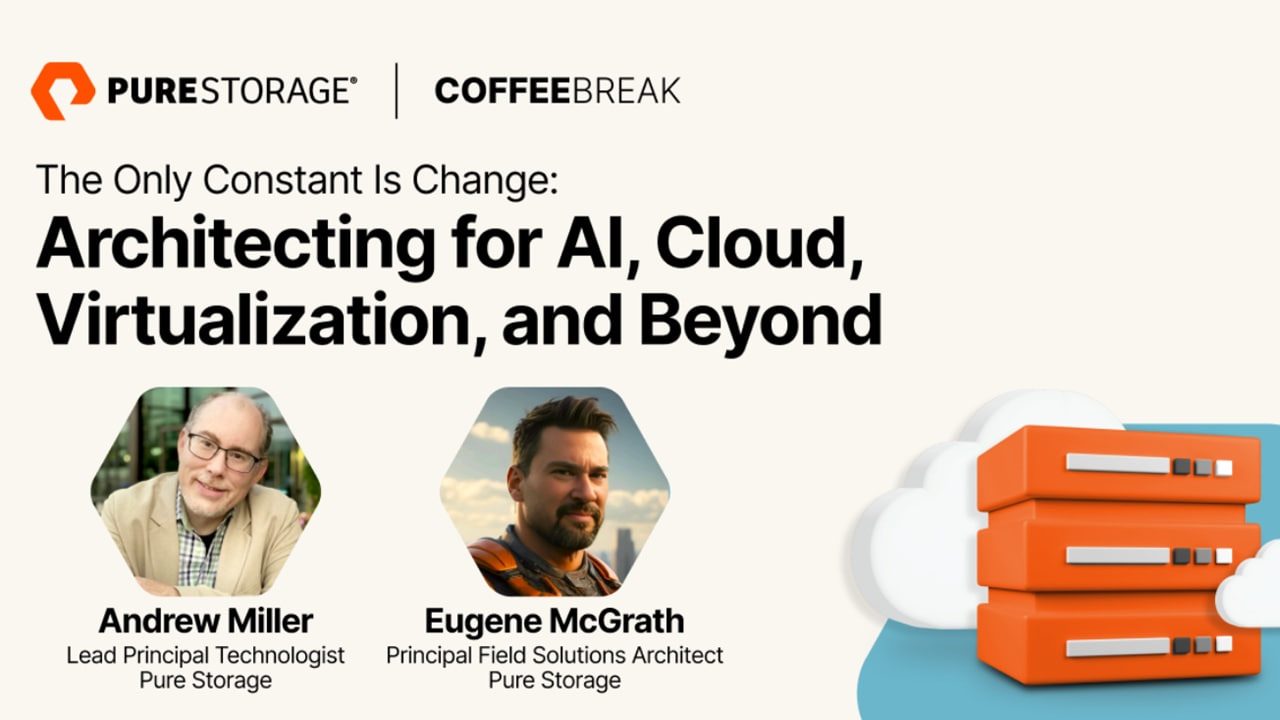
For February 2026, host Andrew Miller explores the idea of data center foundations and how Everpure works with Cisco around FlashStack® to enable both current and future business initiatives. He’ll be joined by Eugene McGrath, Principal Field Solutions Architect for FlashStack—and previously a partner and customer.
This webinar first aired on February 10, 2026
The first 5 minute(s) of our recorded Webinars are open; however, if you are enjoying them, we’ll ask for a little information to finish watching.
Click to View Transcript
Hello and welcome to this month's Coffee Break. My name is Andrew Miller, Lead Principal Technologist at Pure Storage. I'm joined today Thank you, Eugene. Thank you so much for joining. By Eugene McGrath, Principal Solutions Architect.
I think the full title is Principal Solutions Architect, but that, that got too long to put right there, so you'll see it here and then a little bit later. Welcome to the sixth year, 70th episode, something like that. It's been a little while of Coffee Break. This is a series, and if you're thinking about what are we here today to talk about, we're
gonna be talking about some interesting foundational pieces, that relate to data center infrastructure that are, have been super relevant five, 10, 15 go through some of that history, but are still even more relevant today. Therefore, the title, you know, "The Only Constant Is Change: Architecting for AI/ML, Cloud Virtualization, and More," 'cause who knows what's coming next.
Although, I think AI's gonna be with us for a little while, hopefully at least. You know, we, but I don't think we've, we've worn out that trend yet. There's real stuff with it. As always, I'm your host for Coffee Break. It is a series, and we're here every month. If you're curious about some of the previous episodes, have found that historically they
have actually aged better than you might think given to the solution focus there. You can find all of them here, and actually, later on it's a Google Slide thing that organize by topic. You can also find all of them at purestorage.com/events, and you can find both the upcoming ones as well as the previous ones there as well. Next month, excited to have Ken Hoy and
Russell Pope joining. The topic will be Mastering the File and Object Multiverse. Ken and Russell are actually on Eugene's extended team, where they basically spend all day every day talking with customers. So we're gonna look at both kind of the lay of the land currently around file and object,
some of Pure's philosophy around the space, then, we're gonna do one fun one, kind of the wish I'd known list. You know, where sometimes like, man, if I'd known that sooner in this project, it would've been better, and then some level of what's new from Pure Storage around this. Always like to highlight and profile the Pure customer community, 'cause y- good chance if
you're joining us today, either you're a Pure customer or you're, you're a future customer, you know, not yet, or you're a partner of course. We have a mix of folks that always join us every month. You can sign up there for their customer for- community forum, as well as you can actually see what customers say about us on Gartner Peer, Peer Insights, a great resource.
Last but not least, there's a drawing. Hopefully you'll stay around to the end 'cause you enjoy the content, or maybe just 'cause you're hoping to win the drawing, which is a, a Getty mug, and a coffee lover set, and a charger. You can see it there. Stay around to the end and we'll announce the
winner of the drawing. As always, I'm your host, Andrew Miller. I don't reintroduce myself every time 'cause, hey, I'm, I'm here every month for better or worse. But as far as it relates to this topic, I actually started out kind of around the data center and infrastructure stacks with VMware,
and I went from compact servers to IBM servers, and there was Cisco networking in there, and then I was at a partner where we built, you know, what we called actually at the time a Vero Block. That company's now gone. We got acquired, kind of thing. But, did all the layers of the stack, and I actually found, like, some really I've really
loved this piece of the data center landscape for a long time because the capability that brings, and if you get it wrong, you pay for it for a long time. But I'm really excited to have Eugene join us today. I'll, I'll pull the music down, Eugene, as you introduce yourself, but- Sure please, if you don't mind. Always a pleasure, Andrew.
My name is Eugene McGrath. I'm a fu- a Principal Field Solutions Architect for FlashStack at Pure. Try to say that 10 times fast, right? I've been with Pure- Maybe just 1touch fast. Yeah, I know. Fairly, yeah.
One time's enough. One time's enough. So I, I've been at Pure just about 10 years, so one of the, one of the earlier, employees here at Pure, and, and my entire focus is helping customers design next generation da- data centers, how to address for, you know, market shortages and, and, and different strategies around that.
My background before Pure, completely post-sales. I just helped customers architect and build, converged infrastructure, your Vblocks, for hedge funds and, and all sorts of infrastructure around the country. So really, really exciting. I really love, what I get to do here, I get to solve problems all day and help
customers build really cool things. So, you know, really, really excited. And these are my two boys here. This is Sebastian and Benjamin rocking Pure gear, and, you know, the, the lo- the loves of my life and, you know, and they're, and, and they're, it's really, really been a great journey with them.
And, and a lot of these things, all these things have happened while I've been at Pure, so, so many things have happened and changes that have, taken place in my life during my tenure at Pure, so it's been really exciting. Seven years for me now. 10 years for you? Eight years?
Remind me. 10 years. Yeah, 10 years. Cool. Thought I had it right. Roughly. My 10th year. Cool. Sweet. Yeah. So we always do a little bit So diving in here, as always, as you know, we, we try and plan this out. This is being respectful of you as an audience to have some time going,
but, you know, it is planned. So what we're gonna walk through today is an agenda. This sense of, the comment up there, "Plans are worthless, but planning is cause man, if we look back at the last 10, 15, 20 years of the data center landscape, maybe even longer than that, yeah, there's been change.
So we're gonna do a little bit of data center stack history, reference arch to CI to HCI and more. And you're like, "Ooh, that sounds interesting." Maybe not, but I promise you we'll make it interesting 'cause it's actually neat stuff here. Next, thinking about FlashStack.
So this is Pure's partnership with Cisco in this space. You know, kinda network, and storage, but more, where hopefully one plus one three, not two. So some of the core benefits of FlashStack historically, that's why I actually got involved with it when I started with Pure, cause I was like, "Ooh, this fits a lot of things I used to do in the past that I, I wish
I would've had this." Third, then looking at And, and, and also, by the way, we'll often we'll have sections here that as you know from Coffee Break that are kind of agnostic, so the first part, this is just gonna be agnostic to Pure. Here we'll dive into the Pure Storage value in the space. Then back to being agnostic, a little bit more industry focused.
So looking at, actually, it was actually p- ping Eugene, asking Eugene, like, you know, what are you seeing that's new and to talk about on an industry standpoint? So what do you know, cloud, AI, virtualization, some commentaries there data centers. And then again, kind of bringing it into what Pure and FlashStack offer in this space specifically.
And hopefully, please feel free I see Tim reaching out. You're joining us from Denver. Thanks for joining us, and a bunch of other folks as well. Please feel free to put Q&A in the chat throughout. We do have a specific Q&A, so if you have a question you want answered specifically,
please use the Q&A function. But also, you know, put things in the chat. We'll just keep it live.But before we dive in, I always like to do a little bit of polling. Nicole, if you don't mind launching the first poll, and we will let that go there. So what area of the data center stack do you focus on?
And it might be that you don't focus on any of them, and you're just here for the drawing. And, you know, hey, that, that, that, that's fine too. But, you know, we'll let that sit up there. I, I tr- I thought about so many there, you know, network, cloud, compute, storage, et cetera. Was like, you know.
Oh, well. And then something else put in the chat. But continuing on, 'cause we'll leave that up as we go. So thinking about this first section, a little bit of data center stack history, reference architecture to CI, HCI, and more.
So as, as you and I were getting ready for this, Eugene, it actually reminded me that, And I actually added this after we were talking yesterday, that, you and I worked on this a good bit to the point where there was actually a light board that I did on this way back in the day. This is a six-year-younger Andrew Miller. You might be able to tell by the amount of hair or the- the quizzical baffled expression,
you know, kind of thing. But it was like, eh, we could try and do a live whiteboard, but I think instead let's walk through some of the concepts. So when we often think about this space, we think about how it applies from a kind of a day zero, day one, day two perspective. But d- do you mind kind of walking us through, Eugene, how, how you think
one, day two? Kind of what they are in case folks and then even at a how it applies to this kind of data center stack space. So over to you for a little bit. Yeah, absolutely. So day zero is probably, is one of the most important parts of this, and this is where we are before we build the next generation of, of
our platform. Whatever product that w- that you're releasing, it's all about how do I build the infrastructure that is going to address the needs of the, of the business, and also, able to adjust as, as the business dictates. You think about if I built infrastructure 10 years ago, 20 years ago, and didn't plan for the possible eventuality of new applications coming in and, and leveraging the cloud and,
and, you know, some virtualization shifts potentially, how that affects the rest of your solution. So it's all about understanding how to build an architecture that meets your requirements, but also gives you flexibility. Like, if I need to change direction, how do I do that? And then day one is talking about: How do I deliver this?
How does this get set up? Because if it's really complicated, if it takes weeks and weeks and weeks to build, it's going to really hurt the bottom line. It's going to hurt productivity. It'll not be efficient in that manner. And then day two, which is probably the most important part, it's, it's a toss-up between
zero and two- is what does that look like going forward? Is it, is Am I gonna end up being in this, this area where I have tons of of, of power and, and cooling consumption, and then just random things that I, that are really hard to manage? So it's about maintaining, keeping the lights on. It's about how do I upgrade?
What do upgrade cycles look like? What does it look like in the next generation I, that I have to do? And how long will this, will this solution be in our data center? So those are really the three distinct areas that I think of when a company overall architectures. And, and this, I mean, it really resonated to
me as we And we often frame it this way because sometimes you can start with, okay, well, what are the components in there? But hopefully you're joining us, like, this helps give you a little bit of a And by the way, if this is not new to us, I don't want to claim this is new to me or Eugene, but if this is a new framework for you, sometimes it's the right way to think about it.
It is a little d- different than maybe a CI/CD or cloud model, et cetera. But even with cloud, you're thinking about, I'm designing for things. It needs to be intentional about what I'm planning to do, and then how long does it take me to stand it up? Maybe I can do it more quickly, but I still got to stand it up." And then if the
day-to-day care and feeding takes so that I don't have time to think about what else is needed, it, it's all gonna fall down. And if you're already a Pure customer, you're thinking, "Oh, I can feel Evergreen in this," or other stuff, yeah, you're right. But we're, we're, we're not necessarily gonna go there yet, you know, kind of thing.
So if we, if we think about then kind of data center stacks and, you know, you've got compute and networking and virtualization and storage, and all the stuff that underpins or underlies the applications that are what we're often starting with, or at least our executives are starting with, right? They're thinking not about the stuff that supports it.
They're thinking about what provides value to the business. When we looked historically, there were some level of disparate requirements that were actually kind of hard. So I'll, I'll just throw it back to you, Eugene, if you don't mind, as we think about kind of the infrastructure stacks and the goals that we often had there.
So if you don't mind, back to you. Yeah. So a lot of the, a lot of the rise of, we talk about conversion infrastructure and HCI came from certain limitations we had when we built every single piece separately. When I built this server for this application and it was managed one way
application was managed a different way, and it really came down to three things. Number one, am I able to meet the business's demand when it comes to SLA uptime, when it comes to performance, right? The second was, what about when I need to add a new application? That's one of the things that caused the rise of reference architectures
is all these applications. We have more applications than we ever have before, right? And how do I be How do I deploy these applications in a really timely manner? You think of virtualization was a huge, fix to a lot of those challenges, right? And then the third piece is if, as my infrastructure ages, what happens when I need
to refresh? What happens when the next generation comes around? Do I have to rip and replace and spend a month, you know, all my weekends for a month away from my kids, you know, rebuilding everything that I already built before? So those forklift upgrades.
That's, those are the three, you know, pain points that every admin faces for sure. And, and with that, historically, there were almost kind of three major eyes as we build this out. It'll be a little bit backwards. So historically, back in the day I'm even gonna go here. I'll, I'll, I'll ramble for a little with that.
Sorry, Eugene. So we started off and with, you know, reference architectures, which were Well, actually, no, we really even started with just let's build storage, compute, and virtualization, and kind of figure it all out. That's where I started my career. And then we went to when this takes a lot of time, you have all these different factors to figure out.
So what if we said manuf- as manuf- vendors, for me, it was, you know, on the customer side, and if I have a reference architecture where someone's figured out all those pieces ahead of time, the building blocks to put together, that saves me a lot of timeThen we went to converged infrastruct ure often, which was a little more rigid faster time to value, and maybe you'd get it all delivered out of a box.
And then there, there's even the wave of HCI, which said we're gonna combine storage virtualization compute. We're gonna put those together in a single box. We're gonna have the benefit of as I add more of one resource, as I get more of another resource, you know, storage and compute classically. But sometimes the drawback of that, that linear scaling, and that led to that, you know,
you have these different approaches. You know, if you're really focused on simplicity and cost, you might be hyperconverged. You really want flexibility and scalability, it's reference architecture approaches. You want performance and resilience, if those are your primary things, it's
converged infrastructure. And we're trying, by the way, here to be very intentionally positive because there were pros, there were reasons that each one of these were created, but you might be able to infer that the positives had, had corresponding downsides for each one of these approaches. That's why they were all out there instead of individual.
So I'll, I'll toss it back to you, Gene, if, just you m- mind bringing us, if you don't mind bringing us home in this section for some kind of compare, contrast about what you saw with the different architectural approaches historically. Oh, absolutely, yeah. So reference architectures really came out of a need for simplicity.
We s- w- we look back at the app explosion, you know. It used to be you just had a BEZ server, an exchange server, and a web server, right? That, and a database that ran the entire company. And then we started seeing all these additional different applications, so thus came the need for reference architectures.
How do we make this, how do we make this repeatable? How do we follow these best practices and, and, and do this all on our own? And what we realized is that a lot of times with all these different apps out there, a lot of times it was just to, to find someone who's already who's already built this, and can also help, manage this for me because
it got so complicated. So we went into the world of converged infrastructure, because that reference architecture world was very much build it yourself. And so we went into this converged infrastructure world where it was someone could build this for us based on, based on our certain requirements and based on
best practices, and then they can also to some extent manage that, you know, through single call support, through their organization, and so forth. The, the thing that, that, the thing that came out of converged infrastructure is it did add some additional complexities. It, it, it did take a load off in a lot of areas, but you now had in, in certain cases,
you had a whole separate environment for your management stack, then you had your stack, and, and it was additional gear. It was kind of like this, built on top but inside of each other, nested kind of world. But that provided this peace of mind of, okay, not only is it following the reference architecture, but it's, it's, it's built in such a fashion that, that it's r- that I know
it's built the same way every single time. So that gave a lot of people that performance and also that- Repeatability mind. Yeah, that repeatability. And then when, when a lot of customers started to see, well, there's a, there is some complexity between having a management stack but plus a workload stack and,
multiple, multiple arrays, one to run management, one to, to run your workload, then they said, "We want a little bit, something a little bit easier." So sometimes we think of if, if it hadn't been so complicated to, to manage a lot of the converged infrastructure stack because of all the different components you needed to do sync async and things like that, maybe that would've lived on and
stayed, in, in prevalence. But because of some of the complexities and, of, of having to know a lot of different technologies when it comes to converged infrastructure, that, that kind of led to the, the world of HCI, which was let's make it simple. Let's make it really easy. The storage is built in.
We know what the cost is. It's, it's like you said, it's, it's a linear scale. Now, if my workloads are, are different sizes, maybe I have a, a s- a misbalance of I have more memory than I need or CPU than I need, so there's always some complications there. But it was really born out of this I want something simple that I can manage, and I
don't have to pay someone else necessarily to manage that. And so it, it, there's, there's definitely there are trade-offs, but there's definitely places in the market where these all fit, especially for the customers of different, different sizes. And it's about finding the best piece of these and, and really combining them to give you the best result is really what we're, what we're
looking for. The, the one kind of thought experiment I, I know I used to like to do is that when you look at some of these, and especially hyperconverged, I'd argue, hyperconverged fundamentally 10 years ago, 15 years ago as it launched, you know? Mm-hmm. And this is L- Let's just be real. This was launched by Nutanix, but man, there
were a ton of hyperconverged startups at the time. Yeah. Like, is that it, it was the same virtualization layer in general. Mm-hmm. It was often VMware. And the networking didn't dramatically change. Yeah. But the thing that it really helped with was simplifying the storage approach. 100%.
And that's where sometimes I play the thought experiment of, you know, what if Pure had existed 10 years sooner in time, which it couldn't have due to, you know, that revolution in flash that happened. But what if Pure, dramatically simpler Evergreen storage that existed 10 years ago, maybe the hyperconverged wave might not have happened or not- Yeah in quite the same way.
And that's not diminishing, 'cause you're gonna hear, you already know this, we partner with Nutanix, you know, kind of thing. But so just a little bit of a, a fun thought experiment. Can I throw in one note here that- Please. Yeah here 100 I, I, it makes me think of when I was deploying these converged
infrastructures, one specific infrastructure, which I'm sure you, one it was, but just one stack that was just running 100 VMs had three storage arrays, one for the management, o- and then two they need a resiliency between racks, and like, it just became really, really unwieldy to, to, to manage. And so it was, the intent was to make it really, really, resilient, performant, and
also, foolproof, but w- when it come to, it came to day-to-day management, you needed someone else to do that. You needed to hire that company to really manage it and do upgrades and things like that because of all the co- complexity there. So it's all those tiers, those silos that made it so difficult, you know? And that was without all the other applications we have, like, containers and,
and, and so forth that we have now. Totally didn't tell you to say that, but it's about simplicity- Yeah for running applications. That, that's really what we're trying to do here. You know, it's like we wander around to this layer of the stack.
So I think, okay. So thank you. We'll finish up section, finishing up section one, and let me actually go. I will end the poll here, and I will share it back. Thanks to everyone who responded. And, we have apparently nobody here has a networking background or wants to admit it,
you know, either way, 'cause it's always DNS's fault, I don't know, or network the storage fault. Either way, okay. But a pretty even split between cloud, compute, and storage. And something else, I'll put it in the chat, but whoever you are, I don't see it in the chat, feel free to toss it in the chat, you know, kind of thing.
All, all, all good, you know? And, and these are What we do is, as you, in case you're joining us for the first time, always like to run polls so you can get a sense of, you know, who you're joined by, and then we always like to share the results back. It's a little bit of a, a free, you know, if you're kind enough to answer, aren't required, it also gives back to you a little bit.Uh, so with that, Nicole, if you
don't mind launching poll number two, and, we'll let that sit up there again as we dive into part number two. So if you have been in the past, and one second there, I think we are launching. There we go. Good. So of those, you know, we, we I name-dropped some, but we weren't really trying to either advertise or put down anybody,
just being real. So it What, which of these have you used in the past? You know, FlexPod is associated with companies, so is VersaPod, et cetera. You know, it's being real. But diving to section number two, so let's think about the core benefits of FlashStack historically.
So, you know, like it says, core architecture and historic benefit. But, you know, to be the f- more, more fun way to say it, hopefully is a little bit of a FlashStack distilled, the core value. And, and full disclosure, w- when we, you, when Gene- Eugene and I were actually getting ready for this, we used to do a lot of work together in this area five to seven
and as we were getting ready for this, we thought, you know, some of the core value and even some of the slides we used from five years ago are still valid. So we'll do, like, a flashback throwback version, and then we'll do a FlashStack current version. So the core of it is, And actually, I'll, just let you narr- narrate through here if that's all right, Eugene.
So we start with historically, FlashStack started with And I'll click along as you go, so over to you. Yeah. So it started with reimagining, the entire stack. Like, what we looked at was: what are some of the gaps and what are the challenges? We talked about how converged infrastructure was, really, really difficult to manage 'cause
you had all these storage arrays. So we said, "Let's take a look at w- what if we put the best of breed? How do we make this simple? How do we make it like a reference architecture, but then also add things like integration and automation that customers need?" So it, it started with looking at
simplifying the compute layer, and so we partnered with Cisco because Cisco has this stateless nature where I can take the, the, the, personality of a server, IP address, worldwide name, you know, MAC address, things like that, and I can move it around. So that gives customers a lot of flexibility around rack resiliency, around DR, and, as, as, as well as being able to do things like upgrades and break/fix a little easier.
So really finding that best of breed simplicity on the compute side, and it doesn't get much simpler than UCS. And then taking that with the simplest storage platform on the planet, Pure. And again, like we were saying before, imagine not having tiers, not having to have a separate array to manage, you know, the, your, your, your management stack versus your
workload stack and things like that. It makes everything a lot easier to manage. And then the idea that we can get PB in 3U now is mind-blowing. Insane. Yes. Insane. Yeah. So scaling now becomes really, really easy and really resilient.
And then from the networking standpoint, it's hard to argue that Cisco is the gold standard in this area, and there's a lot of great networking companies out there, but when we talk about, really, intelligent, network stacks, Cisco really has the, has the, has the market there. And, and so really you're talking about the best of breed of all the components.
And, and longevity is, is key. I mean, we were It was eight different generations on the UCS layer, and we're, we're above that now on the, on the P- FlashArray, right, platform as well. So talking about a lot of longevity, not ripping and replacing your data center so often.
So really giving customers the flexibility I'm sorry. Andrew? Keep going. You're good. Oh, okay. Really giving customers the flexibility of being able to follow a reference architecture, but knowing that all these components work together in a, in a easier fashion.
You didn't have to be on specific operating systems, specific firmware. We gave you some of the flexibility because all the components underneath were so resilient, and, and, and so easy to manage that you didn't have to worry about a lot of those things, that one little minor, minor change is going to cause everything to stop working.
Just being real, when, when I came to Pure, I was on the, again, name-dropping a little bit, the VCE Partner Technical Council for years, which was in the CI space, to be real. That doesn't exist anymore, right? Div- mergers and acquisitions and everything in the industry. And so I looked at what FlashStack did, and was like, "Ooh, this hits a lot of the
benefits that I wanted without the restrictions." And then candidly, if we look at it from a, you know, we're, we're, we're not afraid to add that day zero, day one, day two slide, where this is now erring a bit on the side of like, oh, it's a lot words on the, on the slide. And this is actually, you know, this is a, a little bit of a vintage one, like from 2020.
That's what it says, 'cause if you know this, you might see some pieces here that have changed or morphed or improved in the last six years? It's 2026. Yeah. It's 2026. What are you so there's, there's pieces there, like you mentioned, on day zero, that core alignment around statelessness.
So just like you could upgrade Pure Arrays non-disruptively over time, it's actually kind of what this shows even back then, that you could go through multiple generations of your entire infrastructure stack without having to re-architect it, so you could keep the same core principles. This is always a fun one to me. If anyone here is on, is joining us with an accounting background, I like to sometimes say,
You know, if you wanna make an accountant's head explode," all due respect to my accountant friends, you say that this is actually reverse depreciation. Like, it gets better over time, either at an Evergreen level or an architec Back then especially, NVMe was a big deal. It still is, but, you know, we're six more years more mature there.
Day one, and actually I'll, I'll toss it back to you. Cisco Validated Designs, that's, that's worth parking on. It's a much higher number than it was back in 2020. But, Eugene, you mind kind of playing out why a Cisco Validated Design is more than just a couple hundred page paper?
Cause it's more than that, right? Yeah. It's, it's definitely, it's definitely more than some, you know, light bedside reading. We're actually at 65 now, so just in six years we've r- released another 40 of these validated designs, and these are application-specific, you
know, hypervisor-specific. We have bare metal, so if you're looking at maybe getting away from your hypervisor vendor, right, or you're looking at something different, or maybe you wanna look at cloud, you want hybrid cloud and containers. We've released all these validated designs, and these validated designs have a, a, a few
really key functions. The first one is if you don't know how you're going to use a solution, let's Everybody's heard of it. No one knows how they're gonna use it or a lot of people don't. Well, you can actually liter- literally read the first section of our, of our AI, CVEs, and it tells you how industries are using it, how
people use it, the different things you can accomplish with it. It then shows how it was built how to build it, the, the entire blueprint then also shows all the testing results. We rigorously test, all these, these validated designs and, and provide performance statistics on that. So it literally tells you how to do everything
and how you'll use the solution. So it's actually a lot more than just, you know, "Here's a blueprint, go and build it." It's, it, it With the deployment literally, command by command, and we also have automated ways to do this as well. So just putting that into infrastructure as code and building it, you know, in an
automated way, so really, really cool stuff. We'll hit more on that later. Thank you. Mm-hmm. Being able to deploy quickly via APIs, we've got different tooling over the years. This disaggregated flexibility is one that still resonates, the idea that if, do I wanna
expand compute, networking, storage? Do I wanna do them together? Do I wanna do it separately? And of course day two, around, dramatically improving the support experience. I'm, I'm, we're still gonna stay kind of back in the day, although this one is more like
still three or four years ago, it's not six years ago. But this may sound like, oh, it's a lot of words on a slide. That sounds kind of cool. Eugene and Andrew seem friendly. But there are some actual real numbers behind it. Mm-hmm. Walk us through, please. Yep, so this was a-
Give a customer example yeah, this one was a major bank. And this is not isolated to this customer. I'll give you a second example as well. This was an, this was a major bank that, was looking to reduce the, the footprint in their data center, because let's face it, power, cooling, everything's
getting more expensive. The world we live in today is more expensive than the world we lived in five years ago, in many ways. And so this customer said, "How do I the footprint of my data center, use less cooling, use less power?" So they chose, they chose FlashStack versus their other, the, the other competitor. They reduced the number of racks by 86%, the
RU, by 86% in the data center. That was over a million dollars just in power and cooling savings. It's just, I mean, just, just think of what that means for- This is like CFO level impact kind of stuff. Yeah. Yep. Yeah. Yeah, exactly, and, and it's money that can be used for something else, to modernize or other
projects, cloud projects, network, what have you, right? And so it was really, really, transformative for them, in their, in, in their world, and they were, they did this because they were getting unparalleled data reduction, six to one, and 100% uptime. No, not a single downtime event over the course of three years, and they're, they're
still a big customer today. And we still, they, they're still, looking at ways to consolidate even further to make room for things like AI. And- And that's not because they didn't do any software upgrades on their storage arrays or their server compute layer. Those are processes that don't involve downtime when you do upgrade
those, so keep it up. 100%. Yeah, absolutely. And the second example of, of where, where FlashStack is really a difference is we have a, a customer medical field, pharmaceuticals, and they have many, many sites around the world, global. And what they were challenged with was the fact that, all these other solutions required
entire racks and two or three racks in these, in these different locations around the world, and it was just really difficult to manage. So being able to use, FlashStack, which, which was, which was able, which gave them the ability to run their entire environment in 14U or less. Think of that, that's like a third of a rack.
And doing so, and they can manage it all from one interface with Cisco Intersight, which is the, which is the management stack. They could see all their sites across the globe and monitor them and make it easier if someone has to go on vacation and, and so forth. So really modernizing how they manage all of the remote sites and, and really reducing the
amount of co- power and cooling, especially the monetary value of Evergreen and reducing the cost, total cost of ownership over time. These are the ways that FlashStack are impacting our customers. Thank you. I think that brings us to the end of section two, so I will share the poll back here, share the results.
So cool, we actually have some people that were on FlexPod. Listen, we were recording, but oh, you know, FlexPod was historically NetApp. Nobody on VersaPod, that was not as comm- a couple people on SmartStack. Cool, good for you. Hopefully not, hopefully this isn't like a PSTG moment for anybody, by the way.
Vblock, that was, that was the, the defining platform for CI in general, so not too surprised. One DHCI, that's probably an HPE thing. And hey, look at that, a lot of people on FlashStack. What a surprise. This is a, this is a Pure webinar although we do try and make it a little bit more general than that and
help educate and learn. So with that, let's go ahead and launch poll number three, Nicole, if you don't mind, and we'll let that sit there as we go. So since 2020, I was curious, and the way, none of these are required have to answer them, by the way, but you know, we put it out there and then we share the results back to you. So since 2020, what part or parts of your
stack have you majorly upgraded or changed? You can see the list there. And then kind of the same question, but for today. You know, what parts of your stack are you currently evaluating? Cause maybe a couple years ago you thought, "Oh, I'm not gonna even upgrade this part of
the stack at all. It's all moving to the cloud." It feels like we are more now in frankly a full on hybrid world, where there's some combination of data center, colo, cloud, schmear across all of them. So maybe something you thought three years ago, "I'm never gonna upgrade it.
It'll just roll, it, it'll just ride off into the sunset," but now you're like, "Oh, maybe I do need to upgrade that piece now," kind of thing. So pulling back a little bit from a, an agnostic standpoint, so we never try and be too, too salesy on this, but you know, the last part was like, let's talk about FlashStack from a value to use standpoint.
But pull it, flipping it back around again, like section number one, two major trends and the impact that we've seen there. I think, I'm pretty sure if I remember right that th- th- this was actually your idea, Eugene, that, if we think about AI and cloud and virtualization, we may be sitting there thinking a little bit like, "Ah, this is, it's fine.
No, the, the fire hasn't gotten to my coffee cup yet. It's just keeping my coffee warm," you know, kind of thing. And by the way, if, if you do, if you do go, do go find this online, the next couple panels of this actually get rather disturbing, 'cause it actually like shows the dog melting. So whatever I've used, I always stick with these ones 'cause they're not as, they're not
as- yeah, freaky. A little bit, to be real. So, so maybe let's, let's think about AI/ML and cloud and man, virtualization, 'cause that's changed in the last four years in ways we didn't expect. So maybe start off, Eugene, if you don't mind, with a little bit of what you've been seeing, from an AI landscape.
And I'll, I'll just leave this up here as you kinda, you kinda talk to that. We pulled this from Wells Fargo. I know it's a little bit low res, but it illustrates I think some of what you're gonna say, so. Yeah. What have you been seeing from a data center stack standpoint as it relates to AI?Yeah, I really think, I really think when
we, we, we talk about this is fine and the, and the whole, fire, cartoon you saw before, that's, that is the culmination of where we are today. Because the explosion of AI has, has really, changed the landscape of the entire data center. Now we're talking about massive amounts of power, massive amounts of cooling, shortages on chips.
If we think about where we were right after COVID when we had all these shortages, and we said, "Oh, this would, though this is a, a one-time event. This will never happen again." And now- And now I'm looking at, you know, memory chips that have gone, that are 8X what they were, just like a year ago, right? And it's because- Yeah, just local NVMe drives have gone up- Yeah three to 5X, or if you can
buy them at all potentially. Yeah. Yep. Absolutely, yeah. And, and so what's happened now is that all this efficiency that we've preached for many, many years, it's now coming to be, a reality for a lot of customers where this is now a need, it's no longer a want. It's something we should have thought of because now in order to run that AI farm at
our, in our data center, we now need, significantly more power and cooling. So it's all about finding ways to efficiently run all those other applications so that a, a majority of your power and cooling can go towards your AI projects in order to stay competitive with every other company that has AI out there. So it's really changing completely the, the entire landscape of computing because
everyone's looking at, to find more ways of being efficient, and there's places around the world where they're saying, "No more data centers," right? No more, no more power." And, and so e- we have to get clever and, and we have to find better ways to be more efficient with what we have. It's all about consolidation really.
I'm thinking of one, one customer that we worked with, and now this is not, was not really a Pure Storage customer, but they, at the point where they could not add any capacity to their data centers. So the only way they could scale 'cause they were out of power was they had to take out something- Yeah whatever it was, and they put in needed to use net less power,
50%, 80% less power, and that would create the headroom to add something else in. And that was the only way that they could, they could expand at all within that footprint, cause they had physical space, but they were out of power. And I was like- Yeah, 100%. Yeah, 100%. The other one, and I'm just looking at some,
some notes here from a, from a friend, this is from a friend so it's anonymized. They were looking at, a server quote, and the NVRAM price increased about 4.5 times, so from like mid five figures to well above six figures. And the local NVMe drive they're building, this is They were looking at a hyper-converged scenario.
Mm-hmm. You know? Cool, 'cause we have, we have friends everywhere. Yeah. the NVMe drives that they locally more than doubled kind of thing. I think even, Eugene, we've seen some stuff from A- and these are companies, like we partner with Cisco, right? So this isn't, is, isn't pushing, but even one
of Cisco's competitors I believe has started to do a right to change the price at build time. Do you mind kind of walking people through that? Sure. To It's only good to be aware of. Yeah. And it's, it's definitely public knowledge, and I work with not just Cisco, I work with Dell, I work with HPE.
Our customers have all sorts of compute. And that's, that's right. So, Cisco right now is 30 days. You have, 30 days on a quote, a, from a, from a The quote is good. Other vendor, another vendor is saying, we'll, we'll give you a certain amount of timeframe, less than a month, but we have the right to, to change the price
when, when the, the solution's actually built." And then one other server vendor is actually saying 14 days, and a lot of companies can't even get a quote approved in 14 days. So it's a really, really tough situation for, for, for companies, and that's because of all the shortages we're seeing right now. There's just a unprecedented shortages with the rise of AI and chips and, being, you
know, being, unavailable for a lot of people. The other piece there, so there's AI that's just driving just insane things multiple places. And I'm actually looking back at some notes here. So we hit on the power, we hit on the capacity. As it goes to even the, if we think about virtualization and cloud, maybe we'll take
those together a little bit. Sure. So for anybody who joined us back in November, I had Cody Hosterman on, and we were walking through the, welcome to the virtualization jungle a little bit because I, I think not Okay, if anyone here listening called the, the changes in the virtualization landscape four years ago, you shouldn't be on this webinar.
You should have bought stock differently four years ago and be retired. Okay, cool. But given that none of us really did or we didn't wanna believe what was gonna happen, 'cause there's some track record for what Broadcom has done in, with other acquisitions, there's been some major virtualization landscape.
How, how have you seen the virtualization landscape and even some of cl- public cloud principles coming back into on-prem affecting the data center? Oh, yeah, 100%. Yeah, without a doubt, it's This is the second piece of that, of that, that, that dumpster fire that we saw in the, in that, in that image, is the fact that no one really knows
what their virtualization strategy is. And the scariest thing for a lot of the, the prospects and customers that I talk to, and just friends in general, is, is, is where that day zero really matters around, "I wasn't planning to switch hypervisors because it's just too expensive," right? And now they're in a really, a bad spot, especially with memory being four and a half
times and, and things, a- and everything just being significantly more expensive now. It's really, really a different world. Everyone's talking about, maybe we need to look at containers now. May- maybe we need to look at cloud-native. And then we have a lot of customers in the cloud that the cloud prices are, are going up
and, and they're looking at how do we reduce this but with a, with a hybrid strategy. Run some stuff on-prem where I don't pay by the month, and then run some the cloud and burst into the cloud. And so we're seeing a lot of customers at m- using the cloud for bursting to cost, a- because of the, the cost of everything else, and infrastructure's getting
more and more expensive, to run, and that's affecting everything, including cloud. And so it's really about the, about costs at this point and also managing risk. And part of the risk is the, is the, is the virtualization layer, is what will our pricing look like five years from now, 10 years from now? And that's really put a lot of, a lot of customers- Really into, you know, a concerning
area, for sure. I, I think the last piece, I'll, I'll, I'll play this one out here a little bit. Of cour- of course, ple- please comment. Is the idea of, as it relates to cloud, not even just cloud, public cloud, private cloud, hybrid, et cetera, okay?
But even the idea of kind of the cloud operating model, that once you're in the cloud, you start to think about-Doing things differently. And this could be everything from is it all API driven, and we s- or even start to think about ideas like declarative versus You know, I define policy-driven and the infrastructure matches and
conforms to what I want. Even do I have different things from a resiliency standpoint. I'm thinking about availability zones versus maybe classic DR, DR disaster recovery, business continuity ideas. Sorry, I wanna say DRBC, but folks may or may not know the acronym.
So some of the principles that are cloud principles weren't necessarily inherent to cloud, or maybe as we look at either repatriation or a steady state of some stuff being co-lo, some stuff being in the cloud, and things moving back and forth, apply common principles around the cloud operating model. Mm-hmm. And this is actually It, it's fascinating to
me 'cause historically we were sometimes a little bit cynical about like, oh, cloud, just someone else's data center. But there can truly be a different way of operating from a cloud operating model standpoint that you could apply in the cloud, and when you didn't, frankly, those are the companies that often had problem with the cl- problems putting their
applications in the cloud. Or- Yeah that you apply on-prem as you start to think about pulling things back on-prem or stuff that you're still running there and you wanna run it in the same way. So I know I kinda covered a good bit of that, but Eugene, please feel free to add in before we go to the, go to the last poll here.
Yeah, I mean, you're absolutely right. I mean, a lot of customers want to look at how do I consume this, consume this that runs like the cloud. I want the ability to use APIs on-prem and use the same ones in the cloud. I wanna have that, that compatibility.
I wanna be able to architect one, comprehensive e- environment that I can, pro- programmably access any part, whether it's in the cloud or on-prem, and leverage whichever, whichever, resource, whether it's on-prem or in the cloud, in a, in a fashion that makes sense for the business from a performance standpoint, from a costing standpoint, you know, from a bursting standpoint.
And so a lot of customers are looking for that as a service model, but to be able to quantify to the business how much this is costing and being able to not have to worry about these really, really expensive upgrades, especially when memory's 4x, four and a half times what it, what it used to be. And that's absolutely true.
Customers are really looking for simplicity when it comes to automation and costing of their solutions, and that's, that's the resonating response I get from prospects and customers everywhere, is we just need consistency. We can't have these really crazy budgets, you know, going over all over the, all over the place. Makes it really hard to plan.
Almost impossible. It's a good point. Okay. Let's go back to, Oh, I'm sharing back out the third poll. I was multitasking while you were talking, so, you know, hope you don't mind. So folks can see, actually, so what parts of your stack have you majorly upgraded? Actually, you know, more than half the folks here have actually, majorly upgraded or
changed vendors on their storage stack, a couple on compute hypervisor, et cetera. But then when we look at it, for looking forward, you know, more, more of you are actually looking at both hypervisor and cloud, although based on the, the responses, it feels like kind of everything's in play right now, which almost makes sense a little bit, 'cause we thought we were at some steady state.
And thanks to AI, thanks to the virtualization landscape shifting and even cloud stuff continuing, I can see, like, everything be up for grabs in the next couple years as far as how you're thinking about what you what solutions and products and vendors you run kind of thing. Okay. Nicole, if you don't mind launching poll number four, and we'll leave that sitting up
as we, as we bring it home here. We've probably got about 10 more minutes left, folks, so hopefully thanks for just being real. I'm always watching a little bit of who has joined us, and at least so far we are still steady with, e- e- everybody is still, is still with us. If it starts to get too boring, I'm like, "Man, are people dropping off?" But, you
been about the same the whole way through. So this one we made pretty simple. You know, just thinking about AI, not picking on that, but, you know, how much is that dominating your new project budget? That was intentionally asked because back to when you and I were customers, Eugene, it was
like I had my new project budget, which was, I don't know, 20, 30%, whatever my budget, and the majority of my budget was all the stuff that we Keeping the lights on Yeah you know, like I'm, I'm denigrating. It's not. You have to keep all the stuff that matters to the business running.
You can't spend all your money on, like, the new cool stuff, so. But curious to see, what that is. Okay. Last section. So even more relevant, and we, we actually adjusted this a little bit. At first it was, we're gonna do like, newly relevant.
It's like, no, no, no, FlashStack. Like, you know, if we go back to the previous, I'll jump to the slides around here. Like, this, this is powerful stuff, and this is still powerful stuff, you know? So that, that historical classic, I'm trying to say something that's not negative, you know, value is still there.
But if we think about today, so the piece there that you walk through, and I'll, I'll summarize some of this, Eugene, and then toss it back to you for a AI/ML cloud and virt, if that's all right. So, what is FlashStack? It is still the core of Cisco, Pure working together around validated designs know, we have new modern, modern cool-looking slides here.
You know, how neat is that, right kind of thing. Mm-hmm. As well as then, you know, I think you mentioned this before. I think you said 65 CVEs, so maybe I'm one CVE out of date here. Either way, people can scan the QR code there if they want to. You'll get the slides later.
And the, the piece that I wanted to call out earlier on CVEs, it's all added in here, is a, a validated design that is application centric is incredibly valuable. So sometimes I like to pick on, on VDI, for instance, virtual desktops maybe. And I wanna say the CVE, keep me honest there, Eugene, is I think Yeah. That's what I figured, yeah. And it's not a 50
virtual desktops that we build out times 100 and assume that it scales that way. It's like the testing that you see later in the paper actually is at that scale, and that's really cool, 'cause that gives you a level of certainty that's very different than, oh, they did a small subset, and then they did basic math, and it may or may not work out that way if there are break points in the solution that I'm gonna run across.
So, so there's And, and even frankly, I've, I've at times I've sometimes pulled these up on meetings with customers, like yourselves listening in, and I'll just even pull up the table of contents, and we'll wander around the CVE a little bit. You know, the, this Pure section setup, which is relatively short, the Cisco UCS section, the networking section, and then the long section showing all the application testing.
And even if you're never, even if you're not the person to build this stuff hands-on, maybe you're engaging with a Pure partner to do it, you're doing it internally, there's a level of value there that's even beyond just like, I'm the person who sets this stuff up," you know, kind of thing.So FlashStack continues to be growth and investment for Cisco and Pure, but let's think about it from a, from an AI standpoint.
So, what's an AI pod? Why do you care? What are some CBDs for FlashStack? I'll, I'll click the slides along as you go, Eugene, but, you know, please, if you don't mind, give us some kind of perspective on FlashStack relevance in the AI space. Yeah, I think there's, there's a ton of relevance here because one of the things that
we provide to the stack is, is, is that costing aspect of it. Cause we think about if I put local drives, local SSDs into the entire I- into every single server Blade you have out there, one, it's gonna be a ton of networking, right? Your networking guys are gonna hate you because you're gonna have all these rack-mount servers everywhere around the environment.
And then you also have disparate storage all over the environment, and the, with the cost of NAND today, that gets really, really expensive. So where we help customers here is, number one, we help them, become more efficient and consolidate, where they can do things like boot from SAN right o- right off the, the, the FlashArray, still give them the performance they need but, but costing them significantly
less, especially when we talk about having to replace internal drives and like that. So giving them a lot of, of simplicity there. Then being able to run all your workloads on the FlashArray within the, the FlashStack means I don't need to have five, six different arrays just to, to ma- to run this one platform.
So our customers are managing less, they're spending less on power and cooling, they're spending less on, on, data center footprint and space, and they're also getting all the benefits. One of the things I like about the Pure//Accelerate compute here, the X Series, is you can put full height GPUs into this blade chassis. It's the only one that I'm aware of you can do that.
So imagine just building your infrastructure for regular, VSI, regular virtual servers and, and you have an AI project come up, and I can just pop in GPUs and, and now I can, and start a, a new AI project. That's the flexibility and that's the simplicity that you get with FlashStack, in order to build this out when the time comes.
So it's about trying to predict the future as much as we can to help our customers and, and deploy it in a very easy fashion. I feel like there might be a couple of specific examples there. Oh, yeah, absolutely, 100%. Yeah. Yeah. I mean, there was, there, there was a
customer that I'm, that I'm thinking of is, that has a lot of edge sites, and one of the things that became important to them was, "What if we can start running, running AI/ML at the edge?" It started off as a cost, a- as a cost, a cost exercise to reduce they, they did that and initially that for, for to reduce cost, and Wow, what if we could use these to run edge AI, workloads with, with OpenShift and so
forth?" And, and leveraging the same gear that they already purchased and just adding GPUs to that, right? And then not having to get another storage array, still being able to use the existing storage array they had, just add the GPUs and continue running. So the, the thing that was really impactful to them was that it- we already thought about the, the eventuality that they might need this, and
Cisco thought about it in their stack, and Pure thought about it when we, when we put this whole thing together, that they were able to do this without having to rip and replace and build a whole new, whole new infrastructure. Now they can run these edge sites all over the, all over the world to run, you know, AI on their different, products.
So really, really impactful when we talk, when we talk about, cost of ownership. And then the fact that you didn't One thing you didn't notice in that stack, in AI pod, was there's no amp. There's no additional gear that you don't really want or need. There it is. Big bump. Think of what that would've cost
today, just the amp with, you know, eight servers and, all the memory that goes in it and a, and a separate, array to manage that. That wouldn't work in today's world, especially with memory being, you know, four to 6X, right? So it's all about simplicity and flexibility for customers.
Faster time to value, that's a historic 1touch Yeah but we always keep orbiting around that at an industry level and looking for it in different areas. As it relates specifically to AI, there are a couple so if you're not an AI the call today, you might find some value in looking at the specific FlashStack. There's one around GenAI, one around specifically AI/ML, another one around RAG.
And you can find those either at flashstack.com, you'll get that in a follow-up email, or again, you can scan this QR code, do it later. Flashstack.com's easier. But this goes through the classic CVE approach of saying, like, what we're it at a business value and architectural level, and then diving in.
Okay, I'm accelerating now 'cause, you know, we're not out of time. We're getting close to the end. So AI stuff and how does FlashStack help there. Next. So if anyone joined us back in November, you may remember this slide that actually Cody and I actually walked through a build of this slide and, you know, kind of we talked about each one of these four
for a while, so it was a very simple structure. It was a simple structure with so much complexity in each area 'cause like of what's going on, not that Pure's complex, but it's a complex landscape. So as you and I were thinking a little bit, Eugene, we're like, "You know, hey, let's think about where all does FlashStack fit," and it's like it actually kind of fits
underneath each one of these, except for the cloud-only ones, but even it has some integration there. So i- if you don't mind, kind of take us through this a little bit and even how FlashStack can fit for a hybrid cloud and I'll, I'll just move the slides along as you're talking. Yeah, 100%. And so the, the thing that One of the, the
core tenants of, of FlashStack is we always look at what the, what the future workload is and what customers are asking for, and so it was, it was very obvious that customers wanted options when it comes to hypervisor. So we started building these CBDs around things like Nutanix. With this big partnership, we have Nutanix and Bare Metal and OpenShift and, and these
different areas. So being able to, to, to give customers the, the choice to be able to switch hypervisor provider if they want, hypervisor vendor, without having to buy all new gear, and that's what we gave them here. And then also the, the entire, container platform with OpenShift and hybrid cloud, and then also giving customers an all you, all you, all-in consumption model.
So you want that cloud, on-prem, imagine being able to consume it like, like the cloud, consumption model, and then ma- that the same costing model as well as the same integrations and so forth you have in the cloud. That's a, that's what we have with FlashStack as a service, and then being able to move data back and forth with, with Portworx so that you can leverage cloud resources
and on-premises resources. These are all the things that we have in FlashStack to really address the needs. So to some extent, we can help customers w- that have some cloud aspirations, right, with, with FlashStack as well. True.There was a fun one, and I'll go into wrap-up mode and then toss back to you for a minute if that's all right.
So th- th- th- this is literally a picture you can see from the heads if, well, p- well, pigs fly or hell freezes over, whichever one you want, you know, Pure. Cause actually I would have a lot of times where Pure and Nutanix actually had a lot of similar design philosophy around simplicity, but, but candidly, we, we competed. Not a ton, but somewhat, and I've, I have a bunch of friends at Nutanix as
But we actually in the last couple in the last year started working together in some really neat ways, you know, kind of thing, where it, where it makes sense to help both extend hyper-converged approach, and they've done some really great work with the Acropolis Hypervisor, AHV, whichever terms you like there. As well, and, and you referred to this a little bit, the idea of if you're looking for
the best on-prem foundation for a hybrid cloud architecture, saying all those words very carefully, would argue you want something that has security around it, gives full stack orchestration, is very flexible, and that's where sometimes we'll talk about how FlashStack is, is potentially, we believe, that best architectural foundation for a hybrid cloud strategy.
And we're talking about as a service and how you can do things from a team standpoint, although know every now and then it may be separate teams that control things, so we get the dynamics there, so you can have it separated from a management standpoint or unified if you want it to be kind of thing. And that even brings us into the, I think this is probably the most, the most heavy slide,
but it's because of that, that's actually good. You know, this is one that you could actually treat like a whiteboard of has so many pieces from a Cisco standpoint, from a partnership and standpoint, from the applications this can support, where they can live, and, and of course, there's the various components that make it up.
So I can't believe you, Eugene, somehow we are at the end of yet another coffee break. Thank you so much. Any, any thoughts to bring us home before I, I do the drawing and, and we do the fourth, f- the fourth, the fourth poll result? Yeah, that my only thought is, you know, I always encourage customers and prospects when you're architecting your next generation environment, think about the future, think
about the flexibility that that solution's gonna provide you, and is it the most efficient that it can be in that, in that realm? And, you know, hopefully I can have a conversation with you at some point if you're building a, a data center. Thank you for all the, to all the customers and prospects out there.
I think you're, you're findable via LinkedIn, and you're just a, you're just a call away. Or if you don't know how to get a hold of Eugene, you know, reach out to your Pure, Pure AI/ML. So he is part of a team, that That's it says field solution architects here, and that's, this is now kind of Pure and another company terminology.
You know, you are, you're a field resource. You are meant to talk to customers. Like, you are good at talking about things. You know, it's part of your job, like real things, technical things. Mm-hmm. But, you know, it's what you do. It's part of what I do, for better or worse.
Okay. So thinking, wrapping up here, and then we'll see if we have any Q&A, or if not, you know, we'll toss back to Eugene in a minute. So if you can, please make sure to join us next month, March 2026, with Ken Hoy and Russell Pope focusing on file and object and just a very practical session around tips from the field. If you were staying around for the drawing,
hey, you know, good on you. I recognize that might be you. So, the drawing winner, I'm looking is Cynthia L. I'm trying to be good with not saying full last names just in case you're more private online.
Cynthia L., you will be hearing, from Nicole or someone else on the Pure Storage marketing team around the, around the Pure Storage coffee lovers kit. You know, Yeti mug, the one that I was Actually, I don't think I even finished drinking my coffee, but I'll finish it afterwards here. We got going too much, so I was like, "I gotta, we got stuff to talk about
And of course, again, then please make sure to, join us, join us next month. That's why I've always put this in. For the last poll, let me go ahead and share that back. I will end the poll here and share the results. So it's actually interesting.
I was curious. So, folks here, nobody had more than a, No, no one is in the AI has taken all my project budget, which I was wondering if there might be a couple, you know, kind of thing 'cause it's not like AI. It's like all the stuff that goes into it. You could be buying GPUs or compute or network or cloud locations or cloud services, but it's
a decent split between under 30%, but a good chunk of you were for it's, it's a good noticeable amount of your new project budget. Do something with AI, says your CIO, and you say, "I, I," and you figure out something- Yeah something new possibly, you know, kind of thing, 'cause this is, this is life sometimes. With that, we've got We always try and be not go the full hour.
If anything, sometimes I target 45 minutes, but I was watching the chat and Q&A. Eugene, I, I didn't prep for this, but if you get a, if you get ques- as you get questions about FlashStack, I'm curious, maybe a dealer's choice here a little bit of, what is the most common question or two that you usually get from customers, at least Mm-hmm. And then, you know, you can, you can answer
your own question, too. Is that a softball? Eh, maybe. Maybe. Yeah. But it's, it's based on ones that you've gotten in the last month to, month through five, you know, kind of thing. So if you don't mind. So I'd say the first question I've been getting a lot is how is it, how do, how do all
the components get supported? And the answer is single call support, is absolutely available to you direct to Cisco, and, and Cisco takes first call support on everything, and they have direct lines into Pure. You could also call whoever you think's at fault. So if you wanna call Pure 'cause you love, the
sound of our voice, you can always do that as well. So I'd say that's the number one question that I get, and then the second question is about mixed workloads. I have customers who wanna run bare metal plus virtualization plus containers, and the answer is absolutely. FlashStack is not specifically built for only one application, one stack.
You can mix and match. You have mixed workloads, and I'd say a high percentage, probably 80-plus percent of our workloads are mixed. So absolutely, we have customers who run bare metal for some workloads, virtualization for others, and, within the same stack. So those are the two I'd say I get, the most, most commonly these days.
And then also what my favorite hypervisor is, which will I will not say on this call. I will pull that thread in a second. Ju- just be aware, I do see, Poonam, raise your hand. We don't usually do live audio questions, but if you either wanna put it in the Q&A and chat, we've still got another minute, so please feel free to type it, type it there.
The, the v- the hypervisor thingMan, just such a, a soft spot in my heart Yeah. But at the same time it's like, man, the world is changing. And we actually had I'm, I'm gonna go back here. We had, I should probably be good as a Pure employee and do a mild advertisement for Pure
Accelerate, which is coming up, you know, in, like, three months now or so. It's our yearly conference. And we had a kind of a, an ad hoc birds of a feather session where people were talking about, customers, you all, were talking about, like, what are we doing from a hypervisor landscape session, and had someone who talked about how, how they'd done a lot with Proxmox with FlashArray.
And wanna be upfront, Proxmox is a different beast as, as Not beast. It's, it's a good thing. Okay. As it relates to support and how it works, it's a different thing. But then we also had people talking about, I actually had a customer two years ago at Accelerate where he was saying, "You know, I run 100 Hyper-V hosts," so you know, this is
in the thousands of VMs, hun- you know, th- thousands of VMs range, and he was feeling very smug about having made a decision there a couple years ago to switch over to Hyper-V, you know, kind of thing, 'cause they're "Ha-ha." He didn't really read the He admitted that later. But, you know, he's, he was feeling very good about where he was at that point in time.
So th- there is so much more diversity than I think any of us expected. But having a foundation that can be flexible- Yeah even as we make changes to this layer, ooh, that's really valuable. We, we can't change everything all the time. We, we just can't handle it, you know, at a human level- Mm-hmm even kind of thing.
Yeah. I have a customer right now testing three different hypervisors on the same FlashStack. That's actually, that's a wonderful story. Yeah. Yeah. And it actually works. He can do it. Mm-hmm. 100%. Cool.
With that, I think I will, I'll pull the music up for just a minute here. Eugene, again, thank you so much for joining today. It's been a great, you know, seven years of working with you in different ways. Can't believe I finally got you on Coffee Break. It took way too long. Thank you on behalf of the
entire Coffee Break team. Can't do this without folks like Nicole and Laura and Tatiana and Lauren and Carol. There's a lot of folks that stand behind this series, even as I'm the face of it, and I do a good bit of work, too, in preparing the content and pulling in the speakers and otherwise. But we will look forward to hopefully having
you next month to cover Mastering the File and Object Multiverse: Tips From the Field. I'm, as always, your host, Andrew Miller. Hope you have a great day, week, month. We will see you again next month. And again, Eugene, thank you so much.
Always, always a pleasure to partner with you. Yeah. Love having Thanks for having me.

Andrew Miller
Lead Principal Technologist, Everpure

Eugene McGrath
Field Solutions Architect, Everpure
Foundations matter: Their flexibility enables or constrains what you can do years down the road with your applications and business initiatives.
For February 2026, host Andrew Miller explores the idea of data center foundations and how Everpure works with Cisco around FlashStack® to enable both current and future business initiatives. He’ll be joined by Eugene McGrath, Principal Field Solutions Architect for FlashStack—and previously a partner and customer—who will do a deep dive on this topic.
We’ll wander through:
- Data center architecture history - from Reference Architecture to Converged Infrastructure, to Hyperconverged Infrastructure, the benefits we hoped for from each architectural phase, and how well we achieved them at an industry level.
- FlashStack - the core design principles behind the Cisco and Everpure partnership and the benefits, including statelessness, innovation without disruption, benefits during Day 0/1/2, and Cisco Validated Designs.
- What matters today - new announcements and capabilities with Nutanix, hypervisor optionality, AI designs, AI Pods, and more!
In short, FlashStack reduces risk with prevalidated solutions for AI and analytics, cyber resilience, business-critical applications, and modern virtualization.
Overview of Coffee Break by Everpure. Who knew that the best coffee break conversations would happen online? Each month, the Everpures Coffee Break series invites experts in technology and business to chat about the themes driving today’s IT agenda—much more podcast than webinar. This is no training session, either; it’s a freewheeling conversation that’s as fun as it is informative and the perfect way to break up your day. While we’ll wander into Everpure technology, our goal is to educate and entertain rather than sell.
We Also Recommend...
Personalize for Me
My Updates
No updates at this time.