1:35:48 Webinar
The Vision for the New Data Dynamic
Experience the complete Wednesday opening keynote on data innovation, modern platform roadmaps, and scaling enterprise AI infrastructure.
This webinar first aired on June 17, 2026
Click to View Transcript
Good morning. And welcome to Pure//Accelerate 2026 in Las Vegas. I am so excited to welcome you today. If this is your first Accelerate experience, well, thank you for investing your time with us.
And to our returning customers and partners, analysts, and members of the press, welcome back. And a special welcome to everyone viewing online. That's right, we are live streaming Pure//Accelerate for the first time. Now, you may notice something a little different this year.
We are Everpure, and there Yes, I'll clap for that. And there's a great reason for that. You know, over the past year, I did a lot of travel, speaking with customers and partners around the globe, and what we heard is that we are much more than a storage company. We are your partner in helping you manage your data.
And we are all living through this incredible market shift. You know, data is growing unbelievably fast, and it's more vital to your success than ever before. You're under pressure to lead with AI, but scaling it to drive outcomes is extremely challenging.
You're managing transformation and virtualization, and the cyber threats just keep on coming. So it's really hard to do what you need to for the business, and the goalposts keep moving on you in the middle of the game. So that's why here at Everpure, we innovate to make storage and data management effortless,
so you can focus on business outcomes. We are never satisfied. We are always working to make your data more secure, easier to manage, and more intelligent. And that's why I'm excited to announce this week's theme, the new data dynamic. You know, Accelerate is our favorite time of year because it's connecting this amazing
community of advocates and leaders and change agents, and it's allowing us all to share insights, learn, and sharpen our skills together. We're not just deploying a new vision, we're building it together. I'm so excited everyone is in here. And so what do we have in store for you this week?
Well, can you believe it? We have over 80 breakout sessions, six community meetups. Over 300 of you are taking certs exams. Let's give a cl- shout out for that. And we want you all to head over to the hub to check out the demos and the flash talks.
And we have amazing Everpure leaders and special guest speakers right here on the main stage. Let me give a call-out to our sponsors. They are key to the Everpure ecosystem and to your business. Thank you to all of our sponsors for your support.
And please, yes, let's clap for that as well. I encourage everyone to visit them in the hub while you're here. So now I am thrilled to kick Accelerate off and get us going. Please join me in a warm round of applause to welcome our chairman and chief executive officer, Charlie Giancarlo.
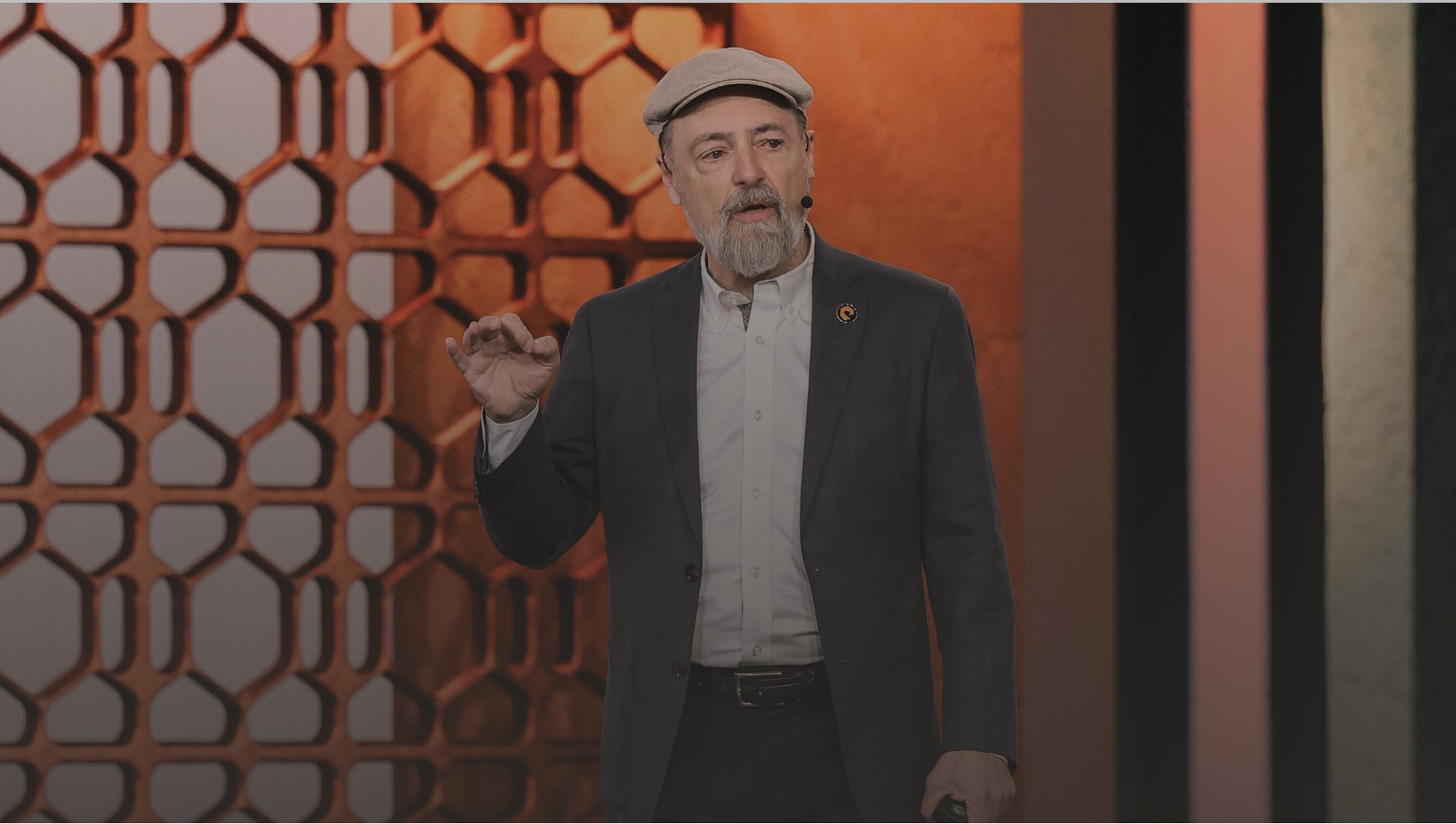
So great to see you all. Welcome, ladies and gentlemen. Welcome, Pure fans. Really appreciate you coming in, spending your time with us, putting in all of, all the effort it takes to get out here. I hope you're staying cool, while you're out here.
I really look forward to the, today's conversation. I actually think this is gonna be something that perhaps you didn't expect. It's gonna be very different. We're going off into some very new areas, ergo the name, to Everpure, and I'm looking forward to telling you all about it.
But let's just start with a little bit of a review of this past year and where Pure is today. I think you've bet on the right horse now that we're in a betting area. We are growing just incredibly. We, had our first billion-dollar Q1, which was a major milestone for us.
thank you. Almost 15,000 customers, ARR now, which represents our subscription services, thank you very much for, for being part of that, at two billion dollar run rate. we have doubled the number of Fusion customers. Raise your hand if you've started using Fusion in your arrays.
Thank you. That's about, that's about correct. So we doubled that quarter over quarter, okay? From six hundred to twelve hundred. Our goal is to get half of our customers or more on Fusion this year. We'll talk a little bit more about that later.
in addition to that, I wanna talk about something though, you know, a bit more serious, and we'll just spend a, a minute on this. But I know how difficult it's been for all of you. we started seeing our costs rise back in December, and we made a, a very, important decision at Pure.
We decided that we couldn't raise prices on you unless we shared in part of the pain. To give you a sense, these little, lines here represent, the, cost increase that we had in NAND. NAND in the last, about six months, six or seven months, has risen between six and eight hundred percent. Think about that, six to eight times just in
the last six to eight months. Consequently, we've had to raise prices. Our overall costs, f- to produce one of our products has increased over three hundred percent. and we raised later, and we've kept and held onto our contractual commitments with you, and
that, that is really our promise. We've had to raise prices, but we are operating today at the low end of our gross margin range that we've ever-- the lowest end of our gross margin range, range that we've ever operated. And we'll continue doing that for as long as prices con-- or costs continue to rise.
We want to be able to share the pain with you. So thank you for sticking with us. I apologize for the industry as a whole. We'll eventually get through this. Unfortunately, it's probably going to take a little bit of time.
So, you know, we've worked both with our partners, and with our customers who are ordering with us to make sure that this is as painless as it can possibly be. So I just wanted to put that out in the open because we know how much trouble and how much pain this is causing you. All right. Let's go, though, to what
the industry is doing. So there's a dead heat now for who's, at the, leadership of Flash, with Pure in, in a, in a dead heat. But actually, as of, Q1, we now ship more, Flash than really anyone else, and it's interesting where this is going.
This has allowed us since our founding to now have about fourteen percent of, of the overall total storage enterprise storage share. Total sh- including hard disk and everything. So, you know, very, very significant. And as you can see, we're gaining at the expense of, everyone else.
And you might say, "Well, why is this? How, how can you do it, and why do we think that this is something that can continue?" Well, as of last year, we now invest more in data storage, research, and development than every one of our competitors, no matter how big. Every single one of them invests less in storage research and development.
For a very simple reason. We came into this market with a differentiator, and that differentiator was we thought data storage was high technology, and every other vendor thought it was a commodity. And we've constructed the company around that simple concept. We really focus on R&D.
So we out-invest. This year, we will ship more Flash or as much Flash as all of our competitors combined. Think about that. That's what leadership is really about. And we are really the only ones growing. This year, we grew thirty-five perc-- or this quarter, we grew thirty-five percent year over
year, and we believe that's accelerating. So very exciting. And you've rewarded us with an eighty-four net promoter score. Again, customer fo- first is our first principle, and we want to make sure that you, or that we provide you a great product, but more importantly, that we're a great partner to you as we go forward.
And not just you, but Gartner has also, honored us with their top score, you know, for, data storage arrays. And now, with a new m-measurement, this is brand new, we are also in their top quadrant for what they basically called an integrated service offering, which is our storage-as-a-service, offering.
So very powerful. Okay. So now I want to switch gears on you. And actually, m- this is the surprise. I'm not going to talk to you about data storage. I want to talk to you about your data.
So your data is held inside the applications that you operate, whether those are traditional apps or they are analytics apps, and now increasingly they are AI agents. But the way that we as an industry have always structured, that is the IT industry, the way we've structured our data is that the data is created by, used by, and managed
by the application itself, right? It is secondary to the application. It is trapped in the silo. And as these, as these applications have grown, those silos have grown. So let's understand how we got here.
It started with a, a very pure concept. That concept was there would be one application to control all of the enterprise's environment. It started with ERP, maybe twenty-five, even thirty years ago. And ERP held the promise that all the data would be held in the ERP system.
The ERP system would provide your finances, they would provide your insights into sales, it would control your manufacturing processes and all your, inputs so that you could price products. And this is how, it would do invoicing, quoting, payments. So the idea was there'd be one application to control them all.
But then over the last thirty years, this started to fragment. Mainly because vendors came along that, that had the concept of managing the workflow for specific functions, for the sales function, for the HR function, for the finance function. And it was very useful for efficiency, right? And not only that, it was very useful for selling because now you could do departmental
sales rather than IT sales by the vendor. And it, and it really made workflow easy for, for workers. And so it proliferated. But as it did so, each of these apps needed connections to other apps so it would have the right data to be able to work on.
Today, though, it's fragmented further because in order to get almost anything really useful done- Like understanding what a customer is, or putting together a quote or an invoice, understanding how your product structure affects all these different, groups, like the sales group, or the finance group, or the manufacturing group. It requires connection to all of these environments.
And a lot of your teams spend their time reconciling the fact that the data is different in each of these, environments, right? The definition of customer in ERP is different from the de- definition of customer in your, in your CRM or in, your Workday Or sorry, the, the, s- the ServiceNow environment.
So it's fragmented the data and furthermore, it's fragmented the context. So what have we done since then? What we've done is we built analytics that would give us a much more holistic understanding of all this data in all these different systems, and it would go out to the ERP or the CRM system.
And then, of course, in order for it to be able to transform the data, we built data warehouses. And then as we wanted to bring in unstructured data, we built data lakes and built context around the data lakes and added agents, et cetera. And so this allowed us to get reports that made sense of all the different data in the
different environments. Okay, so that was the next step in the journey. And now what are we talking about? We're talking about agents. Now, when the agent is contained inside one of these, workflows or SaaS environments, let's take a CRM for instance, it could provide you some insight into the data in the CRM.
But what it couldn't do, if it was buried inside CRM, is put together data that is also in some of the other apps to make even greater sense of it. So to really allow AI agents to be useful, they have to exist above the individual applications themselves. And then again, w- we're looking at, okay, we need connections to all the applications.
So this was the next era, if you will, or this is the era that we're living in. So you have all these different eras, and I might ask you, what aligns them? What is the common theme in all of these different architectures and structures? Well, one theme is that every one of your vendors wants all of your data. All your AI, new AI vendors, they want all your data.
All your analytics vendors, they want y- all your data. Every one of your SaaS vendors, they want all of your data. How many vendors are you gonna give all your data to? It's just not, not a viable solution, is it? Every new application has fragmented your data so that the definition, again, of customer,
let's say, is different in each one of you. The definition of product is different in every one of them, and this creates problems when you want to use AI or agents because you don't have a single source of truth. So w- we do think there is an answer to this, and the answer is different than the way we construct networks today or the way we construct IT to- today,
which is application centric. What we do today is application centric, but if you fragment your a- your applications, you get a fragmented understanding of your own environment. So we think that the answer to this is that instead of the apps themselves connecting to all of your data, that we need to construct a context map.
We need to understand the data itself. We need to understand the context of each of the data s- systems, each of the data environments. And then what we need to do is we need to create shared context of how these different data sets, w- w- how they, cooperate with one another, what the, what the
connections are between the same definitions in the, different data sets, right? Think of this as a universal data intelligence, universal as in across your enterprise, where you understand the con- not only the context of individual data sets, but how those data sets relate to other data sets as well. And when you create this universal, data intelligence, this context graph, you do a
number of different things. One is it reduces the number of data integrations that you need to do. That's a lot of work by a lot of your teams. We believe it reduces the number of data copies that you will need to make. So reduces your costs, reduces your, attack surface for cyber, right?
And we believe it create I- it's going to reduce or increase rather, your data coherence. It'll allow you to get better insights from your data. But we think on a slightly longer term basis, this is a fundamental rearchitecture of the way we think about creating IT environments, you know, our own IT environments.
And this is something that we are actually doing within Pure in our IT environment. And what that is, is creating what we call data primacy. So what is data primacy? We start with this again, assuming, a shared context across all of our different environments. But now we extract the data from these
different environments. And we don't just extract it now, we have to change it. We have to ch-- create an environment where we have sources of truth or systems of record. And what is a source of truth? What is a system of record? It depends. Each enterprise will have their own, but it's,
i- it is based on the, the fundamentals of your company's business. So for us, it's customer. That is what is a customer, every aspect of the customer. You know, not just who's the buyer, but who are the influencers, wh- where, where, who, pays the bills, right?
Their finance organization. Who do you ship to? Where are the a-- Where are the location of the assets? It includes product or product main. It includes an asset main.
So the fundamentals of your business as a source of truth, a system of record that is highly governed because y- entropy happens. You want to make sure it is always a source of truth. And now when you do this and you have the context between these different sources of record, then you are in charge.
And what happens is, as, as opposed to the workflows, your SaaS, environments, as opposed to them controlling the data and owning the data and having complete, control of the context, now you're in charge of the data. You own the data. You own the context between the data, and the workflows just either read from or write to that data under governance.
That gives you incredible optionality. So, and that-- When I talk about apps, it doesn't really matter in this case. Whether it's an app, whether it's analytics, whether it's agents, they work the same way off of your data and off of your context. So let's look at the two different ones.
You have application-centric, and you have data primacy as two different architectures that you pursue in your IT environment. What's the difference? Well, the way we're going now is just not sustainable. We cannot continue to have continued data fragmentation, because data fragmentation, you
know, confuses AI agents. Instead, what you want is a coherent, view, a coherent repository of the sources of truth inside your organization. Secondly, in the case of, of app-centric, you have duplicate definitions of the same thing.
And again, you'll have garbage in, garbage out if customer means something different in these different, environments. Instead, you build a semantic knowledge graph based on sources of truth inside your organization. You make the data primary, not the application.
And so what that means is that, you don't have these brittle handoffs that every time one of the application suites changes, it changes the answer that you might get. It changes the definition. It breaks all the linkages. Instead, you have plug-and-play apps.
Gives you optionality because, again, you have a source of truth. You have, context that you've defined, you know, and on and on and on. You don't have fragmented context. You have coherent, context. You have coherent data, right?
And then you can build a policy-first framework, for how you govern that data, and you force your workflows to match your governance rather than, rather than the workflows breaking the governance. So I think you get it. You know, in the case of app-centric, any change by the vendor changes the relationships among the, the context or the meaning.
That does not happen i- in the case of data primacy. Okay, so we have-- Let's assume that we go down this path of data primacy. It's what we're doing within Pure inside our own IT organization. How does that relate to the rest of what we provide you? How does that relate to the storage?
Well, again, the systems of record is data, right? It is data sets. and the apps are-- You still have apps. You still have a lot of them. And those apps, of course, have copies. they have copies for the purpose of, of, reliability, of backup, et cetera.
You have copies, because of agents and analytics. You have a lot of data. Each-- A-all of that data requires different types of storage capability. And as of today, before Fusion, every array had to be configured, and it had to be managed.
It had different, if you have multi-vendor, you have different GUIs. You have different, characteristics, way of, of being able to manage it. Well, we solved the data problem by taking the data, creating a single, system based on purity that can manage any type of workload at any performance level, from low cost to high, to high performance.
And we've taken this concept where you have to, program each array separately, and we've created Fusion, this unified control plane where you can just define how you want a certain set of data, a data category to be managed, and it can be managed across all of the arrays automatically. And that's what we call, you know, the EverPure platform.
You-- So you put this all together now. You have a platform that can manage data and data sets at the data level. You create your own sources of truth and your own, systems of record, and then you create your own, context and shared context accre-- a-across them. And you have a system that is much more automated, much more coherent that you can
manage at scale. And this is what we at Pure are bringing, bringing you. So the first ten years of our life, we focused on simplifying your array. Over the last five years, we brought in Fusion to simplify your fleet overall. Now, we have unified the management of this environment.
And what our next challenge is, I think, not just as Pure but as an industry, is to help you to be able to unlock the power of your data. Minds blown? I'll take that as a yes. Thank you. thank you very much. So up next is our Everpure, Chief Revenue Officer, Pat Finn, for a conversation with
Pete Cavicchia, the CTO of Fiserv. But before And on how Fiserv is solving data management challenges with, with their enterprise data cloud and the Pure platform. But before we bring them on stage, let's take a closer look at Fiserv. Good morning, Accelerate.
Welcome. My name is Patrick Finn, and I'm the Chief Revenue Officer for Everpure. We are living in interesting times. The playbooks are being rewritten, and I'm thrilled, by leaders who are focusing on infrastructure, AI, and data.
And I'm thrilled to have one of those leaders here with us today. Please welcome Chief Technology Officer of Fiserv, Pete Cavicchia. Pete leads the global technology infrastructure organization for Fiserv, which powers billions of financial tra- transactions worldwide. Pete, thanks for being here.
I know we're missing the, Knicks parade in New York City, so I appreciate it. That's how passionate I am about intelligent data management. You know? But, but thanks, Pat. It's, it's great to be here in, Vegas with you and, of course, the, Everpure community. So Pete, it's a privilege to have you, and I know that you've played both a significant
role in our government, in both cyber and now in financial services. Before your twenty-two-year career in financial services, you sta- you served in the United States Secret Service, leading complex cybercrimes, investigating and earning the Medal of Valu- Valor for your courageous actions during the events of nine eleventh. Thank you for your service.
Thank you. Thanks. At Fiserv, your role as CTO spans across AI, data, and infrastructure, powering everything from digital banking to the Clover point of sales platform. Pete, as you look at the landscape for the rest of twenty twenty-six, what's the primary business and technology pri- pri- priorities
and challenges you're navigating? I mean, think about what we do, right? We serve this massive client base, millions of merchants, thousands of banks, credit unions, and of course the public sector, and it's really our priority to innovate for them. And historically, it's been about the transactions, right?
Capacity, speed. But now it's about the real-time intelligence that comes from those transactions. Monetizable behavioral patterns, the ability to predict fraud, and of course, AI-driven use cases and embedded finance. But really, data is no longer the cost-driving byproduct.
It's the revenue-driving product. And that's where things like Enterprise Data Cloud align for us. Eliminating those silos into a single intelligent data platform builds us the foundation to support AI, analytics. It's resilient and, of course, secure and, and much more efficient.
So really when you think about it, the future of payments won't just be determined by who moves money the fastest. It's turning data into monetizable intelligence faster and with accuracy. And really, with our, you know, at, at Fiserv, our priority is to build that full stack modernization, starting with data center and infrastructure, which is being built to unlock
the power of data and AI. And as Charlie mentioned, the hurdle has always been fragmentation. You know, Pete, it's really interesting because it is about thinking differently about data fragmentation and how to build the right foundation. And you said it, going from expense to revenue is critical.
What's been the core to our partnership? Between Fiserv and Everpure Well, I mean, I think Everpure was a game changer for us. we s-first started working together in twenty twenty really to begin the modernization of our storage estate. And at that time, we were in the old legacy cycle everybody knows, right?
data locked in isolated silos, and it presented a tremendous challenge for us to unlock any of these use cases. Today, we're working together to build the foundation for efficient data management across our diverse product set, and then in turn, laying the foundation for AI. We're really in a transformation moment, aren't we, Pete? Absolutely.
It's amazing. Yeah, Everpure gives us that unified, resilient, high-performance data environment. You know, we can now ingest, process, and feed massive amounts of data into AI models in real time without the extreme cost and, of course, migration delays that usually stall innovation. You know, the key is simplicity.
The uptime is unbelievable and the non-disruptive upgrades. So when you match extreme performance and no migrations, that's a big deal for us. You know, Pete, no more migrations for people in this audience is music- I know to their ears for sure. So let's talk about AI data, AI factories, inference outcomes.
So Pete, how do you and Fiserv think about all of this? Well, if you look all around us, AI is becoming embedded throughout financial services. Things like fraud scoring, risk analysis, and even client service and experience use cases. Also, developer productivity is a huge focus for our company.
And then of course, the use of agentic technology to automate various operations through technology and even in the business areas. So the real challenge is operationalizing data workflows, not building models. The conversation has shifted from algorithms to data gravity, and the winners won't necessarily have the best models.
They'll have the best foundational data sets to ensure accuracy. So wait- Accuracy is the key wait a minute, Pete. That, that's really, really important. So we're all thinking about AI models, and you just said it, it really is about the data. So talk to us a little bit about that.
Well, it's all about the accuracy of the data. I mean, this is an era where every financial interaction becomes intelligent. Think about that. Across payments, banking, lending, fraud, loyalty, and all that commerce converging into an AI-enabled ecosystem. And the companies that succeed won't simply have the best applications.
They'll have the most resilient and trusted data foundations beneath those applications. And Everpure has positioned itself around this AI-ready infrastructure. Thinking about FlashBlades, Exa, Enterprise Data Cloud, and high-performance data pipelines so you can train in, for training inference workloads. And Fiserv is actively moving towards that unified data platform on Everpure.
We can improve our data accessibility and ensure it's secure, governed, and AI-ready. And if you can unlock all of this, it creates a massive potential for business growth. You can deliver those real-time insights and build new AI anal-analytics use cases, and then unleash a whole new value stream for our clients. Our clients want access to more data to succeed.
Everpure helps us give it to them. So Pete, what you're saying is that you're expecting Everpure to deliver the innovation in flash and storage, but it really is about the unified data layer. So our move- Hundred percent to Enterprise Data Cloud is something that we've worked on together, and we've been through that journey.
So as you think through being in a global organization, clearly data centers and infrastructure is taking top of mind. How do you think about sustainabilig- susti-sustainability, energy, and simplicity as you think about incorporating all of this? Well, sustainability is super critical.
I mean, we're always trying to ensure we're taking up smaller data center footprints, fitting more into the space and then our power usage. And then simplification is a big part of that. It, it helps you to be cleaner and more efficient when you're trying to accomplish these things. I mean, complexity is one of the biggest
obstacles to innovation. If you look at any company like ours or anywhere else, these large enterprises have multiple clouds, multiple platforms, multiple data stores and operating models. Sounds messy, Pete. So as you look into the, to the horizon, how are you solving this?
Well, there's a huge focus on cloud native architectures, more with containers because they're lightweight, flexible, and portable. And to fuel that, we're leveraging the power of Portworx and Portworx backup across multiple clouds in our on-prem environments. We're also expanding our OpenShift footprint.
And when it comes to simplicity, we're super excited about the automation potential of Everpure Fusion. 'Cause at Fiserv, we're focused on helping financial institutions and merchants move money, create value, and build trust. None of that happens without a modern data foundation, and that's what we're focused on. Pete, impressive to hear how Fiserv's AI-ready data foundation and the blueprint for modern
financial services infrastructure, but as you said, you're touching lots of verticals. We're incredibly grateful to Fiserv for the partnership that we enjoy, and we're committed to keeping the foot on the gas to deliver innovation as you need it, and this partnership means so much to us. So thank you for joining us on main stage today.
I know you're gonna be around a little bit to answer questions. Ladies and gentlemen, Pete Caveccia. Thanks, Pat. I'm looking forward to it. Now, now we're going to watch the, the Knicks parade. I mean, now we'd like to show some of the videos from our Accelerate sponsors.
Thank you. Hello, EverPure. Juan Orlandini here at Cisco Live at your booth, and right behind me is your logo. And imagine what's in front of me. I'm gonna walk around, and I'm gonna show you the Insight booth.
And I t- I thought this would be a perfect way to showcase how Insight and Pure have worked together so closely for so long, delivering value to our clients across the data center, the edge, hybrid clouds, AI workloads. Y- you name it, we've done it together for a very, very long time. We're super excited to continue that, and look forward to the next decade or more together.
Please welcome Chief Administrative and Legal Officer, Nikki Armstrong. All right. Well, Charlie, Pat, Pete, thank you so much. You've definitely set the foundation around the shift from managing storage to managing data. And so we're gonna see this in action in a second, and how we continue to evolve the
enterprise data cloud and the EverPure platform. So without further ado, please welcome my friend, Chad Kenney. Good morning. Good morning. Charlie just showcased a massive evolution, an evolution between an application-centric world to a data-centric world, where data's at the
core and context is shared. Last year, we showed you how to build your own enterprise data cloud. This year, though, we're gonna showcase a ton of killer innovation and a few really awesome demos as well to allow you to be able to thrive in this new world. It's all gonna start off with the unified data plane, this virtualized cloud of data that
allows you to run every possible workload, from archive to AI across edge, core, and cloud. After, we're gonna talk about one of my favorite areas, the intelligent control plane, giving you autonomous operations based on intent and policies. And then lastly, we're gonna talk about what Charlie talked on, about the universal data
intelligence layer that gives you the ability to be able to discover, classify, and contextualize your data to get meaning of all of it. So let's start with the unified data plane and how you actually store your data. You know, we provide a bunch of different use cases across our unified data plane, but I'm gonna cover a couple key areas with some unique differentiation.
One of my favorites is mission-critical applications. You know, EverPure has always been known for simplicity at scale. You add new controllers, you get the benefits of it, and it's simple all along the way. But our competition, on the other hand, has been complex and challenging. They just add more nodes, use more rack space, get more inefficient, more
complex along the way. But with Pure, you just swap out controllers, get net new performance gains, capacity increases, and we provide some absolutely ridiculous results. Nine hundred and thirty percent more IOPS per rack unit, three hundred and ten percent more IOPS per watt, and four hundred and sixty percent more terabytes per rack unit compared
to all of our scale-out friends that are out there. But what if you just need just a tiny bit more headroom, making sure you deliver on your SLAs? Well, we're excited to announce a new capability with the XL one ninety called Purity Turbo. It gives you the ability to handle workload spikes by leveraging the secondary controller
for read-centric operations. This allows you to protect your SLAs for your various mission-critical applications. But let's see how it works in practice. So imagine for a quick second, you've got an Oracle workload rocking fifty thousand transactions per second and maybe a little retrieval augmented
generation at the same time. But at nighttime, you've got a different story. You run ETL backup or ETL processes, backups, and it starts to actually cause potential for impact to your mission-critical workloads. But what if you had the ability of being able to actually get some headroom on that
secondary controller, allowing you performance capabilities to meet the service levels with no additional complexity, just giving you that headroom, that's available? Our Evergreen One friends out there who use our storage-as-a-service offering, we're giving you performance gains as well called Overdrive. Get a performance boost when you need it, instant access to it, only pay for when you
actually use it, and it allows you to, again, be able to make sure you achieve those SLAs for your mission-critical applications. Now, in the cloud, mission-critical applications are being deployed all over the place, and we're excited to announce that, the general availability of Azure, native VM support for EverPure Cloud.
It gives you the ability to not only reduce your cost by about forty percent but run those mission-critical workloads with the software that you love within Purity and give you that Azure native experience with EverPure Cloud running natively. All right, so let's jump to the next series of workloads, analytics and AI. It's been a massive growth area for us, a- as customers are starting to rationalize their
data and really try to get value out of it. We've always believed that the next generation applications will be built on object. It's a common data layer that many of us will use in the future, and it needs to exist everywhere. It has to go across edge, core, as well as cloud, and have it be actually understood and
rationalized across each of these. And so we're doubling down on this area, adding a bunch of new key capabilities, not only managing this via our intelligent control plane, but also adding in capabilities such as tagging, life cycle policies to build better efficiencies, alerts and notifications so that you can kick off workflows, and one that everyone's been looking for, which is strong
consistency, allowing your data to actually be available in all locations and consistent all along the way. FlashBlade XO we announced last year. It was a killer product built for ultra scale, talk tens of terabytes per second. Our GPU cloud friends were just dying to get this. It had a metadata-optimized engine that was the core differentiator, and it was able to
deliver over four billion metadata operations per second. We ran some benchmarks, delivered ridiculous results. Started off at sixty-three hundred, where most of our competition, in fact, I think the best benchmark was five thousand. We were able to deliver it in, sixty-three hundred AI jobs for a spec result.
Since then, we pushed the envelope even further and got greater than seventy-two hundred, nearly fifty percent more than any benchmark that's ever been delivered for spec AI. We're also adding in new capabilities that our, you know, larger cloud environments have been asking for, things like multi-tenancy, quality of service, as well as, security enhancements
to really be able to make sure this scales effectively. All right, so one of my areas that I absolutely love, and we spend a lot of innovation in this area, is enterprise file. Now, our innovations typically are about two net new features per week per platform. It's a lot of innovation constantly coming out, and much of which went to file.
But we've added in a lot of different capabilities, multi-tenancy, security, protocol expansions, fleet level views to make sure it's intelligent with our intelligent control plane. Now, I know many of you are probably not keeping score, but I know I am. Scorecard's looking pretty good.
We've been leading the file space and leapfrogging the competition dramatically in various different areas out there. Our growth in file has been spectacular. If you're not running file today, you should. Take a look at it. We've got a bunch of innovation in this area.
But we were missing one key capability that absolutely everybody wanted, and that was synchronous replication. Well, I'm excit-excited today to announce that we've extended Active Cluster to include file, giving you not only not the old-school replication that's the old hardware-centric model, but a fleet level view that's policy-driven, all fully automated.
It's pretty magical. In fact, let's show you. Matt, come on stage. All right. Let's rock and roll. Let's see how it works. And we have been waiting to show this for a long time. So historically, bringing synchronous
replication to file workloads has honestly required a bit of a PhD in, you know, suffering. But we are determined to change that. So today, we're giving you a first look at what we are cooking up for the future of file. So let's take a look at how we provision a mission critical file workload without that
traditional Monday morning postmortem. So we don't configure exports from scratch anymore because humans are just terrible at typing. Instead, I'm gonna select this Oracle file blueprint, and doing this embeds our zero recovery point objective policy directly into the deployment.
What's awesome here is it's taking all of the configurations that you'd typically do manually and actually bundling it together so that you can repeat this every single time. Exactly. Really just bypassing the joy of manually configuring managed directory exports. So normally, we're trying to find the right place where massive workload involves several
spreadsheets, a whole lot of meetings, and then let's face it, at the end of the day, we're just probably gonna point, click, and guess anyways. Probably. So but Fusion, on the other hand, provides intelligent recommendations for us instead. So immediately, it's already suggested putting the primary target in Santa Clara, which is replicating over to Mountain View.
Now, it's already verified that we have plenty of performance headroom, which is obviously so much better than finding out that we don't at two AM on a Saturday. That's for sure. So we're gonna advance to the final review screen. We'll confirm our settings, and then we're gonna hit deploy. Now, back on the dashboard, the workload's
already live. It's secure, and it's auto-tagged for cost tracking. Well, that's pretty simple, but you can't show a synchronous replication demo without a failure. Come on. Fine. Let's step it up. All right. Our pristine demo environment is
just way too quiet. So let's induce a catastrophic failure and see if that zero RPO policy actually holds up. So here we have a side-by-side view of our arrays. We're monitoring live traffic, and Santa Clara is currently handling the entire load. We're now gonna simulate a data center vanishing.
We've all wanted to do that. And now Santa Clara is offline, and the workload quietly packed its bags and it lives in sunny Mountain View now. It's a nice spot. So, you know, there wasn't any manual intervention. We didn't panic, and it was completely uneventful, which when it comes to disaster recovery, is exactly what you want.
Very cool. Yeah. Synchronous replication, fully automated, all of it built in fleet level, so it moves across the infrastructure. It's pretty killer innovation. All right, so now we're gonna jump to governing the data. We've been building an autonomous platform for a long period of time.
And for those who have been using Fusion, you've gotten to experience some of the capabilities. Within this, we have a lot of different key capabilities, and we'll show you some of them today. It first starts off with driver assistance.
It's giving you recommendations. You say whether you want to do it. Next, we're gonna apply conditional automation, meaning you delegate. Say, "Hey, every time you see this, just go ahead and do it." After that, our goal here is to provide full autonomy.
Think more about the data, less about the infrastructure, and it just manages itself. The reason being is 'cause ad hoc management has made just an absolute mess of an infrastructure. There's zero data controls, no groupings to even understand what's mission critical, no understanding of service levels or intent.
It makes a maddening challenge to actually control the data. What we've decided to do is build in data controls that allow you to take a storage configuration, which we do really well at today, but actually attach to it service levels, your intent, and your policies to that so that it actually can go manage itself, and do so at a fleet level versus an actual array level.
But what's killer is you define it once, and if you wanna change it, you can just change it and it will auto-enforce that new intent. So let's look at a fun example, 'cause I like to look at these examples. This came from a customer. They had a ransomware attack, and they actually needed to go extend their snapshot policy to 15 day, to 30 days.
They were at 15 days. Just think about how much time that would take you to, to figure out. You'd have to go into each one of these systems and manually configure them, fix every one by hand. But instead, if you have intent-based infrastructure where policies drive the change,
you can see where things are violated, or, where violations exist, and you can go make the change to the policy, and in one swoop change all of them to the correct configuration. That's some fancy slideware magic, but maybe we should show our friends what we're cooking up here. Sounds like a good idea.
All right. So policy exactly is how we prevent human chaos from overriding our data control. So let's say we've got that new ransomware, mandate that suddenly dictates all critical workloads must have 30 days of snapshot retention. Now, instead of logging into dozens of individual arrays and performing the same
clicks until our wrists hurt, we can change the baseline once within Fusion. So let's see how the fleet handles that news. Let's do it. When we look at our overall fleet compliance, we get an immediate operational reality check. This is a live, unified view of compliant workloads, active violations, and exceptions
across the entire enterprise. That is a seriously lot of violations right there. Yeah, but they're not necessarily because of that snapshot policy change. That's good. So let's figure that out. So since that is the latest mandate top of mind for our CISO, let's filter for it.
We'll filter out dev and test, 'cause anybody here worry when those go down? And then we're gonna filter for the snapshot policy, and there it is. Fusion's already flagged a single outlier. We've catched the gap right here on the table that we're only at seven days retention. Nice. Now, fortunately, Fusion's not gonna judge us
for this. It's just going to build the remediation path. Now, the platform is completely capable of fixing this autonomously, but for a production workload that's this critical, we still want humans in the loop to provide that final approval while the system handles all of the heavy lifting for us. Now, finally, active governance requires absolute accountability, and we're gonna step
into the audit view, where there's a complete immutable paper trail. So this is pretty cool. You can actually see this autonomy journey we were talking about up here, where you have certain ones that are user-driven, certain ones that have been delegated, and others that have just been fully automated. Yeah. It, it's a perfect gauge on how the automation is actively protecting the company, and at
what level we still have humans in the loop. So if we open up our ala-, audit report here, we can look for that snapshot change. We get the full details of what actually occurred. Plus, we've got the full timeline from the exact moment that the violation was detected to the moment the details were reviewed straight through to execution.
It's more than just- Yeah a window into an audit trail. It's, it's, it's, you know, a look at the autonomous engine that's treating your policy as code, ensuring that your organization's mandates are strictly enforced even while you're sleeping. Wow. Think about how much time you would save without having to do all these manual
operations, and better yet, how mu- better you'd sleep at night knowing that these things were actually autonomously being managed. Well, what's great is we are delivering Fusion compliance reporting and remediation this year, giving you the ability to be able to not only apply these policies, but enforce them through recommendations or through full autonomy, giving you the ability to manage the
infrastructure through intent. All right, let's jump to the next big challenge we all deal with. It is sometimes the bane of everyone's existence. It is performance firefighting. You typically are super reactive where you have to, you know, you get a call from an
application owner who says, "Hey, my application's not performing well," and you have to figure out what on the infrastructure is problematic. But imagine for a quick second if you had the same kind of experience you do with our support infrastructure, where it predicts issues before it actually occurs, and you don't have to deal with the performance issue.
It fixes itself. Yeah. I mean, it's amazing seeing that we've come such a long way from just making recommendations to that fully autonomous remediation without having to touch a line of code. It's pretty awesome. And the reason why people loved our support is
'cause it protected you from potential issues before they occurred. Well, we're doing the exact same thing on the performance side of the house. We know the SLA that you've defined, the service level, and we can predict that issue, before it actually occurs and send you warnings of this so that you never get a call from that application owner.
You get the violations and a proactive recommendation. It then goes off and dynamically moves that workload to an alternate system to ensure systems stay balanced and operations stay functional. Yeah. For, I mean, anybody who's babysat a migration like this, right? That change window is completely stressful, so- It's a pain let's take that away from you.
Let's show it off. Okay. Heck yeah. So the true power of an intelligent control plane, it's not just enforcing the rules, right? We're gonna prevent those infrastructure crises before they can even happen. So let's look at how the platform uses intent-based management to deliver fully
autonomous capacity rebalancing. So here the system has detected a risk, and it's automatically rebalanced that workload to protect our capacity headroom. Interesting. I wonder if that ransomware policy change we did earlier changed anything in the fleet.
I mean, obviously actions do have consequences, right? But that change immediately put us on track to breach our strict 20% headroom policy within 18 days. So like what you saw in Chad's example, you know, we're not just gonna k- manage capacity, we're also gonna continuously scan f- for performance.
So over in the fleet view, it's already tagged a potential risk to our service level objectives on another array. Now, clicking into the recommendations here, we get a lot more detail of the distinct paths that we can take to fix this. So instead of making us guess which target array the right- has the right performance
profile, it's gonna intelligently highlight the optimal move to rescue our service level objectives. Now, in the details, the chart's gonna show us exactly how this plays out. We're gonna drop from our rising four point two millisecond latency back down to being well within our service level objectives, and that's a win for everybody, right?
The application's gonna perform better, and the array's projec- dropping the array's projected load from eighty-two percent down to fifty-six gives everything staying behind some extra breathing room. You know, one of the bigger concerns here though with dynamic mobility is always vetting this before it actually occurs. And- How are we doing that? And we've got that covered, right?
Fusion's already gonna vet that move because obviously causing an outage while you're trying to, you know, manage some, some latency here, that completely just defeats the purpose of even having an SLO. So while that data copy is running, just keep in mind, this whole process is happening while the application is live.
People are in the middle of calls, they're streaming data right now, so we really don't have any room for hiccups here, right? If, if we're at a site, we're doing our jobs right. Yeah. The platform's gonna seamlessly transition our host paths, it's gonna sweep away the original source data, and it brings us back within spec without a single person even noticing that
their data just moved. Love the automation, love the capabilities of proactive. it, it's gonna be fun for you guys to experience this as a fully autonomous, fleet. And so we'll be in a- we're- we'll be delivering this later this year, full rebalance and workload mobility, giving you the ability to avoid service level violations
and move workloads dynamically without disruption. Thank you. Awesome. Okay. So one quick example. I love talking to customers about what impact it has, and Options was able to reduce the manual efforts by about eighty percent, allowing the team to focus on much more
strategic aspects. And so that's been a big win for them to see a lot of what we're building up here. Awesome. All right. Now we're gonna move on to, governing or understanding the data, sorry. I'd like to, welcome, the former CEO of OneTouch and the new GM of data management,
Asheesh Gupta, to the stage. I'm excited to be here. Understanding your data is critical in today's world of data-driven decisions and AI. However, this is not easy. Data is fragmented across siloed infrastructures and applications.
Unstructured data is growing uncontrollably, ninety percent faster than structured data. And compliance laws are being added on a daily basis. All this put together is making all of your lives harder because it's hard to understand the data, manage it, and more importantly, govern it sp- specifically. And if that was not enough, AI is consuming data from everywhere,
regardless of policies. But what is scarier is that AI needs context. It needs context to be accurate. For all us Waze users out here, context is the information about traffic. Context is the information about the policeman hidden behind the overpass.
That's why I use it. Waze's AI uses this context to determine the best route to get you home safely. But adding context at the right time with the right context is just not easy. But the good thing here is that EverPure Data Intelligence is here to bring this understanding of your data and unlocking this data in a most contextual way.
First, we discover your data, regardless of where it sits, on premises, on the cloud, even on mainframes, structured or unstructured, on EverPure storage or other storage devices as well. Second, we classify it better than anyone else in the industry, and then the magic happens. We start to add context based on how data is used within your business processes and how
it relates to other data within your organization. Matt, I would love to show this to the audience and how it really works. Absolutely. I, I will warn you, I'm a newbie here, so help me out. Okay. So the greatest risk to your organization is not the data that you know about, it's that shadow data that's hiding out in the corners that you don't know about.
And EverPure Data Intelligence is gonna bridge everything, like you said, from cloud storage to databases and file servers. Now, automatically, it's gonna analyze your structured and unstructured data no matter where it lives. Now, take a sports medicine network, for example. A data leak here doesn't just look bad.
It could actively tank athlete trade values and fuel insider betting, and we use data intelligence to automatically isolate this high-stakes information. Now, across completely separate sources, the engine has immediately flagged all of these files containing sensitive athlete profiles. Does this data have to sit just on EverPure storage?
No, completely agnostic. That's amazing. Now, EverPure Data Intelligence is gonna help us understand where that information lives and how it moves across the organization. Now, as we go into the data graph, think about your own data, and does any of us really know where all of our sensitive information lives?
I mean, we like to think that our data is completely con- consolidated in a nice database like these patient email addresses. However, if you click into the athlete social security numbers, these things are everywhere, sprawled across cloud buckets, file shares, and exposure of this data is a headline that nobody wants. So take a look at this Word document, for
example, that data intelligence found within a file share. Within this are nine different types of data exposed, from social security numbers to diagnoses. And when you're sharing terabytes of data a day with research partners, that is an expensive breach waiting to happen.
So with EverPure data intelligence, we can trigger remediations on the fly. That's terrific. Or, or redactions. Now, to show you the real human impact of this technology, let's look at how these disconnected data points actually come together, automatically mapping the business relationship context across separate sources.
Now, Ashish, you were telling us this story the other day. It's like, dude, we have to put this in the demo. It's so cool. Yeah, you know, this is a real-life scenario. In addition to that, we did discovery and classification of all the personal information that this client had, and interestingly, we found seventy percent duplicative
PII and PHI information. That's the metric people use to decide on what the cybersecurity premium is. We saved them two million dollars in the first year of our service. That's incredible. And this story t- too was, you know, just a interesting use case of how, how everything
could come together. So to show you how this real-world scenario played out, let's take this anonymized case of an athlete that we're gonna call Shane Falco. Now, buried in a PDF on a file server, data intelligence has surfaced a hereditary heart condition and instantly linked it directly to his estranged dependent's social security number.
And that dependent is his son, Johnny, whose records were siloed in a completely separate database. And because EverPure data intelligence linked those sources, it flagged a critical gap that the son shared that same genetic risk but had never been screened for it, and a preventative test led to an early, highly treatable outcome.
So that's EverPure data intelligence, right? And that context really helped make that decision. Yeah, yeah. You know, and we're gonna shine a light on your, your shadow data, help neutralize risk, and automatically connect dots that everybody else misses.
That is terrific. Yeah. Thank you. Thank you so much, Matt, for sharing this. As you see, EverPure data intelligence really delivers results, starting with total contextual visibility, allowing applications and AI, as Charlie said, to use the data in a secured and governed way.
And at the same time, making AI more accurate and efficient by only using smaller, relevant, context-rich data sets. All of this available on EverPure's highly scalable infrastructure. With that, I'd like to say thank you and welcome Chad back on to wrap up the session. We showed you how the enterprise data cloud comes together.
The unified data plane stores the data, the intelligent control plane governs the data, and our new universal data, intelligence allows you to understand the data. Together, they create a new operating model where governance follows the data, AI operates at enterprise-wide context, and the platform continually optimizes itself. This helps you be able to evolve from that application-centric to data-centric world.
This is the true power of the enterprise data cloud. Thank you. All right, now we're gonna check out a quick video from our platinum sponsor, Nvidia. Thank you. All right. Y'all are really quiet this morning.
Like, it's really quiet in the back, and we're like, "Are they awake?" So need you to wake up because we've still got a lot to, a lot to share with you. So great to hear from Chad and Matt and Ashish. Of course, when Ashish was talking about duplicative, PHI and PII, that's the type of stuff that makes a chief legal officer really, really itchy.
So, you know, living through the AI era, it is, you know, the rules of business have completely changed, and they've been completely rewritten, and the stakes are high. And bad or siloed data, that can lead to wrong decisions or insights at scale, and that's not good for any of us. So to unlock the true power of AI, organizations like yours need to shift to focus in on improving management and
understanding that data. That way we can ensure speed, trust, and resilience. And so to talk more about that, please get loud and get really excited to welcome our VP of Customer Engineering, my friend, Sean Rosmarin. Thank you all for coming down to Las Vegas.
Let me tell you what I've learned about the people in this room. Over the last year and a half or two years, you've all been asked to bring AI to life in your organization, by your board, by your business leaders, by your CEO. And as Charlie said, the only way to get this right is by all of us shifting our focus to data Because the bottleneck that's stalling AI is not compute, it's not
models, it's not tooling, it's data. Some of the latest research drives this point home. Earlier this year, we partnered with IDC and surveyed over thirteen hundred IT leaders. But here's the number that stopped me cold. Eighty-six percent say storage is holding AI back.
Eighty-six percent in a world where every board is asking about AI, and billions of dollars are being invested. Why? Well, over sixty percent say their data infrastructure needs improvement or a refresh. They say their data platform isn't connected enough or rich enough in context.
Read these stats together, and the conclusion is unavoidable. Data is at the heart of AI success. But there's three things you need to make data work for AI. First, you need AI-ready data, data that's refined and ready to be served up to AI models. Number two, you need AI-ready infrastructure.
This is what Chad just showed you, a unified and intelligent data platform that not only stores but understands, governs, and protects your data. And finally, you need ecosystem integration with partners like NVIDIA. Here at Everpure, our platform delivers all three. If you already run Everpure for your tier one workloads, your databases, your file systems,
your object stores, the same platform covers every phase of your AI journey, from connecting and preparing data to training and inference. No new systems, no new teams, no new silos. Much of the focus over the last few years has been on training and inference, and the Everpure platform is ready for both.
Today, we help you train models which require massive throughput because slow data can hamper innovation. We built FlashBlade EXA to deliver over ten terabytes per second of read performance. It's been benchmarked feeding more than ten thousand GPUs without a single idle cycle, achieving top results in both MLPerf and spec storage.
But we don't stop there. We also help AI infer because users won't wait for a slow answer, and agents don't take coffee breaks. Inference requires low latency retrieval and high concurrency. FlashBlade S delivers two hundred and twenty gigabytes per second and four hundred and fifty million IOPS.
FlashBlade EXA handles four point six billion metadata operations per second, and KV Cache accelerates inference response by twenty x. The output of all of this, agents and agentic build-out is happening on containers, so it gets even better because Portworx is the engine for containers, making endpoints elastic, scaling automatically under load with sub-minute failover.
Many platforms can handle training and inference, but they skip a critical step, getting your data ready for AI. And here's how Everpure is different. We help you connect and prepare your data. Other vendors want you to copy all your data into their system.
Some optimize for training alone. Some are retrofitting backup infrastructure for AI. Every one of them solves a single slice, creates a new silo, and asks you to move your data to do it, which means AI is always working on a copy. And guess what? A copy is always behind.
Instead, as Chad highlighted, Everpure data intelligence brings AI to your data where it already lives on primary systems in real time. No copies, no silos, no stale answers. And our new product that we're unveiling today, Everpure Data Stream, helps you prepare that data, automating pipelines from ingestion to inference to deliver
results faster. Classify, curate, index, vectorize, feed your AI factory. Today, this step can take skilled teams of data engineers months of work. We believe it can be automated in minutes. More on that in just a few.
Finally, your data platform must be optimized to feed your NVIDIA AI factory so you can continuously power innovation and create intelligence with AI. Over the last few years, we've achieved NVIDIA storage certification across all performance levels with validated reference architectures including Enterprise, Superpod, and NVIDIA Cloud Partner. Together, the Everpure data platform is the
foundation that turns your data into a competitive advantage. Faster delivery, real-time decisions, and AI agents you can trust. Now's the really fun part, where we get to show you something new. To help me unveil, I'm thrilled to welcome Kevin Deierling, SVP of Networking, NVIDIA, to the stage.
Kevin, thank you for joining me and some of my closest friends here today. Great to be here. Let's just start-- Let, let's get down to brass tacks. When NVIDIA designed the AI data platform, what problem were you trying to solve? Yeah. So enterprises have decades of knowledge
sitting in documents, files, and databases, but their AI can't reason over it. Data was never connected across all these systems of record. Every application understood its own slice, but nothing understood all of the data, the whole. So the AI data platform is our reference architecture to fix that, and it brings NVIDIA's accelerated compute and AI
software stack directly to the data where it already lives. So agents can query enterprise knowledge in real time. And that's what we're here to unveil, our new service based on NVIDIA's design, Everpure Datastream. That's right. NVIDIA and Everpure have spent the last year
as extreme co-design partners across the entire stack building this solution together, and we couldn't be more excited to show it to you. I hear from customers all the time that preparing data can take a skilled team of data engineers months of work. That's just not sustainable.
We believe that it should be automated and do this in minutes. So NVIDIA and Everpure worked together to solve this challenge. Yeah, it's exciting. Our new product, Everpure Datastream, delivers just that, allowing you to automate pipelines from ingestion to inference and deliver results faster. To walk us through the live demo, it's my
pleasure to introduce Per Botts, Vice President of AI Infrastructure. All right. Kevin, you ready to show everyone what we've been up to? Let's do it. All right. So, so, to, start off, I wanna show you what you can do with this new product we built, Datastream.
It's powered by FlashBlade, and it's built on NVIDIA GPUs. And the whole goal is to make every one of your arrays AI-ready. And what I'm gonna do, I'm gonna show you an agent, an agent that we built on Datastream, and it's used for traffic court. It's the place where you don't really want to have hallucinations in AI.
No, we don't wanna get anybody in trouble with traffic court. All right, so let's get going and showing off what we built here. So Datastreams ingest and curates data. It does that to create clean AI-ready data, and clean AI-ready data make it easier on AI model to find the correct data without any hallucinations or duplications.
And you know what? We're using NVIDIA NIMs to curate the data. Oh, that's great because NVIDIA inference microservices are containerized, packaged to be able to make building applications easy. Exactly. Exactly. Now, once we have curated a data stream, we index and vectorize it to
make it ready for inference. And what this does, it enables the court-- enables the court clerk to semantically search the legal assist stream for similar cases that's been before the court. And here you can see how an AI found similar courts to cases has been before the court to determine if the court follows established guidelines.
This is great. It really lets you find things instead of just search for them. We finally have find. Exactly. Exactly. Semantically find. Now, sometimes you really need to have even more advanced AI. And, so what we did, we added support for connecting data streams to other modules and
agentic workflows. In fact, this legal assistant needed to do more than search and find similar cases. It needed reason about the data. So Kevin, we're real excited that we have developed the capability to connect NVIDIA's absolutely most advanced reasoning models to Datastream.
And this is what we're showing here. We're predicting how this case will progress through the court based on all other court cases visible in that data stream. It's a great way that you've shown an application that's leveraging all of the infrastructure and the models that we've built, and I think you can build applications like
this across many different disciplines. Oh, absolutely. Anything that's information-driven, you can build these types of applications on. Now, you do wanna see the actual Datastream product, and this is how the product looks like. This is the user interface we developed.
And our goal with Datastream was to take regular enterprise file and object data and make it AI-ready with built-in governance. And so here, let's pick on the legal stream, where we define the source, the classification, and the creation governance rules for everything that's been ingested to it. The court cases came to Datastream as files from a file share, and the ingest policy for
Datastream allows you to pick which data types and what update frequency you should use. I love this 'cause you're able to take the data from many different places and enrich it and make it AI data-ready. It's, it's so true. I mean, th- this could come from any array, and we suck it in, into Datastream and make it ready for AI.
Fantastic. Now, I saved the best for last. A data stream that's in your story data lets you talk to it. We ship several LLMs right inside, so you can chat with the data, and you can uncover insights that go so far beyond search. Datastream delivers the complete stack, data management, curation, classification, and LLMs
running on your data securely and in your data center. Every one of the hard problems has been sol-solved easily for just a few clicks. And we developed Legal Assist in this for the-- on top of Datastream literally in under an hour. It's that fast to develop. And finally, let me share one more piece of good news.
Thomas Wagner that we illustrated the Legal Assist with, he doesn't reall- he don't-- he never really got a ticket. We generated him with AI. Oh, good. Thank goodness. All right. Now, we're about to wrap up our demo, and I really wanna thank you for, for the partnership.
It's been fantastic to work on solving this together with NVIDIA. Extreme co-design is something special. Yeah. And I really like-- I saw some app calls in there. Do you have APIs that are defined so that people can build these applications easier,
other applications on top of, Datastream? Y- you're absolutely right. I mean, the reason why apps are so fast to develop, on Datastream is 'cause we built really strong APIs, standardized APIs. We validate against open source packages. Bring your own agent, use ours, build new, build your own or, or, or deploy open source.
The choice is truly yours. It's, it's amazing platform to build stuff on. And on a personal note, I mean, the engineers, we really wanna thank NVIDIA. Th-this has been a great collaboration. Thank you so much for the partnership, Kevin.
Yeah, it's been great working with Everpure. Thank you. Yeah. Thank you. Now, we're gonna show you more details at the breakout session. Please come and join the Datastream breakout session. Sean, over to you.
Thank you, Kevin. Thank you, Par. Pretty good stuff, guys. What do you think? And just to be crystal clear, Everpure Datastream is available today. Folks, this isn't theory. More than fourteen thousand five hundred
customers run on Everpure across financial services, healthcare, manufacturing, and some of the largest AI clouds in the world. These customers are already running AI factories at scale on Everpure. So as we wrap up, here's what I want you to remember. For the last thirty years, every system maintained its own truth, its own silo, its
own context, and you all paid for that fragmentation every single day. That era ends now. Applications used to define the enterprise. Data now defines the enterprise. And the organizations that can operationalize, govern, and understand their data in real time
will define what comes next for AI. We at Everpure built this platform for this moment. The question every organization in this room needs to ask is this, "Is our data platform ready for what's coming next?" At Everpure, we're confident we have built it, and we are just getting started. Thank you.
All right. Up next, we're bringing back Kevin Deierling of NVIDIA to set the stage, along with Omar Lari, senior product leader of Crusoe, for a discussion hosted by Everpure CTO Rob Lee on data infrastructure for the next wave of AI. But first, let's get familiar with Crusoe's business. This is the moment.
We're at the dawn of a new industrial revolution, the intelligence age. But to win this race, we must rethink the entire foundation of compute. We're pioneering a new age of energy abundance to power the AI revolution. The result is cost-effective, reliable power for intelligence. We are Crusoe. We are building the foundation of the future
for the next era of innovation. Awesome. Well, welcome back. We're in the home stretch. Kevin, Omar, thanks for joining us today. Kevin, I think you got the loudest applause of everybody, so we're gonna have to bring you
back every year. all right, well, let's, let's just dive right in. Kevin, you and I, we've been working together for a couple years, in and around AI. would love you to share with the audience, what you see as, some of the biggest changes that have happened over the last couple of years, and specifically the impacts on
infrastructure in the AI space. Yeah, I think what we've seen is the transition from single shot AI, where it just answered a question, to this agentic reasoning. So we've heard a lot about that. I liken this to AI eating its own tail.
So we have AI that's generating a response, and it's feeding it back to itself. It's doing tool calls. So all of those applications. I love the way you've unified all of the different data with the Datastream platform, making the data AI ready.
And the networking plays a huge part in that. Been a great partnership working with you to make the infrastructure so that we can get faster time to first token, better performance, better efficiency out of the infrastructure. Absolutely. Omar, as a, you know, as a, a leader in the infrastructure space, building out AI, how does this jive with what you're seeing in, in
your customer base? Yeah, I mean, I think what strikes me the most is that AI is not just a software problem anymore. It's a full stack problem, right? It starts from the frameworks that you're using, whether that's TensorFlow or PyTorch, goes all the way down the stack, right?
What version of CUDA you're using, the drivers, and eventually all the way down to the hardware. and what's really interesting for me, you know, I've been working in the cloud and building on cloud for several years, so for me, hardware is cool again. Um- Hardware was always cool.
Hard-hardware was always cool. People just didn't realize that. Yeah. I, I mean, well, from my perspective, it was always abstracted away from me, and we got to operate at a lot higher layer. but now, you know, the, the hardware is really driving what AI is able to do.
and all of those innovations are really important because AI is not gonna move forward without all of these hardware innovations that's happening across the GPU stack, the network stack, the storage stack, and all of that needs to play in concert with all of the software that's being deployed. so I'm really, like, just seeing this, like, really interesting co-evolution of the
software and the hardware, you know, kind of happening si-simultaneously, and it's really awesome. Yeah, and if hardware is cool, storage is really cool. 'Cause context is so important. We heard a lot about context, and it's really important, so storage is super important. So, we've talked a lot of tech, got a lot of building blocks and pieces.
Now, at the same time, Sean was up here a couple minutes ago, shared some pretty scary sounding statistics, right? Basically saying, "Hey, most of y'all in the room, there's a pretty big gap between what you wanna do with AI and, and kind of, reality and, and bringing that to bear." so Omar, you know, as somebody who's working with leading customers in the space, why is this so hard?
What's, what are people running into? Yeah, I mean, I think there's three main factors that a lot of our customers are asking us for. it's all about reliability, performance, and operational excellence. I mean, reliability is pretty obvious, right?
Customers are making huge capital investments. They wanna make sure that that infrastructure is always operating. performance is a really interesting perspective, right? Like, if you think about an eight hundred GPU cluster of Blackwells, that's about a quarter of a petabyte of HBME memory.
if it's taking you twenty, thirty minutes to load that memory, load your model weights, load your training data, you're sitting around waiting for, for bytes to fly around, right? And so it's really about efficient data movement across of that instru- infrastructure. and that's why, that's why, you know, storage and network are equally as important as the GPUs, right? This performance needs to be reliable 'cause
you don't wanna have, you know, mi- hundreds of millions of dollars of GPUs sitting there idle. so I'm just seeing this, like, renaissance in not just the compute space, but the storage and the networking space, and our customers are asking us to really operate that for them on their behalf. the second part of that
is operational excellence. You know, I kinda tied abou- talked about, like, the, the deep coupling between hardware and software. Anytime you make a, a seemingly small change somewhere in the stack, that could have massive implications elsewhere. So, you know, being really good at operations and being able to run that on behalf of our
customers, is something that we really pride ourselves on. So, okay, so we've heard context, ontologies, CUDA drivers. there's a lot of deep tech here. Kevin, I think this, goes to the heart of what you guys are trying to boil down, but we're working with you ar-around NVIDIA's AI data platform, to really make this, more easily,
accessible and deployable. you know, how, you know, how did that come about and, and, how are you guys leaning into AI data platform to solve some of these challenges? Yeah, I think there was a realization several years ago, and we talked with you about that and the team at Everpure, and said that we need all of the data to be pre-ingested
AI ready. So AI-ready data, this notion of context, and as we're starting, you know, you were talking, Omar was talking about training, it's even more important for inferencing that we actually have the right data at the right time that's delivered reliably and efficiently. Because with an agent, we're doing a harness around that.
We have an agentic loop, and the AI is generating a response that's actually maybe doing a tool call and then coming back in. And so to get fast response, we need very quick access to data. We work with you not just on, file systems, but on objects that actually curates that context.
We can run it over what's called RDMA, super important. You're a great partner to be able to build this, deliver the- Networking is cool again, so Networking's cool again. So it's funny, that was, you know, it's, thirteen years ago that we first heard that software is eating the world.
It turns out software needs to run on something, and all of the compute and the storage is vitally important, so maybe hardware's eating the world again. All right, so maybe, maybe switching gears, you know, it turns out infrastructure's really important, whether it's, moving data really fast into the GPUs, networking, you know, storage we've talked about. so Omar, you know, as an infrastructure leader
in this space, what do you think about, what advice would you give, you know, our audience, in terms of, evaluating vendors? what do you look for in technology choices? what led you to Everpure? Yeah, I mean, it was, you know, as we explored this partnership, it was a lot more than just the technology itself.
So I think there's three, three things that really drove us towards Everpure. one is, a really strong reputation for reliability, right? You've been serving the enterprise segment for several years, and very good ratings on that and, and the feedback has been amazing there. two is a really important piece for me is, empathy for the service provider.
so at Crusoe, we're not buying like an appliance and serving our internal needs. We're buying multiple appliances, petabytes of data to serve the needs of multiple customers, right? We're running multi-tenant infrastructure. There's variable performance and variable read and write capabilities
that our customers require. and so really, you know, I think Everpure understood what that means and the challenges that come along, serving multiple customers across, single fleets of devices. and then the last thing I would mention is, just strong understanding of the supply chain. I think both from, you know, being able to get us the capacity but really understanding, all
of the different components that go into building an AI system, and making it very easy to deliver that for our customers. So I mean, tho-those were like the kind of three shining things that, you know, helped us move forward with this partnership. Awesome. Awesome. So maybe to bring us home, lightning
round, fifteen seconds, each. a lot changing in the ecosystem. folks wanna do more with AI. Technology's changing super fast. Hard to predict the future.
What advice would you leave our audience with, in terms of how to get started, how to get successful, how to make these projects a reality? Yeah. So I think what's really important here is to get started today and that you rely on a partner that has all of the attributes that you talked about, that, reliability and the empathy and the supply chain operational
excellence, but also a partner that's very nimble because this AI world is changing so fast that you have to adapt. And what I love about the new Datastream platform is that it's built all of this compute and the ability to do the governance and the provenance and prepare it. We were talking earlier about ontology, the way we're going to organize data so that it's
all part of a whole, but you're looking at the pieces with graph networks. I think this is a great engineering team that's involved and understands this, you know, starting with Charlie, who's a deeply technical CEO, and all the way down to the, the management team here. I think that's a great partnership that you wanna work with and be responsive to the customer needs.
Omar, any, any closing thoughts to leave the audience with? Yeah, I mean, I, I mean, just to add on to that, I mean, I think we've seen a lot of technology evolutions over the past several years from virtualization to cloud to containers, now AI. And so I think there's a significant step function of operating AI
clusters and AI infrastructure. So I think, you know, we should get really good at that, as a community. and then lastly, you know, I think, just echoing a lot of the statements that have been said today, I think, your data and your processes and your internal knowledge are your most valuable asset.
I don't see a lot of enterprises going out and saying, "I wanna build the next frontier model." They wanna unlock the intelligence that they already have and leverage the capabilities that, they already do. So I would encourage you to look at, of ways of capitalizing on those assets. Agreed. Agreed. Awesome.
So we heard AI-ready data. We heard context understanding is super important, infrastructure, super important, reliability, but also flexibility in this age. please help me give, Omar and Kevin a, a warm round of applause. Thank you, guys. Thanks, Robert.
All right, all right. So to help us bring it, bring it home, Nikki and Lynn are gonna come back on, on stage to close it up. but before we do that, we're gonna take a look at a slightly different way at managing data. Tidings most grave, my lord. The data for the AI model must be fetched from every corner of the realm.
Else the machine cannot divine its answers. Ulrich, I told you, stop calling me my lord. My name's Kevin. But my lord, I- I'm sworn on pain of death. It's fine. Everpure's data management platform unifies our data, so we always know where it is.
No more errantry? We're good for errantry. I am tired. Well, well. Great. What a way to kick off day one.
And, Nikki and I are back, and we're celebrating the new brand with our accessories. So we have had so much goodness this morning, right from roadmap to demos to great customer conversations. We are making data management effortless to give you control back. And we know it is a lot to take in, but it's important for every single one of us here.
So keeping up with the pressure of AI and data and the massive data growth, it's like another job on top of your full-time job. That's right. And so to help with that, we're providing lots of technical advice and insights in the breakouts. But Accelerate is about more than hearing from us, so we want you to find
a peer, make a connection. Those are the most important conversations to have. That is so true, Lynn. And you know, we provide the foundation, but you all provide the expertise. And so we have a packed day, so the best way to navigate this is to use your app.
So I hope that you have it all downloaded. We have breakout sessions that are starting at 11, and we encourage you to go check out the hub, particularly the CUBE interviews. And of course, as Lynn mentioned earlier in her opening, you won't wanna miss the Demo Fest sessions today.
And we have a special welcome, to Rewriting the Code. They are a nonprofit organization who is joining us, and they are dedicated to expanding opportunities for women in tech. And we are so proud to partner with these future leaders. So women of Rewriting the Code, where, where are you?
Can you just raise your hand? Welcome. All right. We are so excited that you are here. After the last session this afternoon, it's time to focus on community and peer-to-peer engagement. So we have 5:30 community meetups.
There's many to choose from, but one I'd highlight in particular you won't wanna miss is with Bob Ward from Microsoft. He's the principal architect for SQL Server. But pick what interests you most. Then bring your energy to our party at 6:30 at Zouk nightclub.
But Lynn, they can't forget their badge because no badge, no entry. So please make sure you bring that badge. So let's dive in, join a session, and most importantly, talk to each other. Talk to each other. See you on the dance floor tonight.
Watch the full opening keynote to see how Everpure is helping organizations navigate changes that span data, infrastructure, and innovation. Join Everpure executives and industry leaders and learn about product roadmaps, modern data management, enterprise modernization strategies, and data optimization for the AI era.



Personalize for Me
My Updates
No updates at this time.