
9:04 Webinar
Red Hat, CSX, and Everpure on Modern Virtualization
Everpure, Red Hat, and CSX discuss virtualization change and the path from traditional VMs to modern platforms.
This webinar first aired on June 17, 2026
Click to View Transcript
All right, all aboard the, the virtualization journey. Well, listen, customers are looking for a single platform that can run their AI workloads, their virtualized workloads, and their container workloads. And Everpure and Red Hat have been partnering for years to deliver that consolidated platform.
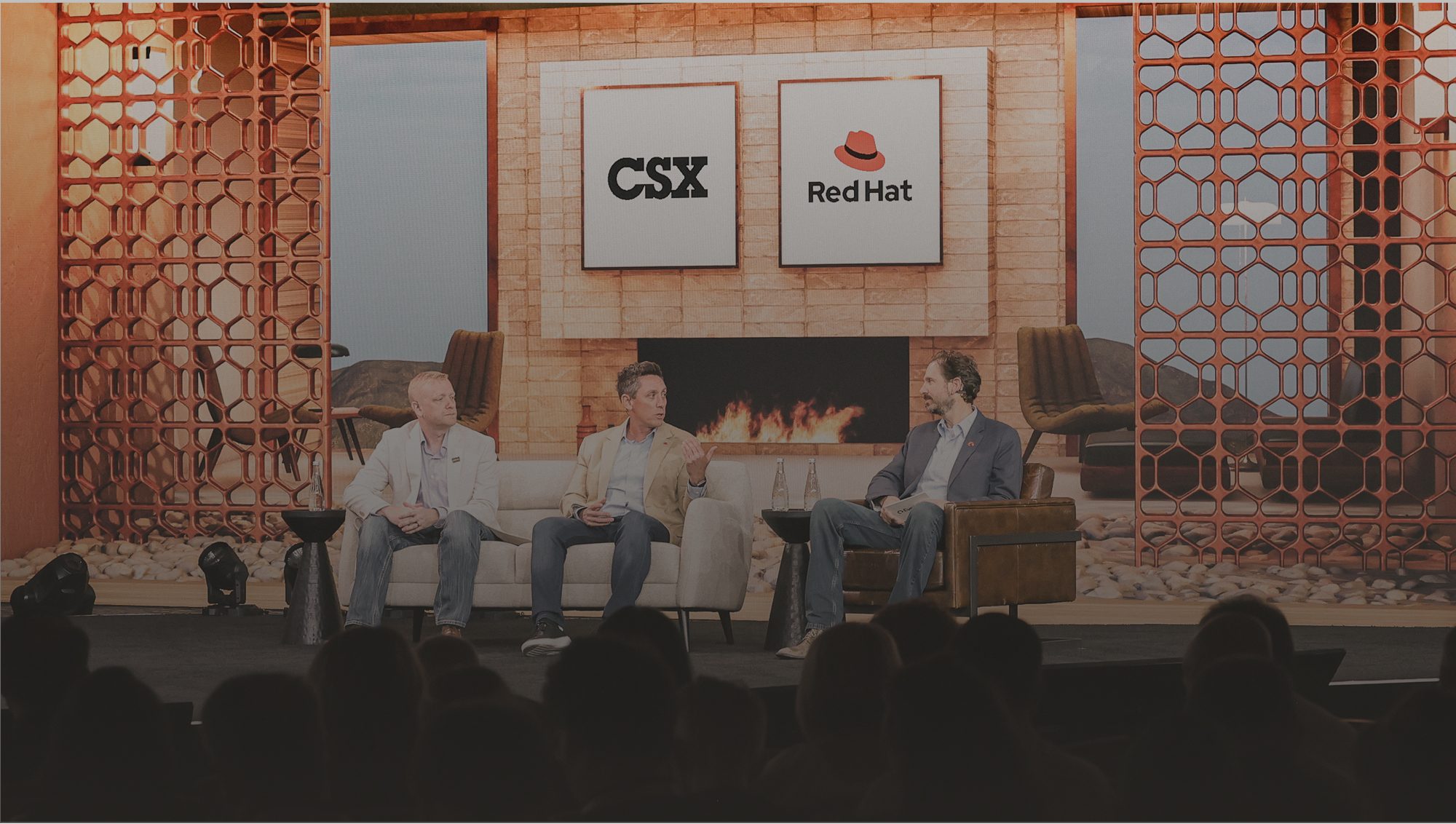
So I'm very excited that I'm joined by two very special guests today. I've got Eric Graybill from CSX. Now, Eric brings decades of experience navigating multiple waves of infrastructure transformation, and he continues to evolve the platform at CSX to adapt to what's next. I'm also very pleased to invite or to have Joel Jackson here with me on stage.
Joel from Red Hat brings a very broad market perspective. He works with a lot of organizations across a lot of industries as they make key infrastructure decisions. So I wanna start with Eric here. Eric, can you tell us a little bit about your modernization journey and how you're thinking
about it? Yeah. Thank you. Great to be here, and thanks for the opportunity to share a little bit about CSX's story. so we already are on our modernization journey where we've migrated about 80% of our applications onto Kubernetes, OpenShift specifically, so containers.
and those applications run both in the cloud and on our on premise in our own data c- data centers. so as we look to virtualiz- virtualization, I said 80% are moved to containers, so we have 20% left running on legacy VMs. So as we looked, our priority was, simplification and flexibility, and we had
that experience, over 10 years of experience with OpenShift. so we didn't wanna have disconnected stacks to manage. We didn't wanna have to, retrain our, our staff and, and a whole new pane of glass, a whole new application. So one operating model across VMs and containers really just made sense.
we also wanted a, a, a practical transition path, that we didn't have to big bang move everything at one time. We have moved successfully quite a bit of it, but at our own pace, we can move those remaining 20% onto the OpenShift platform. And then, we have if we ever need a mix of between cloud and on-prem, we can, that flexibility, as well as the, the reliability that we've come to know from OpenShift.
That's a broad ecosystem that you operate across. You know, we all understand trains. They're very, very easy to get. We see them all the time, but we don't really have a good understanding what it takes to keep those trains running. Can you tell us a little about the workloads
that you actually run behind the scenes to keep that going? Yeah, sure. Yeah, we support, more than 400 applications, and they're things that you might not be thinking about. They're mission critical applications. So I'll give you an example of our tier zero workload, something we call PTC, Positive
Train Control, and it's not just us that call that. That's a federal requirement. but things like 20,000 sensors that, that are all along every track that we have that are measuring sound, vibration, and heat, temperature off of, bearings and axles off of the train. And PTC ensures the safety of where we're
running, that if something goes wrong, it, it starts to heat up, signifying a problem, we might have a derailment. Or even if we just stop getting data from those sensors, the brakes are literally applied to the train. That's the safest thing that we can do. So it really comes down to that it is, critical that our infrastructure, that where
we're hosting our applications are resilient and reliable. That's why a resilient data architecture is central, meaning that, we have to have something that's enterprise ready like Red Hat OpenShift. and so it was just the logical next step to do our, our virtualization there as well. That makes a lot of sense. Joel, let me turn this to you a little bit.
What are you seeing more broadly in the enterprise? Are you seeing this desire to run all these different types of workloads on one platform? Yeah, I think what, what Eric said is, is Well, first of all, thank you for having us here. It's a wonderful partnership with you guys, and, we're, we're very honored to be here with you.
But what Eric described, I don't, I don't think it's unique. It's a, it's a new bl- bl- blueprint for our customer base, and I think most of enterprise IT. they have this environment that's fragmented, like you said. Cost of running them continues to rise, and that's why we wanna give them this
architectural freedom across a hybrid cloud environment, and, that's become the priority for a lot of our customer base. So that kinda covers the compute layer of things, like my, my applications that are jumping, but what about the data side of things? Yeah, Red Hat, we, we try to meet customers where they are.
I think, Eric, you had a, a You know, you already were an OpenShift customer. they wanna run VMs natively on the OpenShift platform. they got VMs and, containers, and now, AI applications landing on those. So, yeah, it gives them a low friction, high velocity, starting point. Now, the, on the You said on the data side.
Yeah, the data layer, i- if, if your data is still trapped in a legacy silo, your modernization strategy will certainly grind to, to a slowdown or a halt. So that's why the, the relationship that we have with you guys and Portworx is just so, it's so, it's so critical. So the, Portworx delivers the data services needed to keep those applications protected,
and we give you an OpenShift platform that's consistent across those applications. So, when you're running tier, tier zero applications, like Eric said, workloads, it can stop operations immediately if, if they And we have a long history with you on PTC. Mm-hmm. but look, you need more than basic storage, right?
You need a unified data platform that can span infrastructure, eliminate these silos, and, ensure applications stay protected. Our, our joint solution together, especially with a single pane of glass with Portworx directly integrated into the OpenShift console, huge for us, and, I think our customers, both love that joint, pr- proposition together.
Yeah, we just released that integration, actually announced at Red Hat Summit. so that, that sounds really good, Joel, but, you know, there's a lot of moving parts here. How do enterprises get started down this journey? Well, we try to make it simple. This is not a simple It We try to make it simple, but if you're moving a massive fleet
of applications with a lean team like Eric s- Eric said, you need a predictable, repeatable migration plan, and that's- That's exactly what Red Hat and Portworx are trying to build, and we have built with some, some very key customers. resources for you, we have the migration toolkit for virtualization, we have joint reference architectures, hands-on labs, and we have consulting experience when, customers
need more guidance. Thanks for, that sounds, like a lot of resources there. Eric, let's look at how you made this decision. What are the considerations that you put in place? How did you decide to move to OpenShift and Portworx? Yeah, so we really had, it was natural for us to choose OpenShift because we had so much of
our, applications running on there already. But the difference between running containerized OpenShift and VMs on OpenShift, data is really the key there. Yeah. It might be a nice to have a persistent volume to offer to an application for containerized, but it's an absolute requirement for a VM.
That is the VM itself. so we did a POC with Portworx and with Red Hat, and they walked us through the procedure. We tested a couple different scenarios, and that was really important. And I will say that, the decision to go with Portworx and OpenShift for running the VM was because from basic running local disk with ODF compared to running Portworx and Pure as our
backend storage was a 10X difference. I mean, so we tested all of those different, types of, creating VMs, migrating VMs from a legacy platform, and, migrating VMs for HA within the cluster or, or cross-cluster. but really the difference for us was to have, bring our expertise and our experience. we have a lean team. We only have, two full-time employees working
on OpenShift, and we're able to do that because, like we said, now that it's in, in the console, we can basically, once it's set up, it manages itself. We can add nodes, we can move things around, and we don't have to be storage experts. I'm not the storage expert, I'm the Kubernetes guy. All right. It's amazing that you accomplished all that
with just two team members as well. I think that's pretty incredible. For sure. Well, listen, we're just about out of time here, so to wrap up, if I can just get one sentence from each of you. I'm gonna start with you, Eric. What piece of advice do you have to this room full of IT experts of what they should do to
get started or, or think about as they're getting, th- thinking about getting started on this journey? Yeah, I would highly recommend the consulting service, that when we bought our licensing for Portworx, they offered, like, a white glove consulting service, and it really went above and beyond our expectations. they really know the questions to ask that you don't even know to ask yourself of what you're
gonna be using the environment for, the types of VM workloads, all of those things so that you're not painting yourself into a corner, you're designing it from day one. So I highly recommend that, that consulting service that they offer. Sounds like good advice. Joel, any words from you? Yeah, the sa- I think it's the same theme, right?
Start with a platform and a data strategy that brings VMs, containers, and, and now AI workloads together from day one, so you can focus on what comes next. It's a very agile methodology that we try to bring to the, to the customer base. Well, that's fantastic, guys. Sounds like you guys are set up for success.
I wanna thank you very much for, for joining us here. So thank you very much. Thank you.
Everpure, Red Hat, and CSX explore how organizations are navigating virtualization change, simplifying operations, and building a bridge from traditional VMs to more modern application platforms.



Personalize for Me
My Updates
No updates at this time.