
49:23 Video
Readying Your Data for AI (Federal)
Getting AI-ready starts with your data. Learn how federal teams can reduce silos, strengthen resilience, and build a trusted foundation for mission-focused AI.
Click to View Transcript
Hello, everyone, and welcome to our session, Readying Your Data for AI. Hi. I'm Emily Jarvis, and I'm the senior manager for events here at GovLoop. And today I have the added pleasure of also being your moderator. So thanks so much for joining me, and a special thank you to our partners at Everpure
for helping us put on this session today. So let's get right into it because federal agencies are under pressure to deploy AI/ML for everything, from cyber defense to citizen services, but most are still contending with the data that is fragmented across systems, hard to govern, and difficult to recover after an incident.
Without modernizing that data foundation, AI can increase the risk faster than it creates mission value. So what can you do? Well, the good news is that today our expert will share what it really takes to get data ready for secure and responsible AI/ML.
But before we get to all of that good stuff, I've got some housekeeping items to go over with you all. First things first, we have some great resources available for you on the console under that resources button along the bottom of your panel. Make sure you check out those learning opportunities 'cause there is a lot of good nuggets over there.
It's also where you can find out a little bit more about our speaker today, so make sure you check those out. Of course, if you need access to that closed captioning feature, just look for that Show Captions icon along the bottom right-hand side of your panel, and that's where you'll find that added accessibility.
Now, of course, we hope you don't have any technical difficulties, but if you do, send us a message in that Q&A tab, and my colleague Maddie will get you all sorted out. And here's the secret sauce, friends, because it's in that same tab where you can submit questions to our speakers. And we want your questions.
That's why we're here. So put your questions in early and often. You can also chat with your fellow govvies using that chat button. And right now I'd love to know where you're logging in from. I am in the very dreary Rockville, Maryland. So I'm hoping you are logging in from a slightly sunnier spot, but let us know where
you are dialing in from. Finally, we are recording this training, so check your inboxes tomorrow because we'll email you a link so you can watch the entire session on demand. All right. With all of that housekeeping out of the way, I want to introduce you to our speaker.
And I say speaker 'cause today we are gonna be doing a deep dive with Austin Boone, who is an AI specialist at Everpure. Austin, thanks so much for being with us today. Yeah. Thank you very much, Emily. It's a pleasure. Wonderful.
All right. So today we're talking about all the things that kind of underpin AI/ML, and specifically the data that empowers AI/ML to be successful. So I wanna take a second here and really lay the groundwork because we hear all the time that let's just sprinkle pure.ai on top of a government program and it's going
to make it that much more effective and productive. And perhaps that could be true, but it, it requires a lot of work on the backup for that to actually work effectively. So when agencies talk about adopting AI, Austin, what do you see teams getting wrong early on, and why does starting with the problem more matter more
than perhaps starting with the model? Yeah. That's a great question, Emily. Really what I'm seeing across the market is there's a lot of pressure, to opt, adopt and implement AI/ML systems and solutions that accelerate, you know, outcomes. There's many constraints that key stakeholders are under for accelerating that time to value
for the investments that they've made, often under constrained budgets that they've had to fight for and validate. They have to deliver operational AI/ML capabilities at speed and scale. They've gotta maintain governance, and control, and accountability for responsible AI principles.
And then they also have to eliminate tech debt. During the same time we're, we're asked to implement new things, there's this requirement to eliminate tech debt and maximize return on investment. And, and additionally, there's this requirement, it's gotta be easy to implement, right?
So we have to reduce the operational complexity associated with adopting AI. All right. So just a, a few things, can, can get in agencies' ways. But there is a real emphasis on moving to AI/ML solutions. And so what I wanna talk about here today are, are some of the things
that you just highlighted. What are slowing down agencies as they're looking to invest in more AI/ML solutions? So we know a lot of AI/ML pilots, they're gonna stall out, or they're never gonna kind of widespread production.
From your experience in working with all the government customers that you're working with, what are the biggest operational or data-related barriers that are really holding agencies backup? Well, first of all, like you kind of see here in the chart, data generally has been cultivated over time to meet specific use cases.
Now that AI is kind of like this transformational capability that requires-Really broad observability of our data in order to glean information and produce an output, there's a requirement for us really to go back to understanding how are we governing the data, in relation to the operational outcomes that we're looking for with AI. If that work isn't done, what generally
happens is you begin with some form of a pilot or some form of an acquisition of a system, then implementation kind of stalls out because you're not getting the performance that you were looking for out of the system because use cases haven't been defined. Measurable outcomes haven't been defined. Performance metrics.
As you can see there in the middle, we've got, organizational readiness is a concern. Is our organization ready to adopt AI? Do we have the correct talent? Do we have, mechanisms to break down data silos that have existed in the past because work centers were separated, and now we've got new ways of operating within our
organization that, that now that we're leveraging AI/ML? So it's very important that we don't always just start with a model in mind or a software solution in mind. We really have to start with a problem in mind that is mapped to organizational outcomes, because AI is a transformational capability, and things that aren't largely
transformational or improved processes, generally end up failing because of lack of adoption. That makes sense. And kind of just taking a peek, at your maturity model that you've got up here, you know, it makes a whole lot of sense about where you're seeing some of the, the pain points popping up for agencies, because I think people are, are jumping too forward,
too far forward in the maturity model. Maybe 'cause they're excited, which we love to see, but they're, they're missing out on, on kind of some of those foundational steps. I wanna talk about one thing here, and that's this idea of what AI is, and perhaps the a- alternative is what it isn't.
Because, you know, I think a lot of people use the term AI/ML, and enterprise AI/ML, it's not just one entity or one thing. It's training, it's inference, it's RAG, it- it's agents. There's so many pieces of the puzzle here that kind of make up the umbrella that is pure.ai.
So where do agencies, from your perspective, where do you see them underestimating maybe some of the complexities of these different patterns? Well, that's a very good question. So based on these patterns, these patterns are generally aligned with some form of an outcome that is desired. For example, you train a model in order to
perform a, a very specific task against data sets, right? Mm-hmm. To either create something that's industry or agency specific, or you will use fine-tuning in order to take an existing model, use some techniques in order to create, STaaS domain-specific capability, for your organization. And then there's inference, where you actually deploy that model in order to act upon
real-world data and produce an output for you that has value, within your organization and feeds higher-level processes as well. So the challenge is the conversation about AI. AI isn't just one thing, it's all about outcomes. So generally speaking, we will only focus on, hey, let's focus on training large data sets.
This is a g- generally speaking like a research problem or something that a data scientist will handle in order to develop a solution, that solves a very specific problem and produces a model that can, solve that problem, repeatedly, right? That requires an entire life cycle. It requires data pipelines and a data foundation in order to support that.
That may be different than, when you push that model into production and it supports, your inference, based on the applications that you are pushing out into your environment to support a line of business, within your agency. In addition to that, when you start to have, these agents that we're leveraging on a day-to-day basis, really an evolution of a, a chatbot, something that can act and perform
tasks, independently that are pre-prescribed by us, and if you're really brave, you're allowing the agent to come up with its own process and optimize it for you. But that requires, really deep lineage across your data, within a life cycle that, and pipelines that support those agents being able to make those transactions, to be able to access data, to glean the appropriate information from the models that
have been trained, and then produce an output for, the requester. That makes sense. A couple of years ago, so back in the way, way back times of AI, we sat down with the IRS and we were interviewing some folks who were on their AI/ML team, and they had deployed this AI system, kind of a, a chatbot, one of the earlier versions of an AI chatbot,
and it, it went live on their site, and it was working phenomenally from a production standpoint, right? A constituent could put in their information, you know, "I am filing XYZ taxes. This is the question." But the problem that they had is that it was pulling data and information from tax codes of years past.
So they hadn't effectively trained the system with the proper data, and so it was spitting out all of thisThoughtfully curated information that just wasn't accurate. And so they had to really go back and do a lot of training, and realigning kind of the data that it was able to pull from, because I think they overlooked kind of what you were
talking about here, that example of getting those pieces in place properly ahead of time, kind of finding your, your proper data sets and where your, AI/ML is actually able to pull from. And now it's working great. So feel free to use the IRS site right now, and the chatbot that they have.
But I think it's a good example of what you're talking about, where oftentimes agencies underestimate the challenge because they don't fully understand how all-encompassing these systems can be and where and how they can pull information unless you put the parameters in place. Is that kind of what you're talking about?
Yeah, and absolutely. So that's actually a use case that is repeated, you know, really all across the I support, where you'll see that a, a solution has been implemented, and you have to really start to calibrate- Mm-hmm those desired outcomes based off of compliance, based off of privacy, different policies that the agencies have to adhere to, and that really gets back
into how the data pipelines are built, managing the data life cycle associated with each one of those pipelines supporting the use case, right? So for, for instance, in that same scenario you mentioned with the IRS, my assumption is that the behavior of the pure.ai system would need to be different, based on usage and what you would want the public to be able to use. Right.
Right? So there's different things that need to happen throughout the pipeline to tag that data appropriately so that it can be retrieved, either from an internal or an external perspective based on the Kontxtual, and approvals for different types of data as they go through these models. Gotcha. All right, so let's drill down a little bit
into that data readiness piece of the puzzle that, that you were just talking about. And it keeps coming up in our conversation today because And it, it's obvious, because we know AI/ML is built on data and data is the foundation. We know that. But what does not ready or data that is not perhaps useful in the context of an pure.ai, what does that actually look like
how does that show up perhaps in some of these AI/ML outcomes that we're seeing? Absolutely. So I'm glad you brought up the last use case, with the IRS 'cause that, that is a, a nice illustration to show that, just because data, may not be ready doesn't mean it's not usable. It just needs to be processed appropriately a- throughout a data pipeline.
Because really what happens is outcomes suffer because the quality of the data and accessibility of the data that has been, processed through a pipeline may or may not, garner the right AI behavior from a, a chatbot or an agentic AI solution. So really what happens is, we've got to go back and set a firm foundation that allows us to start with governance and strategy, allows us to in- that governance and strategy informs
Huawei, invest, how we build our, systems that support our AI/ML, enabled outcomes. They allow us to, identify, improve, and govern, and actually operationalize that data in a way that it feeds, our mission outcomes in each one of the use cases. Therein, in many cases there are separate data pipelines that are supporting each use
case independently, and those things need to be addressed. I see. I do want to make a note for our wonderful attendees who are on today. I've got a list a mile long of questions, and I'm just gonna pepper poor Austin, with all of these questions. But if you also have a question, you can
either throw it into the chat or the Q&A portal because he's an expert in this field so you should definitely take advantage of that expertise. But while we're, we're looking at this data readiness pipeline kind of that you were talking about, you've got your identity, improve, govern, operationalize. That is a, a, a, a really thorough and useful investigation of, of a timeline.
As you're working with your government clients and agencies as they're going this, are you seeing, maybe more pushback or challenges in certain areas over others? Or is it just kind of a challenge as a whole to get a handle on kind of the data that exists within your, your organization?
Yeah, so that's kind of complex. I did Well, the reason why is I've, I've, I did 24 years in the, in the Army, and we've always had a data problem, right? Yeah. Mm-hmm. As I entered private sector, we've always had to understand that there's a data problem.
It's being addressed by developing even more complex systems in order to overcome a problem that already exists. Yeah. Right? So as we consult with our customers on a day-to-day basis, it's really understanding, hey, what data is relevant for the outcome that you're desiring to-To, to achieve.
There's many different acronyms that come out about how the data needs to be presented across a unified environment, but really, it's coming up with those key principles agency, understanding what the desired or organizational outcomes are, identifying the data sources, working to achieve the approvals to access those data sources, because in some cases, there's a requirement for, specific handling of different types of data.
So, identifying those, gaining the approvals, establishing the controls in order to ensure the data is, is, is appropriately, acquired and processed through the system, and then implementing some form of governance that allows you to use tools and monitoring to ensure that access to that data meets all of the requirements that have been dictated. And then you operationally, operationalize that data by taking what has been,
architected in the form of a data pipeline and then presenting that to intelligent applications. Yeah. That's something that we, generally have to address with every customer, whether it's public sector or if, if it's a commercial customer.
Gotcha. And I think it is so important to, to talk about the fact that data pre-AI wasn't usually in a useful form either. This is a mess that has been growing for probably the beginning of information collection at, in, in some way, shape, or form.
But in order for it to work properly for AI, there do need to be some kind of, some classifications in place and some data vetting and making sure that it's ready and secure in the way that it should be. Um- but I think you're absolutely right that we weren't, we weren't without data problems before pure.ai. They certainly existed, in a, in a lot of
different forms, so I think that's a really important, point you just made. Yeah. And, and Emily, I, I just kind of, I m- I may date myself- but we've gone through several different kind of technology horizons where- Mm-hmm you know, it wasn't too long ago that we were talking about, cloud-native as the thing, right? Yes.
Then there was, big data, right? Uh-huh. And then there was, there's all these horizons that, that really are all trying to, to solve similar problems. AI kind of just brings all of that together and says, hey, y- you know, if you haven't addressed all those things in the past as we were becoming very data-centric, you need to
address those things now because there's capability to get beyond just a STaaS dashboard. And STaaS dashboards had their own problem. Everybody saw a dashboard, and they were like- Yeah "Give me one." Uh-huh. Now this dashboard is useless." Uh-huh.
Make it work." And then you had to go do all this data work, right? This is, this is something very similar, but it just brings us back to work that needed to be done in the first place. It's the cycle. It's the cycle. But this is the new version, and I, I think,
there's a lot of potential in this area. And as we're kind of looking at the potential of what could be, one of the, the key elements is obviously to be looking at AI/ML as what you were just kind of describing, that all-inclusive system, that end-to-end system where you've got data, models, infrastructure, orchestration, governance, all of these pieces of the
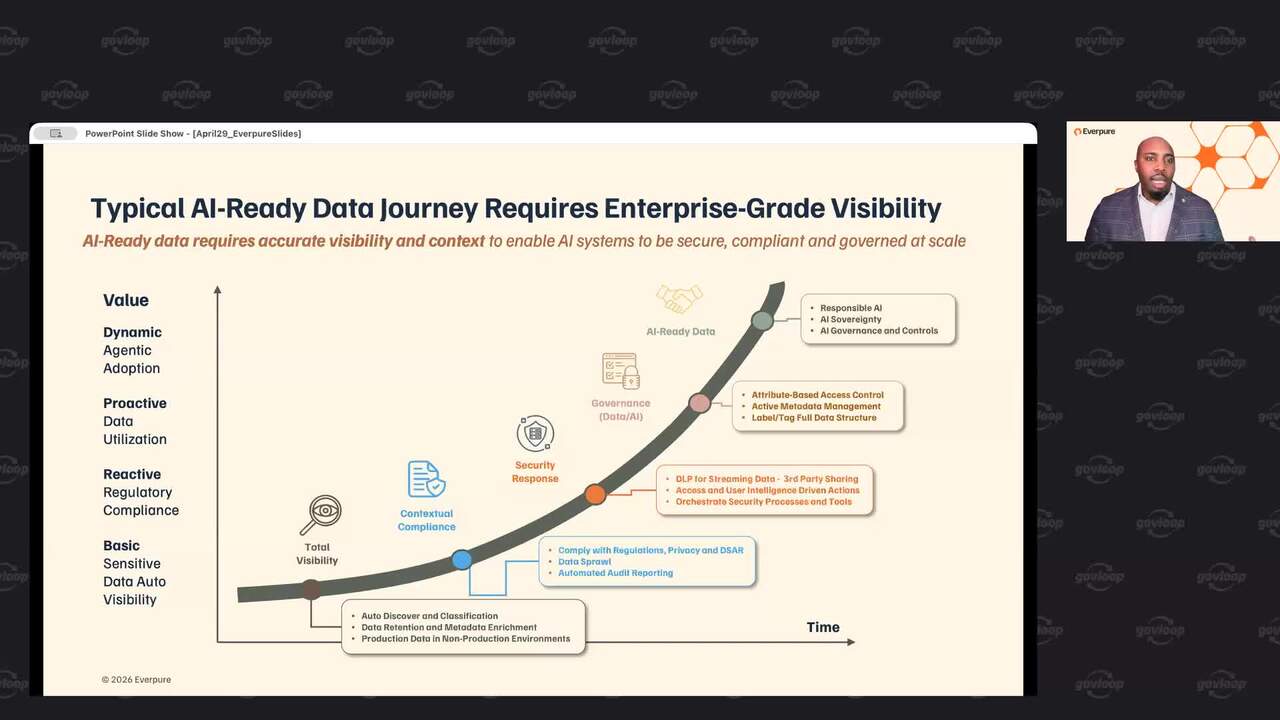
puzzle kind of coming together. Where should agencies focus first to, to kind of get the ball rolling? Cause you can't necessarily do everything all at once. Yes, absolutely. So, what you see here on, on this chart really as we just kind of walk through it, this chart, on the left-hand side just shows elements of
value that we're looking for. So from basic, auto, gaining visibility of, of your data, what state your data's in, the, the level of usability of your data, just finding that out generally is a task in and of itself- Yeah that most stakeholders need to address. Then, moving into adding Kontxtual to data in order to ensure that you're able to apply
the right levels of compliance and security to that data. Then, starting to govern the accessibility of the data. What is allowed to access this data? What entities, personnel? What are the attributes of the other systems that are able to access the data?
And how can we manage that data, and those systems collectively in order to understand, risks and CVE, in addition to performance and operational value? And then as you kind of, work your way up the chart all the way to the top, after you've addressed each one of these things, Kontxtual security, governance, now you've got
something that gets you to the point of pure.ai data. You're able to start having conversations and, instrumentation to understand, am I following all of my responsible AI requirements? Mm-hmm. Am I able to implement successfully my AI/ML data sovereignty requirements?
Am I able to, validate and report on my governance and controls, to higher level authorities, confidently? This is just a, a chart that just kind of shows, an increase of, different tasks and, and processes. That will enable you to get those different levels of value, and increase levels of adoption because as you move up the scale, data becomes more rich,
more usable, and able to be, successfully consumed by, customers, w- across agencies. And I think this, this graph really puts in perspective for users like myself who can get intimidated by the art of the possible when it comes to AI/ML.
You know, people will say, "You know, AI can do X, Y, and Z," and in my head I'm like, Well, I don't even know how we would begin to get to a place where it could do X, Y, and Z. So giving this kind of clear steps of, like, what I should be thinking about and what I should be looking at as I'm exploring some of these use cases, is, is really important, especially, obviously, when we're talking in that government, government sense with the
compliance and security, aspects of this because those are obviously critical information, that agencies have, and that need to be protected. So I really appreciate you laying this out for us. You're welcome. And Emily, I just got one last thought on that. Oh, yeah, go for it.
Looking at this process, think about how can I accelerate AI/ML adoption? How can I increase, or decrease the failure rate for AI/ML projects? And really establishing the groundwork for how these pipelines are established. You know, they say, data is the new oil. Mm-hmm. Right? It's like, how, how can I, how can I
pr- create a refinement process- The fuel that enables, you know, a foundation that to just go ahead and, and innovate at speed and scale now- Mm-hmm because we've already addressed the resource requirement- Mm-hmm primary resource requirement. That was a good metaphor. I liked that one. I liked that one. I've also heard it called rocket fuel, so we
we can add them both together, there. All right. So your, your model makes a lot of sense, and building this data foundation, this unified data foundation where you've got all these pieces of the puzzle coming together is obviously the clear best way to, to move forward.
When you're trying to act in the real world, where you've got these pilot programs that agencies are investing in, and they're moving into, hopefully, Hyperscale programs where they're mission-facing workloads, talk to me about the power that having that strong data foundation can really provide for an organization. If you do these steps right, what can that get you?
Well, what it will do is it'll increase the accuracy of the outcomes of your data, as they are processed through your applications or, you know, higher level systems that are adjacent. But really, the value that you will get, and this is coming from somebody that's been in the government longer than I've, been an adult,
um- There, there's a real challenge with trusting the validity of that, the information that's provided to you. Mm-hmm. That's even with a human, right? So now that you know that there's a system that is providing this, an AI-enabled system there's really this, this challenge with trust, right?
And it only takes one or two times for, someone to get an output that they don't respect before they- lose trust in the system. Mm-hmm. So when we look at critical AI/ML systems that need to be performant, that are, supporting, you know, people services, at, at, at varying levels of agency, even to include things that are happening in the
Department of War, these systems need to be very accurate and trustworthy. And the, the, the leaders that are making decisions based off of these outputs, really need to have an understanding of where this information came from, which system it's using, and how, how, how accurate and reliable is this system. So having that data infrastructure already in place with the access management, with the
governance, and with pipelines that are built specifically to support those use cases, it actually makes it easier on the engineering side in order to make tweaks to the actual, model or the AI/ML system, or the way that those things are architected, to produce a higher and more trustworthy result. I think that trust component is so difficult, I think, to, to quantify, but you know it when
you feel it, right? Like, I, I have been dealing with some, health insurance information on my end. This is not government related. But I talk to one person on the phone, and they tell me one thing.
The documentation says something slightly different. My doctor's office says something in a different Kontxtual. And so you're getting these different outputs that are all talking about the same thing, in theory using the same information, but giving you different results, and you end up walking away, or I end up walking away from the situation just feeling
frustrated and confused. So I totally understand what you're talking about in that Trust Center here. If an AI, enabled application or a chatbot or even, for the more advanced agencies, some of these agents are putting out information that we think is not accurate, it's going to lead to less engagement with those constituencies because
they're not gonna be using the tooling, and it creates this self-fulfilling prophecy. So I totally, am-I appreciate what you're talking about when it comes to the information has to be accurate in these systems, especially on the off-prem side, in order for that Trust Center component not to, to be impacted. Absolutely. So as agencies are thinking about
visibility, governance, compliance, that's a lot of potential speed bumps in the process, right? Mm-hmm. Every, every check of the system can slow things down. Speed and innovation are also out there, and we want agencies to be moving towards these new solutions while keeping trust in, in play as quickly as possible.
So what does that balancing act look like? How can agencies go quickly without sacrificing trust, security, accountability in the mix? That's a good question 'cause, AI anxiety's real- Yeah and, mandates to move very quickly often cause, disjointed lines of effort in
order to, one, scope what even requirements are out there for an AI/ML solution. So starting with that one, I would say, asking the question that's gonna drive a requirement document that says, "Hey, you know, how can I clearly articulate what are my organizational outcomes with AI/ML? And then how can I, address the requirement for supporting systems like an AI platform
platform, the correct networking improvements, the software acquisition? How can all of that come together in a cohesive way that allows a seamless, accurate acquisition, of a solution that has some type of measurable value?" Mm-hmm. In many cases because that's bifurcated, as somebody that, that responds to numerous, RFIs, RFPs- you can get an overly prescriptive, um- Mm-hmm solicitation
or you can get something that is, is, so vague that it's impossible to answer all things that this agency wants to do. So being able to have a conversation and, and a workshop to that clearly articulates the element of value- value, the, the desired mission outcome, even helps industry that has the solutions that, an agency's looking for.
So measurable value. And then looking at, asking that question, what data do I need in order to support those mission outcomes? What use cases are gonna be aligned with each outcome? What are the tasks associated with that? And do I have access to the data sources?
Do I need to produce new data in order to support, this AI/ML system? Who's gonna own it? Who's gonna manage it? And, how does that come together in a full data stewardship strategy that supports, a, an AI/ML initiative that's going on? And then nextly, understanding really what needs to be true about
some form of a pilot that we are running that has been proven out for it to be moved into production. You know, what, what key things need to be, be true? Do I have a validated test plan? Are we monitoring that test plan?
Mm-hmm. Are we actually engaging with all of the stakeholders that are STaaS with that test plan, that are, providing equipment associated with a POC, in order to prove out or disprove operational viability, right? And then what do we do from there?
That requires, relationships. It requires, different levels of risk assessment to be in place. It requires, teamwork in order to engineer the correct software, in order to validate the right models, in order to, validate data readiness and orchestrate the data pipelines. And then, some success criteria that says, all
right, so now we've achieved these things. We can move it from pilot to production, and then we've got a test group in order to, validate the human component. Is this trustworthy? Does this work in operation?
Is this actually solving problems the way that, the design, the to-be design was architected and developed for, this use case? And then lastly, balancing speed, trust, and governance. I will tell you that this is almost impossible- but it's important for, for, agencies to consider.
You come to work one day and you've got a copilot activated. Mm-hmm. You know? And you come to work one day and, you know, a tool that, that you used to use that gave concrete results to you, now the model has been updated, and you've got to change the way that you prompt that system, right?
So balancing speed, trust, and governance, I would say the speed we generally don't have a problem with just putting new things out there after they've been approved to be on a network. Mm-hmm. The trust piece comes with that human component where you do have to, there has to be some training. Mm-hmm. There has to be some education and information for onboarding onto a system
there's set SLAs on how to interact with this, this new pure.ai solution. Be some information about where the data is coming from so that the, users actually can trust, "Hey, I understand that there was a pipeline, data pipeline, that was engineered specifically for this tool that we're using. It's purpose-built for my line of business. And then I can be confident that when I copy
and paste something, I'm not gonna get fired. Yeah. Right? And then the next thing is that governance. So, governance really un- undergirds all of this. Governance should drive how the tooling, is applied.
It should, it should guide really the speed and scale at which these solutions are implemented across the environment, and then how they're used and monitored over time. Wonderful. And I like what you said about kinda that training and the cultural side of a tool. Cause I mean, I think we've all been the person that says, "I want, I want new tools.
I want my job to be faster," and then they bring a new tool to you, and you're like, Ooh- Mm-hmm I meant that tool for literally all those people over there but not me." so I do think, to your point, there is quite a bit of, learning and kind of setting new cultural norms as these, new tools roll out, so I appreciate you talking about that. All right, we only have a few minutes of our session left here, Austin.
We have- Yeah covered quite a bit already. But, one of the things that you've, you just talked about was kinda getting a pilot up and running, and I want to take that one step further. Because a lot of agencies have pilots up and running, and now they're looking, to potentially Hyperscale.
From your purview, what are the signs that an organization is really ready to scale AI responsibly, maybe larger than a pilot? Maybe to the full team, maybe to the full organization, but how do you know if a, a pilot is ready? Yeah, so that's, that's a good question.
So I would say that after you've identified that you've got a viable pilot, understanding that there are actual use cases that is, that this is mapped to externally, scoping what the scale of the use case implementation would be. And then here's the deal: You've gotta make sure that your investments within the infrastructure, your AI factory, infrastructure, your data platform, your
networking, all of those things are actually right-sized for your actual scaling of that solution. Many times what happens is there's been a purchase that's been, executed. Mm-hmm. There's some type of tool that's been developed or capability that's been developed in a lab, and then when it comes time in order
to scale that, There's actually a term, too, called pilot production. Mm-hmm. Like, sometimes people say, "Hey, once it's validated and, the pilot has been validated, and it starts being used by production users, they don't wanna stop using it. Uh-huh. So now you've got something that is kinda straddling the fence on still even being a
pilot, and it's starting to scale. That happens all the time. So making sure that you, have discipline, in understanding what the true requirements are gonna be in order to actually move from pilot to production, that those are clearly articulated, and then that your environment is, is such that it can scale appropriately to
match the aligned use cases. Mm-hmm. Generally speaking, I work with organizations in order to create a technology roadmap over time. That does include, identifying those use cases, assessing the data readiness, selecting the architecture for what the, the to be once deployment happens, at scale
across the enterprise. And then what portion of the environment, needs to be set aside for, design, development of that pilot or proof of concept. Mm-hmm. And then, you know, what, what they need to do incrementally over time in order to ensure that they're able to scale.
Gotcha. And I can imagine that that scope creep happens quite quickly with the pilots. Cause if you hear a coworker using something that is working really well for them, of course you're gonna want access to that as well. So that, that makes a whole lot of sense to me.
All right, two final questions for you. Mm-hmm. And I want to move into the cultural side little bit for this second to last question. And as leaders of organizations are embarking on a more robust AI/ML journey, it's, it requires folks to change their mindsets and kinda change
their approaches perhaps than, than work in ways that they had done previously. What is one mindset shift or practical step that can help turn AI interests, So I've heard about this thing, maybe we should explore it," to actually seeing some operational impact? Yeah, so I've got, I've got really three things. Okay.
So the first thing is we really have to do a good job of framing what our, our, our, our, our, our outcome should be. Mm-hmm. AI is a transformational capability. It can either transform you into where you're trying to go-Or it can transform you into an organization that has become stagnant with their ability to understand how to leverage AI
for, future capability development and optimization, right? So clearly framing what the outcomes are, establishing a starting point to STaaS all the REST API readiness across the organization. Organizations do this, when they wanna understand, hey, we wanna transform to, address these new set of requirements that have been levied on us from the government.
Now we're responsible for XYZ. They right-size their organization in order to, achieve those goals. They make transformative decisions in order to meet their desired outcome. The same thing needs to happen within the, the AI/ML infrastructure, to include the data, understanding what tools do we need to put in place in order to address all of the Hyperscale
level decisions that are being made across the organization. And then the second thing is to start really building those foundations that are gonna allow you to address, changes that are gonna be happening in the market. When I say market, I, I mean, within your purview as an agency, the things that you're responsible for, the way that people consume new services, the way that you have to provide
those services, the way that you have to change your organization in order to, optimize the people that are managing those processes. And then, how are you gonna layer in all of the, the governance and stewardship and access management to not only the systems, but the underlying data that's supporting those systems?
Once you establish those foundations, which really, I'm a data guy, so establishing a firm data platform that is operational, that each one of the stakeholders have a piece of managing, will definitely accelerate your AI/ML journey. And then the last thing, I really wanna say we have this Hyperscale really because of hype to talk about GPUs- Uh-huh only the software.
Usually, a- and this is sad, data's always the afterthought because it's not the most attractive thing to talk about- Right because it's always been the problem, right? Find new ways, in order to, to talk about the data problem AWS as a way to, optimize and enable, you know, this new AI generation. You know, in order, we can move faster if we're able to, increase our levels of, of data
readiness and data stewardship and data governance instead of those things being an after effect. Okay. AI/ML is supposed to serve us. You know, we're not supposed to have to be here to serve AI, and, and setting up this foundation creates that, framework.
I love that. All right, final question for you. You know, we've, we've talked about a lot of different aspects on today's training, you know, everything from where are the biggest pain points to some of the, to the opportunities to some best practices. If you could wave your magic wand and have our attendees who are listening today
walk away from this session thinking, knowing, remembering an aspect of the conversation, what would you want them to walk away kind of thinking about? Start with the problem and not the model. The models are gonna change. Matter of fact, since we've been having this webinar, there's probably, you know- some new
announcements that's being prepared about a specific model that's out there. Mm-hmm. Preparing your organization to be able to leverage the power of these tools and capabilities is the most important thing that you can do. So deduplication, data readiness is crucial. Think of AI/ML as an end-to-end system that includes GPUs, that includes,
high-speed networking, that includes modern applications and data services supporting those applications, and includes a data platform that is really, the foundation for all of it to work, right, outside of, of power. Right now, power, we hear about data center, all the time, power to data centers, and actually, data are two of the huge bottlenecks that need to be solved now,
in the AI/ML community. In addition to this, like I said before, that data governance, the AI governance, the organizational work that needs to be done, the technology selection, and the, identifying those performance outcomes, really that enables you to scale faster because you've already prescribed and done the work of, of here's what our organizational goals are, and
that's what's gonna inform all of the development, and getting that executive consensus showing that it's aligned with, mission value. All right. Austin, thank you so much for sharing your insights with us today. You certainly gave us a lot of really practical and useful information, so thank you
so much for spending your afternoon with us. Just a few quick reminders before everyone logs off. If you haven't already, take a peek at that resource center. There are a lot of great learning opportunities over there, so make sure you check those out.
We'll also be sending you a link to the on-demand version of this session tomorrow, so check that out in your inboxes. You could, of course, watch the session again or send it along to one of your colleagues. But on behalf of GovLoop and Everpure, I hope you enjoyed this deep dive into readying your data for AI.
And as always, we really appreciate and value the work that you do, so thanks for taking the time out of your busy schedules to join us this afternoon. Have a great rest of your day, and we'll see you on our next training. Bye, everybody.
We Also Recommend...
Personalize for Me
My Updates
No updates at this time.