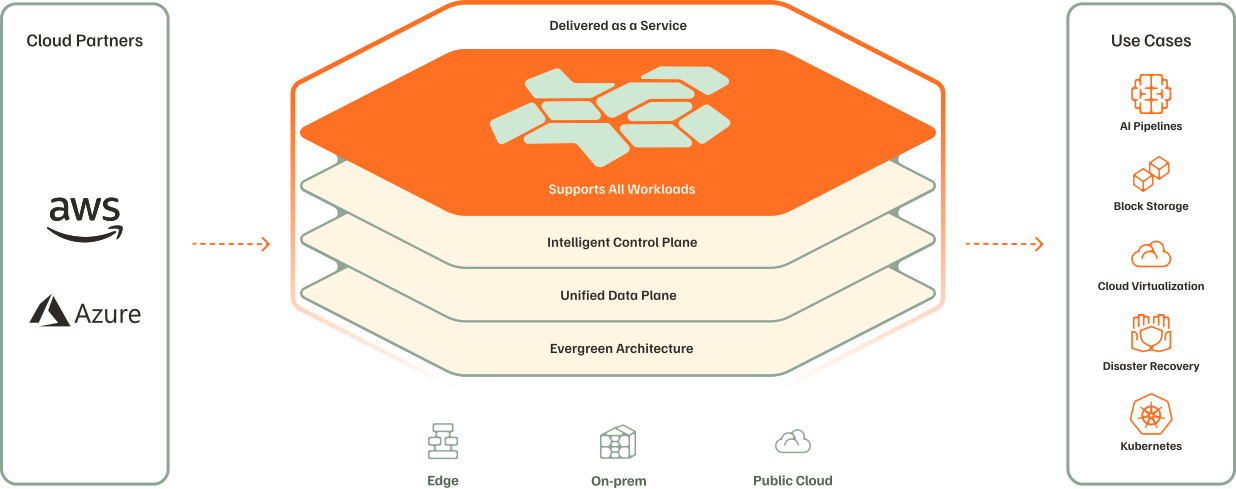


Forget the usual cloud tradeoffs like fragmented data, subpar security, and unpredictable costs. The Everpure platform lets you manage and protect all your data—from on-prem to cloud—in one place.
Significantly reduce your storage TCO.
Breathe easy with embedded security and unmatched resilience.
Ease migrations with simple replication and hybrid data mobility.

Optimise storage by up to 5X through deduplication and compression for unmatched savings.
Unify public cloud and on-prem environments into one virtualised cloud of data.
Move data flexibly across environments, without refactoring.
Gain peace of mind with immutable snapshots, replication, and copy data management.
Get an enterprise-grade cloud storage solution for AWS environments.
Remove operational complexity with a fully-managed service for Azure.
Easily manage your containerized applications across clouds.
Navigate rising complexity, cost pressures, and virtualisation disruptions.
Learn how to modernise your hybrid cloud to simplify management and lower costs.
Easily bring the performance and agility of Everpure to the cloud.
Both private and public clouds offer improved agility, scalability, and efficiency. Both can use virtualisation on-premises and remotely. The only difference is whether the resources are dedicated to one organisation or shared with other customers. In other words, the private/public cloud divide is defined by privacy.
A private cloud offers:
You can integrate all these benefits of a private cloud into your larger multicloud strategy.
In terms of business applications, organisations are moving rapidly to a hybrid cloud model in which enterprises and cloud-native companies alike can capitalize on hybrid applications that take advantage of innovation across linked, on-premises, and public clouds.
Although it may be tempting to use the two terms interchangeably, they’re not the same thing. A multicloud architecture could involve the unification of two private clouds or two public clouds. However, the moment you unify public and private cloud environments, you have a hybrid cloud environment.