




Trusted. Certified. Compliant.
See our certifications and explore how we safeguard data with leading security controls and compliance.

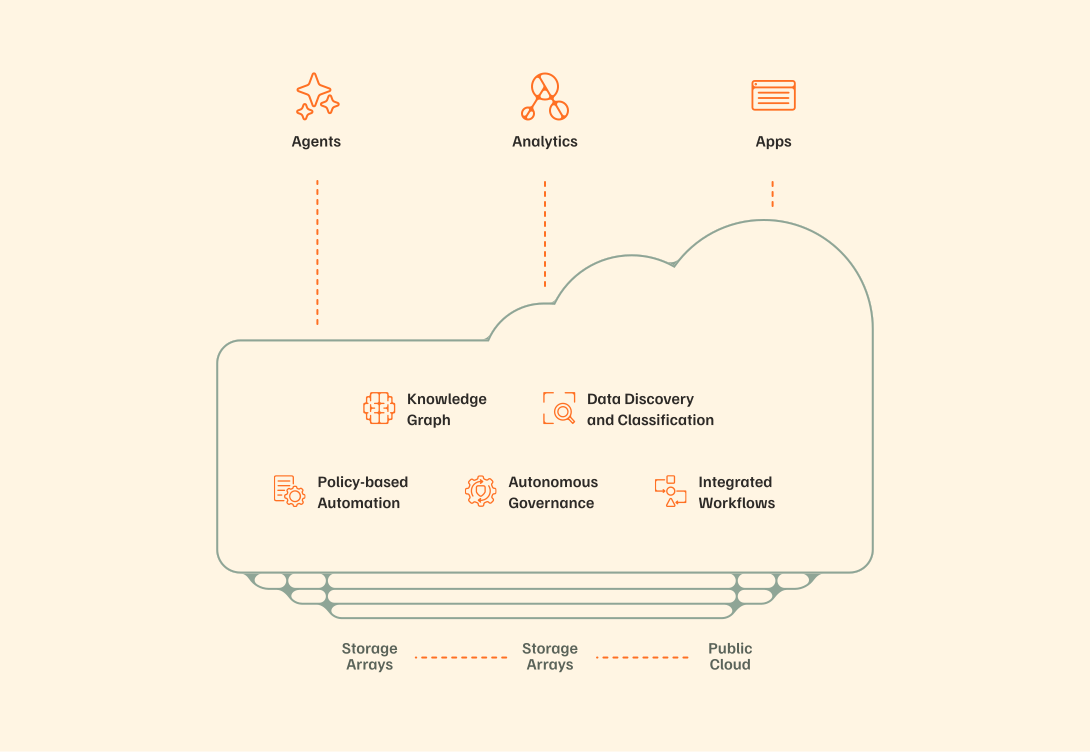
Your data has always been fragmented across applications. An EDC unifies it—bringing intelligent control and AI-ready data management under a single model, across every environment.
Get the most out of your Enterprise Data Cloud
“An Enterprise Data Cloud (EDC) provides you a future where your data is always under control, always available, more secure, and maximising its value for your organisation.”

A single cloud of data that spans on-prem, hybrid, and public cloud locations, giving IT a consistent data environment everywhere.
Global, intent-driven policies automatically control placement, protection, governance, and lifecycle across every environment.
Get uniform cyber resilience with continuous monitoring, early threat detection, and rapid recovery across the entire data cloud.
Our storage-as-a-service model delivers consistent availability and performance everywhere, backed by guarantees.
Continuous, in-place updates keep the entire fleet modern without downtime, migrations, or refresh cycles.
Discover, classify, and map every data relationship, so every decision comes from accurate data.
Provision globally in minutes, not weeks, without redesign, rework, or operational drag.
Keep data understood and current with continuous discovery and classification.
Copies break quality and lineage. EDC keeps data at the source—accurate, traceable, complete.
Keeps every workload performing reliably, without manual tuning or guesswork.
Lean on an SLA-based service for ultimate reliability and risk reduction.
Traditional storage architectures are built around isolated systems—separate block, file, and object arrays managed individually, refreshed every few years, and operated through manual processes. EDC is an architectural approach that is unique to your organisation, not a product. It describes the operational state you achieve when the Everpure platform runs as one system across your environments. You manage your data as a single cloud with global policy and automated control.
EDC works across on-prem, hybrid, and cloud environments, but it doesn’t require a public cloud. You can achieve an EDC entirely on-prem and extend it to the cloud when and where it makes sense, without changing how data is managed or governed.
Most enterprises have data spread across on-prem, cloud, SaaS, and edge—ungoverned, unclassified, and invisible to the teams that need it most. An EDC addresses this through data intelligence, which continuously discovers and classifies data wherever it lives, maps relationships across systems, and builds a knowledge graph that gives every team and every AI model full context. Governance policies travel with the data, not the application, so classification and compliance stay consistent regardless of where data moves or how it's accessed. The result is data that's understood, governable, and ready to use, without forcing it into another silo.
An EDC removes data silos, manual operations, and inconsistent control that slow teams down and increase risk. It enables data to be managed consistently across environments, reducing operational effort, improving reliability, and enabling teams to scale without redesigning systems.
An EDC scales by coordinating control, not by adding complexity. As data volumes, workloads, and AI demands increase, policies, placement, and operations remain consistent, avoiding the sprawl and manual effort that typically come with growth.
Policy-based automation allows IT teams to define intent, such as performance levels, protection requirements, compliance rules, and cost targets, rather than executing manual storage tasks. In an EDC, these policies are enforced automatically across the entire storage environment using an API-first, software-driven control plane. Provisioning, scaling, optimisation, and protection occur dynamically based on policy, enabling consistent operations at global scale while reducing human error and operational overhead.