7:19 Video
The New Data Dynamic
Everpure is featured by the Global Sustainability Trade Initiative in partnership with CNBC for our expertise in enterprise data and sustainability.
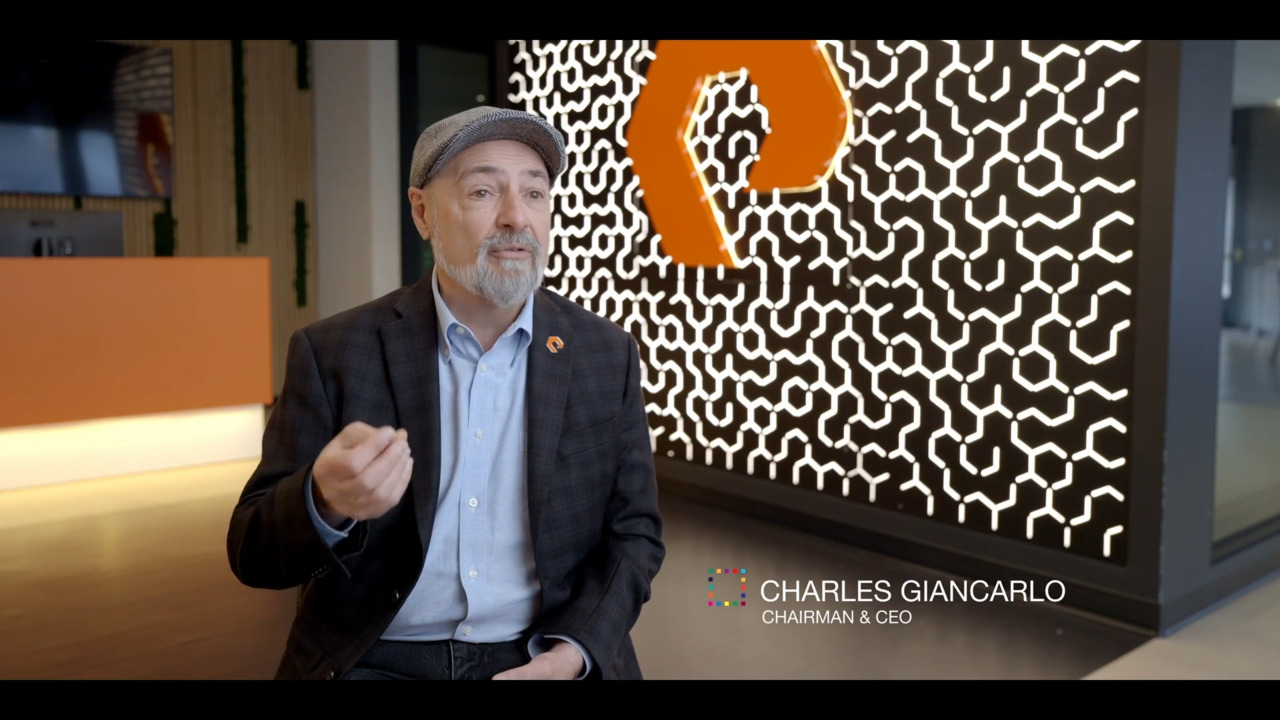
Click to View Transcript
Data has just exploded over 30 years. It's 25,000 times more now, reaching hundreds of zettabytes. A zettabyte is a thousand exabytes, and an exabyte is equivalent to a billion HD movies, and a billion HD movies would take a million years to watch. Pure has been at the forefront of advancing data storage and data integration.
As customers look to the future, they need to network their data so that data is held as an enterprise organization globally so that it's always accessible. And secondly, it's gonna have to be enhanced with metadata so that it can be turned into information, useful information that can be used for AI/ML or analytics. These are two major transitions for data as we go forward in the future, and they're major
architectural transitions. One of the earliest breakthroughs with the FlashArray//X was that storage finally just worked. Our mission was simple but radical. Make storage more reliable, more sustainable, and more efficient by ripping out all of the
waste that had accumulated over decades. That allows enterprises to unify and securely access data across all of the things that they do. And for us, it's really about helping our customers make the leap from managing storage infrastructure to managing information.
Options Technology is a specialist MSP focused on running infrastructure for global capital markets. The challenges we were facing were really quite broad and in the AI/ML world, all of sudden firms need to run analytics across much, much bigger and broader data sets. And we realized that if we wanted to build a data lakehouse product over the next 10 years, we
needed to either do it ourselves or find a firm that we could partner with, and that's where Pure popped up. It's really important for organizations to do a better job of unifying their data simple reason. AI. If the whole game is feeding pools of data into these models to get better results out of
them, well, then you've gotta have a way to bring all that data together. Automation does a better job. It is less error-prone and is just more efficient overall. We are driving, that same transition in how infrastructure business IT is being managed. The Enterprise Data Cloud allows our customers to understand their intent
behind how they store their data and manage their data, set it in software policy, and then the system has it done completely automatically. The principles of Evergreen and the Evergreen//Forever promise are critical Enterprise Data Cloud. At its heart, the Evergreen promise is one of avoiding technology obsolescence, of always being able to constantly evolve, grow, scale
to not just today's needs, but what's coming next year and the years after that. Now, why is that such a critical enabler of the Enterprise Data Cloud? Well, part of what we're enabling customers to do is manage their entire estate across a multitude of different data storage needs with one consistent technology. We're turning data increasingly into information, having it able to be managed on a
worldwide basis, according to the policies that are set by the organization. Pure has been a very powerful partner as our business has grown. Over the course of a decade, the amount of data that we store on Pure is gonna increase between 10 to 20X. So the fact that we have a platform that lets us scale really easily is a huge value.
For cybersecurity, because of the nature of our business, we have to take it seriously we always have. The way Pure Storage arrays and the enterprise data platform is deployed gives us an awful lot of safeguards to make sure that we won't be compromised in the first place. And if we are, we can recover quickly and seamlessly.
We approach cyber resilience, through a multifaceted approach. Number one is we build on secure foundation, which is our unified data plan. On top of that, we're bringing all of the management of these systems together with our intelligent control plane, making it much easier and much more holistic how we can reflect observability and telemetry around the security perimeter.
And then thirdly, through our API and our third-party ecosystem, we're driving third-party integrations to the best-of-breed security tools so that not only can we detect threats when they happen, but we can help customers take immediate action. Well, the ship of Theseus is an old Greek myth about replacing every component on a ship. The question being, if you've replaced every component on the ship, is it a new ship?
It's effectively what we do with our Evergreen program. Over a period of time, we replaced every single element in one of our arrays in a customer site without non-disruptive to the customer's environment. And we do this without the customer having to spend another dollar, for that product. Evergreen really enhances sustainability.
When we replace some elements of the products, we will use those products in our STaaS offering. So one of the most pressing issues or challenges that the storage industry is facing today is energy. Data centers are already consuming about 1.5% of global electricity.
STaaS accounts for about a quarter of that. Pure has been able to actually deliver systems that use roughly 85% less energy up to 77% less operating costs at scale. If adaptability becomes a core strength and not an afterthought, what other challenges across sustainability, resilience, security, or access
could we solve for? The outline of what's coming next, we believe is very predictable. Data information is becoming more and more important. Now, the detail, of course, is never fully predictable. And what you need is a flexible, very capable architecture that can
change with customer needs. We've done both. We're helping our customers not just with products, but with the architectures necessary to be able to take advantage data and all of the information that they are now creating.
We Also Recommend...
Personalize for Me
My Updates
No updates at this time.