

31:23 Video
Smarter Infrastructure, Not More Hardware: Lessons from Arkansas' Transportation System Transformation (Transportation)
See how Arkansas DOT modernised legacy infrastructure to improve reliability, strengthen resilience, and support smarter transportation operations without adding more hardware.
Click to View Transcript
Hello, and welcome to today's webcast Smarter Infrastructure Not More Hardware: Lessons from Arkansas' Transportation System Transformation. Once again, I'm Sean McSpaden. I serve as a senior fellow with the Center for Digital Government and with our Center for Public Sector AI.
It's, it's just a great pleasure to be the host for today's, webcast. I think we're gonna have a great conversation. I'm excited to learn more about, the Arkansas story. And I'm sure, sure you're gonna, gain insights and best practice advice along the way. We do have some housekeeping notes for you on the screen.
We'll email a recording of the presentation, to all registrants within 48 hours of the close of the webcast. Please use the recording for your own reference, or better yet, please feel free to pass it along to your colleagues using the share widget in the console menu. We would welcome any questions you might have.
We'd love for this to be interactive, so please submit them using the Q&A widget in console menu. And finally, we do have some additional resources available for download, via the related content widget in the console menu. Well, with that housekeeping out of the way, it's my great pleasure to introduce our two
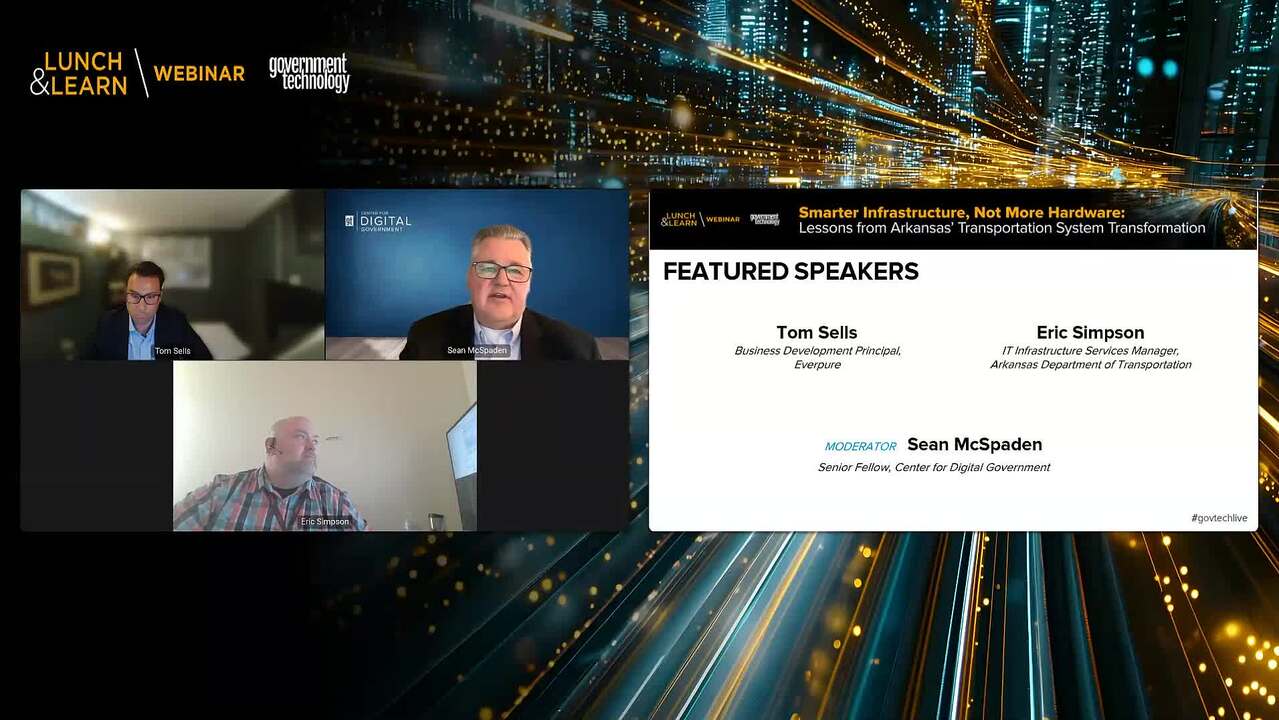
featured speakers, for today's, discussion. Tom Sells, who serves as a business development principal with Everpure, and Eric Simpson, who serves as the IT infrastructure services manager for the Arkansas Department of Transportation. Eric and Tom, I'd love to give you an opportunity to introduce
yourself to our audience. Eric, I'd like to start with you. Yeah. So I, I manage the, like you said, the IT infrastructure STaaS. So that includes networking, data center operations, cybersecurity.
So we have a, a streamlined team, not a, not a huge staff, so, so we have to do more with less. And I've been serving in this role for, for almost seven years now. Thank you, Eric. It's great to have you with us. And Tom? Awesome. Yeah.
Thank you, Sean, and thank you, Eric, for, for joining us on this. Tom Sells. I work, as a business development principal Here at Everpure, primarily focused on the state and local, and education market for US, dealing with customers' needs and challenges across the country and how they're really approaching this new era of, of IT that we're all in, and, and working together on how we
solve these challenges. So looking forward to the discussion today hearing more about, Eric's journey and, and Arkansas Department of Transportation's journey as well. Well, thank you, Tom. And, again, once again, thank you, Eric, for being with us. Just in the way of setting the stage for our conversation, you know, suffice it to say,
we're in a volatile, environment. And certainly, transportation leaders across the country are facing an unprecedented combination of challenges. You know, on the one side, there's a global NAND and DRAM shortage. It's driving unpredictable price spikes, and supply chain gridlock.
On the other hand, transportation leaders, like Eric, have to manage aging infrastructure, provide the information technology, support infrastructure, that makes, 24 by 7 traveler safety, modernization, and now this AI-driven future all possible. For the Arkansas Department of Transportation, as Eric's gonna describe, the answer wasn't to buy more boxes and hope for the best.
It was instead a fundamental shift in architecture. So I'm just very pleased that over the next 30 minutes, we'll have a chance to talk with Eric, with Tom, about this transformation, and to, to better understand how, Eric and his team transformed a legacy siloed environment into what, by all accounts, is one of the most reliable transportation infrastructures in the country.
So, gentlemen, again, it's great to be with you both. Love to give each of you an opportunity, to share some opening remarks. Eric, why don't we start with you again? You know, I think the, the key thing when you're looking at your technology strategy is first understanding the business.
We, we exist to support the business, and innovation is important when it aligns with the business needs. And so I think the, the start of our journey began with first understanding the business needs and operations across the department. We have about 34 unique and different business units in the Department of so understanding those business needs and how to align our technology strategies with those
was step one. Just some great points. You know, I've heard it s- said that, there should be no technology projects. There should only be business projects that are supported, by technology. So you, you make a great point there. Tom, any opening remarks you'd like to share?
Yeah. I mean, I think just on the backup that, you know, in, in today's climate and the pace of change and the pace of technology, you know, evolving, I really think it's important to select a real partner in this journey, you know, a vendor that you can rely on, that you can really have a partnership with, that understands your business challenges, understands the demands on the technology that
you, you know, are seeking to solve your, your key issues. And I think that's, you know, something that we're, we're obviously very proud of in our DNA as Everpure, in how we, you know, seek to be a true partner to, to the challenges that you all face day-to-day, solving some of the most complex data challenges, IT challenges that exist. So just humbled to be here, with this group
and, and to talk more about it, but, I think that's a really key dynamic, and important, pillar to, to take away in, in, this evolving climate.Uh, just a great point, Tom. You know, certainly my work in Oregon, and those that I talk, with across the country, they're looking for strategic partners. They're not looking for a transactional relationship any longer.
You know, unless that's all STaaS needed. But for the most part, we really are in it for the long haul, and really wanna set the stage, to have that strategic relationship moving forward. Audience members, we'd love to hear from you. So we do have a poll question.
The question we're posing, how is your organization currently approaching infrastructure modernization? We've provided five response options for you. While you're recording your responses, Tom, Eric, and I will have a brief conversation. We'd love to start with you, Eric.
You know, as we look at where the audience is on their modernization journey, and we'll reveal the results here in just a second, for you and your team at, at RDOT, what were the key inflection points that pushed you to move away from, again, this buy more hardware mindset to more of an Enterprise Data Cloud model, mindset? And, and what signals should other agencies, be watching for?
So for us it was, it was, you know, part of it's manageability, so when you're, when you're looking at streamlined teams and, and your personnel assets, you wanna make as common of a STaaS you can for, for managing. And, and that helps with your vendor management, that helps with your cost management.
And, and ultimately too, it came down to a long-term financial decision on what's the best way to move forward and to stay modernized. And, and I will tell you, to touch on what Tom said, the key thing as well is finding that are partners, value-added business partners, and not, you know, I have plenty of people that try to sell me things every day.
It's about finding those, those companies and those organizations that are truly willing to invest in you as a partner as well. So that's, that's also something to look at in your modernization and your selection process, is who you're choosing to be your partners. That's a strategic decision that's important.
Very well said. Tom, you know, you heard what Eric had to say about his experience. Does that align with, you know, what you're finding with your other clients across the nation? Yeah. Absolutely, and I mean, we've dealt with
this across departments of transportation, across airports, transit systems, you name it. I, I think where it all starts, kinda to Eric's point, is just what is that holistic strategy that you're gonna bring forward to your technology architecture and to your data, most importantly? Y- you know, the, the AI/ML, you know, use cases that continue to come forward, what we're
seeing more and more is a lot of the time, you know, the, the data and the STaaS to what's powering that data, how that data is accessed, across your environment, breaking down those silos where that data lives, is really important to bring your infrastructure into the next, you know, kind of this, this AI era. And so I think, 100%, and then I think it just underscores these evolving use cases and
challenges that we're seeing with customers, is coming back to the blocking and tackling of, you know, having a holistic strategy to managing your data, and, and how you have to do that to be successful. You know, Tom, I really appreciate that, that, that, advice to step back and focus on the, on the fundamentals. So, again, just some great insights.
Well, in the interest of time, let's, turn to our poll results, find out, what our audience has to say. Wow, looks like there's, quite an even split. We asked how is your organization currently approaching infrastructure modernization? We've got, essentially a tie, in the first three responses. Still primarily operating in a traditional siloed infrastructure.
Some are beginning to consolidate systems. Others are transitioning to a cloud-native architecture. And a, and a, you know, certainly a, a good bit of our audience, is, you know, in another stage of, of maturity, so to speak. Any surprises here, Tom, based on your experience, nationally?
No, I think, I think it's spot on. And, and candidly, the challenges highlighted there, really underscore what led to Pure Storage evolving to now we're known as Everpure, right? Because again, the, the challenges and, and just viewing your data holistically as an entire data plane across on-premises environments, cloud environments, wherever,
you really need to view that as one single pool of data. That's the only way that we're gonna be successful, in this day and age, is to have that unified capability across the board. And so these challenges and, you know, kind of some of the, the, the focused responses in the, in the poll, not surprising at all, and I think that's what, you know, really led to
this evolution that, that really is just It's what customers need to be successful, to tackle these new priorities and, and, and solve some of these challenges because, you really, it's, are gonna have a tough time doing that, if your data is in silos and you don't have that holistic strategy and approach. Thank you for that, Tom. Eric, I wanna turn, back to you, and, and, and
move our, our conversation, forward. Focusing back on a key term, you know, we've used a couple of times this term, set of terms, of Enterprise Data Cloud model. That's a little esoteric, unless you're in the, in the thick of it. First, you know, could you describe what that means to you, certainly what it meant to your
team?Uh, and also if you could harken back to some of the, the biggest internal or organizational barriers that, you and your team had to overcome, you know, whether they're technical, cultural, or financial, in moving your transformation effort forward. And, and, and I'm gonna kinda I gotta go back a, a, a day or two to paint the picture, cause when I adopted or took over the infrastructure, we were still heavily reliant
on a mainframe. Excuse me. We were still heavily reliant on a mainframe computing system, and we had got the first of our virtualization in place, but we still had several physical servers and some old spinning rust storage. The s- the Pure guys l- or love it when I say that because I'm not a big fan- Yeah of the
spinning disk. But, you know, it was just a lot of disparate systems and a lot of different ways of doing things. So part of that was to standardize, right? It was to, to make a concerted effort to standardize the processes and the ways that we do things on the back end and, build a high, more reliable,
more robust infrastructure. And an Enterprise Data Cloud is what gives you that reliability and robust infrastructure where you can support the organization. Because, you know, you, you deal with down-times, right? You deal with this server, caused an outage on this system, or it's a cascading outage
you have a storage area network that supports multiple applications and multiple systems. Or you've got a SQL Server that's got a conglomerate of stuff and it's a physical server and it went down. So it was a concerted effort to move towards virtualization on the server side it on the back end with the Enterprise Data Cloud.
Cause if you're gonna have a virtualization environment, an Enterprise Data Cloud is what makes a difference. And, and you know, from a culture perspective within the enterprise, it was really a matter of being tr- building trust and, and showing the value. And primarily that for us came in system performance and uptime.
We went from having a lot of outages on a regular basis to, to seamlessly no outages. So there was a culture change was a lot of building trust in that area. Yeah, I couldn't agree with you more. You know, most of these efforts, they ultimately turn into change management, initiatives.
And in particular, you mentioned trust. Trust is built on performance over time, so, you know, kind of this, this show me mentality, really can make a difference, if you're transparent about how things are working, how they're not working, the adjustments you're making. So just some great points.
Tom, I wanna turn back to you, and get your perspective from working in, in multiple states. How common, is the overpayment trap, tied to, this, NAND and, and DRAM volatility? I know we mentioned it in the abstract, for today's webinar.
And, and what should IT leaders be doing right now to avoid that? Yeah, it's a, it's a great question, and it's, a huge challenge. You know, and I think that is, really the underpinning, and, and we'll talk, you know, Eric and the team at Arkansas Department of Transportation have done this, which is move to a different STaaS model of how you actually acquire the IT
that you need. I think what we see STaaS is that you're either in one of two scenarios as you are trying to plan a traditional purchase, into the future. You know, you try to make some projection of how much availability, how much storage you think you're going to need, how much data you're gonna be processing, and you buy for
that, and you, you know, maybe give yourself a little bit of a buffer. Well, a couple of things. Number one, in today's current climate with the NAND shortages and the price volatility, you really don't have the, you know, the luxury to, to afford that, overpayment of infrastructure, right? It's really, really hard.
And so what, what our consumption model does at, at Everpure, what we call our Evergreen One consumption model, is it really eliminates those challenges of overbuying capacity or underbuying capacity. If you overbuy capacity, then you're dealing with waste. If you're underbuying capacity, your applications are gonna fail.
It's not a good spot to be in, and it's very difficult to navigate. With Evergreen//One, we eliminate that uncertainty and we just say, "We're gonna, we're gonna get you into a framework where you're only paying for what you're actually using. Cloud economics delivered on-premises in the cloud, all with our industry-leading Everpure Enterprise Data Cloud Platform but giving you the flexibility to be dynamic
because the reality is we don't know. I mean, we just don't know. There's such an, a, a constant change going on right now. It's so difficult to really pin the tail on the donkey of how much you're going to need, so giving yourself that breathing room is critical.
And we have the, the, the, the model that can get you there with our Evergreen//One, consumption-based model. Thank you for that, Tom. Eric, I wanna turn back to, to ARDOT. You know, you and your team, in, in the area of analytics, workload consolidation, you know, that's the decision between on-premises versus, versus cloud, you, you made a de-
deliberate decision to keep telemetry and analytics on-premises. What, what factors tipped the scale away from public cloud for those real-time workloads? So I think cost predictability is a big one. As Tom was saying, you know, I, I just got done doing my fiscal year budget for next year and providing a five-year pro- pro- projection, and I can do that-Because I
don't have to worry about capital expenditures for our data store, right? That's, that's something that I think we all know sometimes you'd, you'd come in for a year and go, "Okay, well, my, my data store is out of, end of life. That's gonna be a forklift upgrade of $2.1 million," and that's not something I have to do anymore. I can, I can predict, right, what my cost is
gonna be, and I, I look at my data growth across the, the enterprise, and I can also predict my subscription increase if I need to do that. But even if my subscription increases and it requires more hardware, that's, that's not a purchase I have to make. That's something in our Pure contract that, that comes in and gets put in as our
subscription increases. So that really helped drive that decision because I can manage costs in my Enterprise Data Cloud better than I can manage what Azure or AWS or any other cloud provider's costs are gonna be. Now again, it's not a cookie cutter.
It's not one-size-fits-all. There's, there's certain operations and decisions that have to be made on where is best data solution for, for which system. But overall, we made an intentional investment in our infrastructure and virtualization create our own cloud where we can control those costs ourselves.
So that was a, a driving force behind being able to keep a lot of those things on-premises, and the Hyperscale of Pure didn't hurt either because the IOPS on the, on the FlashArray storage is amazing. Thank you for that, Eric. Tom, looking ahead, how should public sector agencies be thinking about workload placement strategies, now that we're talking
about, you know, the full gamut, AI- Mm-hmm video surveillance, sensor data. Uh- Sure what belongs at the edge, on-premises, or in the cloud? Yeah, it's, it's really interesting because, the real, the real, I think where, where the puck is going, if you will, right, is that as you just mentioned, you have all of these sources of data. You have sensor data.
You have video surveillance data. You have all kinds of data sources across an environment, and especially with a transportation customer, you know, you even have that to, like, you know, an exponent degree, right? It's like that on steroids. And the real insights that you're gonna gain, through analytics initiatives, through AI/ML, are
gonna happen across, you know, multimodal data sets. You need to bring that data together in one place for you to be able to analyze that effectively and understand what those trends, are across data sets. Again, not easy to do and not easy to do in an economic way. You might think the easiest thing is, okay, well, we're just gonna go ahead and dump all
of this into a multicloud, until you realize doing this AI/ML work in the cloud is probably one of the most expensive things that you can do in the public cloud. So what is the right architecture? What makes sense? It really is environmental, environment dependent.
Every- It's gonna vary. Mileage is gonna vary customer to customer. We see instances where there's analytics happening at the edge in certain customers, where they've got a lot of different data sets and so forth, and they're doing some initial baseline processing at the edge of those environments and then sending results back to a centralized repository to try to break down and gain those multimodal
insights across locations. So it's, it's a, there, there's no one-size-fits-all with it. I think there's a lot of, you know, ebbing and flowing and, and really trying to come to an architecture that makes the most sense is, is gonna be customer dependent on your particular environment.
But that's how I think we see some of these, environments coming together and, and what makes sense for where, and that's where we think we can provide that, you know, the horsepower to do that and give you the flexibility of where you do that kind of analytics. Just some great points there, Tom.
Eric, I wanna turn things back to you, to the specifics of your business area. Many transportation agencies, they're, they're struggling, you know, like agencies program areas with fragmented systems, but in this case, fragmented systems across rail, road, air, public safety. What, what was your approach to creating a unified data, landing zone, landing zone, if
you will, and what benefits did that unlock? Yeah, I think it goes back to understanding the business solutions and finding where there's commonalities and designing the best solution and strategy that can meet the most requirements efficiently, right? And so for us, it's a lot of data.
We, we have a 2PB data store. And, you know, when you got 17,000 miles of roadway, there's a lot of data points, right? We've got a huge ArcGIS environment that we, that we have, and we have the Arkansas Highway Policy that's part of us, so we've got their CJIS data as well. So it wasn't always It was a matter of looking at the operational capabilities, which is, you
know, we're, we're a rarity because our entire data store, including our backups, is all-flash. So it had a lot to do with our resiliency as well and our cybersecurity, 'cause being able to have SafeMode on and have immutable snapshots of all of our data, if we do have a restore, having all-flash, I don't have to wait for spinning disk to, spin up and, and take hours or weeks to restore data, 'cause from FlashArray to
just rehydrate and you're operational quickly. And, and it was about selling and communicating that strategy, right? I spent more time probably out in the business community of ARDOT than I did with my technical team at times, just again, because learning the business and selling the ideas and communicating those to the business owners was critical to get them to understand
why breaking down these silos and workload consolidation, even though sometimes it, it causes some discomfort for the business units to modernize, that was a big key in, in building those relationships and being able to sell the technology and the innovation as a benefit to them. You know, Eric, just a key kind of people point here, there's nothing that helps you
build trust more than getting up out of your chair and going meet- going to meet your customers, where they live, to try to understand, their pain points from their perspective. So, just some great, great advice and best practice, insights there. Tom, would love to give your- get your thoughts about the future.
So as you look two to three years ahead, how do you see, AI/ML-driven, you know, systems, whether it be in the transportation area, or any other program area, changing the requirements for underlying IT, architecture that is being deployed out there, being implemented? Great question, and I, and I think, you know, kind of back to that flexibility point is gonna be the most critical component to it, in
my opinion. Because the reality is, we don't know what three years out is gonna look like. The, the pace of change right now, the Everpure requirements, the environment that we live in with the NAND supply shortage and how long that might be around you know, one thing I can tell you is that it's gonna look different than what it looks
like today. What exactly that looks like, I think, is, is gonna depend. And so, how do you plan for that kind of uncertainty? You need to lean in on something that is gonna give you the agility and not lock you into something ransomware, again, you're either under-buying for the amount of technology that
you need, and risk not meeting the demands of the business, or you're overpaying for something that you're not fully utilizing, and you're wasting taxpayer resources. Not an easy position to be in, and I think it's, you know, we get it. And so having a model that gives you the flexibility to say, "Well, this is what we're doing today, and we're gonna, and we're gonna give ourselves the flexibility to be in a
platform that can address all of our data needs across our entire STaaS." and then as requirements evolve, as new, you know, demands happen or, or, or come out on the, of what they're looking for in the underlying technology, we can easily, you know, shift that environment to get you to a place of what's gonna make you be successful. And then at some point, perhaps if that then, you know, you start to throttle that down, we
can do that as well too. So I think the agility and the flexibility is just gonna be absolutely critical because there's so much uncertainty in the years ahead. But I can tell you, it's just gonna need, it's gonna need that, and it's gonna need to have some performance. And, and that's really gonna be at the
and butter of all of it. Thank you for that, Tom. You know, gentlemen, we are nearing the end of our time together. Eric, I'd love to get, your thoughts in two areas. We got an audience, member question, again, on this issue of operating in, you know, highly siloed legacy environments.
And, you know, you, you, I'm gonna paraphrase here, your team engaged in a transformation effort, and any time you use that word, you know, the effort can be non-disruptive. So the question that was asked, what were the first practical steps ARDOT took to begin consolidating and modernizing without non-disruptive transportation operations? Now, before you answer, we, we I, I'd love for you to, briefly respond to that, but also
share any of your parting thoughts, key takeaways you'd like to leave our audience with. So take it away. You know, I think the first thing about transformation, a- and this is key, is you cannot be afraid to fail. You're gonna hit your bumps in the road.
Technology isn't perfect, and innovation isn't always perfect. But it's about building trust and communication with the business units that helps you get through that. So it's definitely, we have to move out of our IT closets, if you will, and out into the business community to really build that rapport and build that trust.
But not be afraid to fail, and be able to address it when it happens. And as far as a first practical step, it was really, getting that first virtualized environment, getting that first major system moved over, and just providing proof and evidence of how efficient the modernization would work. And, and really walking through the steps and doing your, your, your testing, validating,
making sure that you've checked as many of the boxes as you can, but remembering that most of it's an 80% solution violently executed, right? You're never gonna have perfection. Yeah. Great, great thoughts. Thank you so much, Eric. And Tom, I'm gonna give you the last word, 30 seconds.
What key takeaways would you like to leave our audience with? Yeah. I, I mean, I, I just think one, one thing we can all be certain of is change is constant, and so having that partner strategy with your vendors is gonna be critical. You know, we, our, our Charles Giancarlo just came out with a letter to customers
commitment to partnership, highlighting our commitment to not profiteering off of this crazy s- you know, supply sh- chain shortage and all the navigating that we have to do around that. So we're here to help, and, and, and be a partner through this journey. We look forward to that. We've had a great run with Eric and the team
out in Arkansas, and look forward to helping solve these issues, that present themselves with customers across the country. Thank you, Tom. Well, Eric and Tom, we're gonna have to close things out there. I wanna thank you both for your time, for your insights, for your best practice advice, to our audience.
I'd also like to thank Everpure for making it possible to have this important webcast discussion today. And finally, many thanks to all of you for spending your scarce time with us. We know you have choices. We thank you for being with us, today.
We look forward to seeing you all again soon at another government technology event in the near future. And with that, I wish all of you a great rest of your day. Tom, Eric, great to work with you. I hope we get a chance to, meet and do it again, sometime soon.
Appreciate it, Sean. Thank you. Thank you, Eric. Yep. Thank you for having me.
Transportation agencies are under pressure to modernise aging infrastructure, keep critical systems running, manage growing volumes of operational data, and do it all within tighter budget expectations. This webinar looks at how the Arkansas Department of Transportation approached that challenge by rethinking architecture instead of simply adding more hardware. Hear how ARDOT reduced silos, improved operational continuity, supported real-time traffic and telemetry use cases, and built a more resilient foundation for modernisation. The discussion covers data readiness for analytics and future AI-driven initiatives, stronger cyber resilience, non-disruptive infrastructure evolution, and a consumption-based model that helped make five-year budgeting more predictable. For public sector and transportation leaders, this is a practical look at how smarter infrastructure choices can improve service reliability, reduce risk, and keep more resources focused on mission impact.
We Also Recommend...
Personalize for Me
My Updates
No updates at this time.