

25:56 Webinar
Product Roadmap and Platform Innovation
Everpure leaders walk through roadmap priorities and the latest platform innovation across the business.
This webinar first aired on 17 June 2026
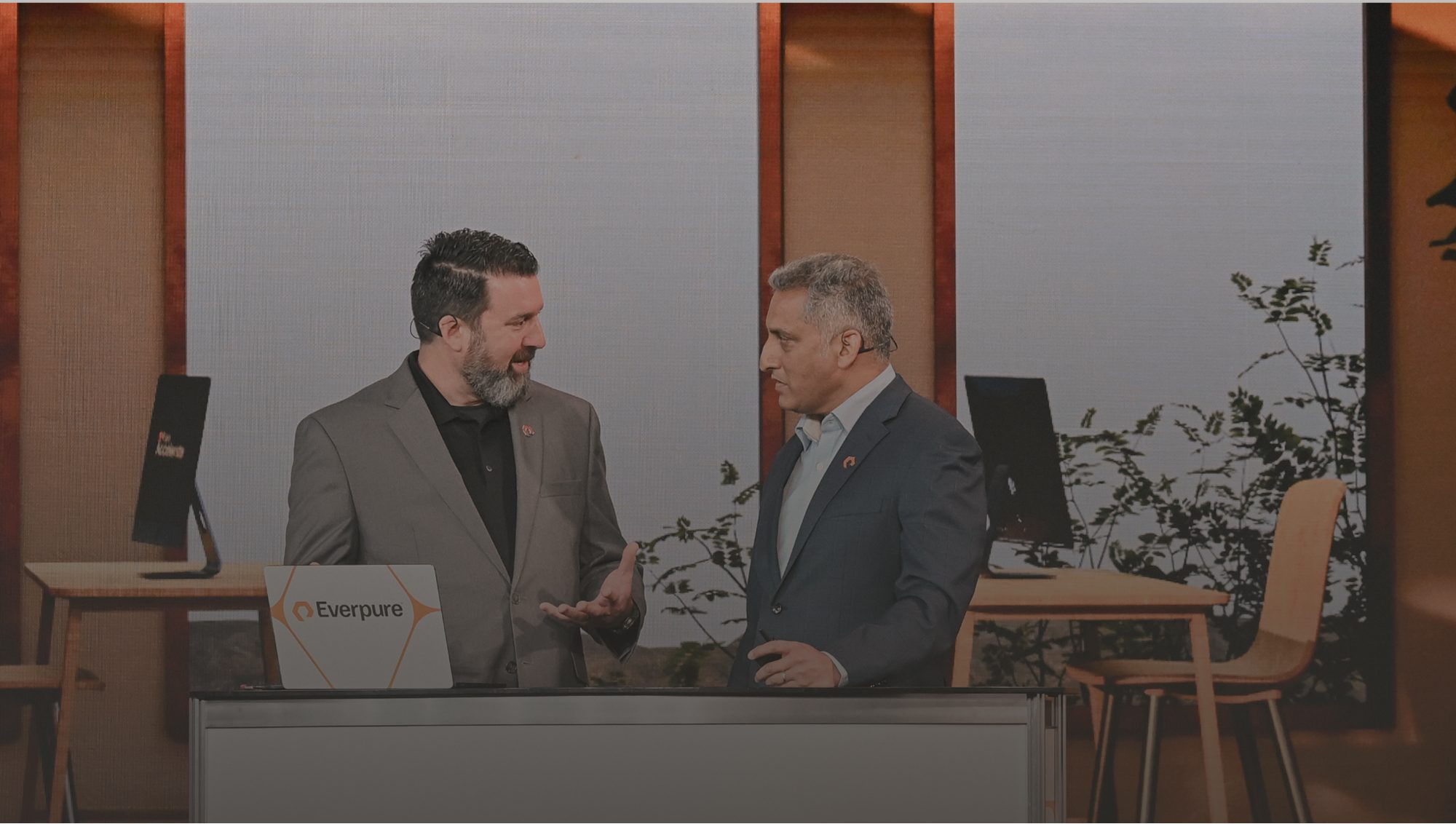
Click to View Transcript
Good morning. Good morning. Charlie just showcased a massive evolution. An evolution between an application-centric world to a data-centric world where data's at the core and context is shared. Last year, we showed you how to build your own enterprise data cloud.
This year though, we're gonna showcase a ton of killer innovation and a few really awesome demos as well to allow you to be able to thrive in this new world. It's all gonna start off with the unified data plane. This virtualized cloud of data that allows you to run every possible workload, from archive to AI across edge, core, and cloud.
After, we're gonna talk about one of my favorite areas, the intelligent control plane giving you autonomous operations based on intent and policies. And then lastly, we're gonna talk about what Charlie talked on, about the universal data intelligence layer that gives you the ability to be able to discover, classify, and contextualize your data to get meaning of all of it.
So let's start with the unified data plane and how you actually store your data. You know, we provide a bunch of different use cases across our unified data plane, but I'm gonna cover a couple key areas with some unique differentiation. One of my favorites is mission critical applications. You know, EverPure's always been known for simplicity at scale.
You add new controllers, you get the benefits of it, and it's simple all along the way. But our competition on the other hand, has been complex and challenging. They just add more nodes, use more rack space, get more inefficient, more complex along the way. But with Pure, you just swap out controllers, get net new performance gains, capacity
increases, and we provide some absolutely ridiculous results. Nine hundred and thirty percent more IOPS per rack unit, three hundred and ten percent more IOPS per watt, and four hundred and sixty percent more terabytes per rack unit compared to all of our scale-out friends that are out there. But what if you just need just a tiny bit more headroom, making sure you deliver on your SLAs?
Well, we're excited to announce a new capability with the XL one ninety called Purity Turbo. It gives you the ability to handle workload spikes by leveraging the secondary controller for read-centric operations. This allows you to protect your SLAs for your various mission critical applications. But let's see how it works in practice.
So imagine for a quick second you've got an Oracle workload rocking fifty thousand transactions per second and maybe a little retrieval augmented generation at the same time. But at nighttime, you've got a different story. You run ETL backup or ETL processes, backups, and it starts to actually cause potential for
impact to your mission critical workloads. But what if you had the ability of being able to actually get some headroom on that secondary controller, allowing you performance capabilities to meet the service levels with no additional complexity, just giving you that headroom, that's available? Our Evergreen One friends out there who use our storage-as-a-service offering, we're
giving you performance gains as well, called Overdrive. Get a performance boost when you need it, instant access to it, only pay for when you actually use it, and it allows you to, again, be able to make sure you achieve those SLAs for your mission critical applications. Now in the cloud, mission critical applications are being deployed all over the
place, and we're excited to announce that, the general availability of Azure, native VM support for EverPure Cloud. It gives you the ability to not only reduce your cost by about forty percent, but run those mission critical workloads with the software that you love within Purity and give you that Azure native experience with EverPure Cloud running natively.
All right. So let's jump to the next series of workloads, analytics and AI. It's been a massive growth area for us, a- as customers are starting to rationalize their data and really try to get value out of it. We've always believed that the next generation applications will be built on object. It's a common data layer that many of us will use in the future, and it
needs to exist everywhere. It has to go across edge, core, as well as cloud, and have it be actually understood and rationalized across each of these. And so we're doubling down in this area, adding a bunch of new key capabilities, not only managing this via our intelligent control plane, but also adding in capabilities such as
tagging, life cycle policies to build better efficiencies, alerts and notifications so that you can kick off workflows. And one that everyone's been looking for, which is strong consistency, allowing your data to actually be available in all locations and consistent all along the way. FlashBlade XO we announced last year, it was a killer product built for ultra scale, talk
tens of terabytes per second. Our GPU cloud friends were just dying to get this. It had a metadata optimized engine that was the core differentiator, and it was able to deliver over four billion metadata operations per second. We ran some benchmarks, delivered ridiculous results.
Started off at sixty-three hundred where most of our competition, in fact, I think the best benchmark was five thousand. We were able to deliver it in, a, a sixty-three hundred AI jobs for a spec result. Since then, we pushed the envelope even further and got greater than seventy-two hundred, nearly fifty percent more than any benchmark that's ever been
delivered for spec AI. We're also adding in new capabilities that our, you know, larger cloud environments have been asking for, things like multi-tenancy, quality of service, as well as, security enhancements to really be able to make sure this scales effectively. All right. So one of my areas that I absolutely love, and
we spend a lot of innovation in this area, is enterprise file. Now, our innovations typically are about two net new features per week per platform. It's a lot of innovation constantly coming out and much of which went to file. But we've added in a lot of different capabilities, multi-tenancy, security, protocol expansions, fleet level views to make sure it's intelligent with our intelligent
control plane. Now, I know many of you are probably not keeping score, but I know I am. Scorecard's looking pretty good. We've been leading the file space and leapfrogging the competition dramatically in various different areas out there.
Our growth in file has been spectacular. If you're not running file today, you should. Take a look at it. We've got a bunch of innovation in this area. But we were missing one key capability that absolutely everybody wanted, and that was synchronous replication.
Well, I'm excit- excited today to announce that we've extended Active Cluster to include file, giving you not only not the old school replication that's the old hardware-centric model, but a fleet level view that's policy driven, all fully automated. It's pretty magical. In fact, let's show you. Matt, come on stage.
All right, let's rock and roll. Let's see how it works. And we have been waiting to show this for a long time. So historically, bringing synchronous replication to file workloads has honestly required a bit of a PhD in, you know, suffering. But we are determined to change that.
So today, we're giving you a first look at what we are cooking up for the future of file. So let's take a look at how we provision a mission critical file workload without that traditional Monday morning postmortem. So we don't configure exports from scratch anymore because humans are just terrible at typing.
Instead, I'm gonna select this Oracle file blueprint, and doing this embeds our zero recovery point objective policy directly into the deployment. What's awesome here is it's taking all of the configurations that you'd typically do manually and actually bundling it together so that you can repeat this every single time. Exactly. Really just bypassing the joy of manually
configuring managed directory exports. So normally, we're trying to find the right place for a massive workload involves several spreadsheets, a whole lot of meetings, and then let's face it, at the end of the day, we're just probably gonna point, click, and guess anyways. Probably. So, but Fusion on the other hand, provides intelligent recommendations for us instead.
So immediately, it's already suggested putting the primary target in Santa Clara, which is replicating over to Mountain View. Now, it's already verified that we have plenty of performance headroom, which is obviously so much better than finding out that we don't at 2:00 AM on a Saturday. That's for sure.
So we're gonna advance to the final review screen. We'll confirm our settings, and then we're gonna hit deploy. Now, back on the dashboard, the workload's already live, it's secure, and it's auto tagged for cost tracking. Well, that's pretty simple, but you can't show a synchronous replication
demo without a failure. Come on. Fine, let's step it up. All right. Our pristine demo environment is just way too quiet. So let's induce a catastrophic failure and see if that zero RPO policy actually holds up. So here we have a side-by-side view of our arrays.
We're monitoring live traffic, and Santa Clara is currently handling the entire load. We're now gonna simulate a data center vanishing. We've all wanted to do that. And now Santa Clara is offline, and the workload quietly packed its bags and it lives in sunny Mountain View now. Nice spot. So, you know, there wasn't
any manual intervention. We didn't panic, and it was completely uneventful, which when it comes to disaster recovery, is exactly what you want. Very cool. Yeah. Synchronous replication, fully automated, all of it built in, fleet level, so it moves across the infrastructure. It's pretty killer innovation.
All right, so now we're gonna jump to governing the data. We've been building an autonomous platform for a long period of time, and for those who have been using Fusion, you've gotten to experience some of the capabilities. Within this, we have a lot of different key capabilities, and we'll show you some of them today.
It first starts off with driver assistance. It's giving you recommendations. You say whether you want to do it. Next, we're gonna apply conditional automation, meaning you delegate. Say, "Hey, every time you see this, just go ahead and do it." After that, our goal here is
to provide full autonomy. Think more about the data, less about the infrastructure, and it just manages itself. The reason being is 'cause ad hoc management has made just an absolute mess of an infrastructure. There's zero data controls, no groupings to even understand what's mission critical, no
understanding of service levels or intent. It makes a maddening challenge to actually control the data. What we've decided to do is build in data controls that allow you to take a storage configuration, which we do really well at today, but actually attach to it service levels, your intent, and your policies to that so that it actually can go manage itself, and
do so at a fleet level versus an actual array level. But what's killer is you define it once, and if you want to change it, you can just change it and it will auto enforce that new intent. So let's look at a fun example, 'cause I like to look at these examples. This came from a customer.
They had a ransomware attack, and they actually needed to go extend their snapshot policy to 15 day, to 30 days. They were at 15 days. Just think about how much time that would take you to, to figure out. You'd have to go into each one of these systems and manually configure them, fix every
one by hand. But instead, if you have intent-based infrastructure where policies drive the change, you can see where things are violated, or, where violations exist. And you can go make the change to the policy, and in one swoop, change all of them to the correct configuration.
That's some fancy slideware magic, but maybe we should show our friends what we're cooking up here. Sounds like a good idea. All right. So policy exactly is how we prevent human chaos from overriding our data control. So let's say we've got that new ransomware, mandate that suddenly dictates all critical
workloads must have 30 days of snapshot retention. Now, instead of logging into dozens of individual arrays and performing the same clicks until our wrists hurt, we can change the baseline once within Fusion. So let's see how the fleet handles that news. Let's do it. When we look at our overall fleet compliance,
we get an immediate operational reality check. This is a live unified view of compliant workloads, active violations, and exceptions across the entire enterprise. That is a seriously lot of violations right there. Yeah, but they're not necessarily because of that snapshot policy change.
That's true. So let's figure that out So since that is the latest mandate top of mind for our CISO, let's filter for it. We'll filter out dev and test, 'cause anybody here worry when those go down? And then we're gonna filter for the snapshot policy, and there it is. Fusion's already flagged a single outlier.
We've catched the gap right here in the table that we're only at seven days retention. Nice. Now fortunately, Fusion's not gonna judge us for this. It's just going to build the remediation path. Now, the platform is completely capable of fixing this autonomously, but for a production workload that's this critical, we still want humans in the loop to provide that final
approval while the system handles all of the heavy lifting for us. Now finally, active governance requires absolute accountability, and we're gonna step into the audit view where there's a complete immutable paper trail. So this is pretty cool. You can actually see this autonomy journey we were talking about up here, where you have certain ones that are user-driven, certain
ones that have been delegated, and others that have just been fully automated. Yeah, it, it's a perfect gauge on how the automation is actively protecting the company, and at what level we still have humans in the loop. So if we open up our ala-- audit report here, we can look for that snapshot change. We get the full details of what actually occurred.
Plus, we've got the full timeline from the exact moment that the violation was detected to the moment the details were reviewed straight through to execution. It's more than just- Yeah a window into an audit trail. It's, it's, it's, you know, a look at the autonomous engine that's treating your policy as code, ensuring that your organization's mandates are strictly enforced even while
you're sleeping. Wow. Think about how much time you would save without having to do all these manual operations. And better yet, how mu- better you'd sleep at night knowing that these things are actually autonomously being managed.
Well, what's great is we are delivering Fusion compliance reporting and remediation this year, giving you the ability to be able to not only apply these policies, but enforce them through recommendations or through full autonomy, giving you the ability to manage the infrastructure through intent. All right, let's jump to the next big challenge we all deal with.
It is sometimes the bane of everyone's existence. It is performance firefighting. You typically are super reactive, or you have to, you know, you get a call from an application owner who says, "Hey, my application's not performing well." And you have to figure out what on the infrastructure is problematic.
But imagine for a quick second if you had the same kind of experience you do with our support infrastructure, where it predicts issues before it actually occurs, and you don't have to deal with the performance issue. It fixes itself. Yeah. I mean, it's amazing seeing that we've come such a long way from just making
recommendations to that fully autonomous remediation without having to touch a line of code. It's pretty awesome. And the reason why people loved our support is 'cause it protected you from potential issues before they occurred. Well, we're doing the exact same thing on the performance side of the house.
We know the SLA that you've defined, the service level, and we can predict that issue, before it actually occurs and send you warnings of this so that you never get a call from that application owner. You get the violations and a proactive recommendation. It then goes off and dynamically moves that workload to an alternate system to ensure
systems stay balanced and operations stay functional. Yeah, for, I mean, anybody who's babysat a migration like this, right? That change window is completely stressful, so- It's a pain let's take that away from you. Let's show it off. Okay. Heck, yeah. So the true power of an intelligent control
plane, it's not just enforcing the rules, right? We're gonna prevent those infrastructure crises before they can even happen. So let's look at how the platform uses intent-based management to deliver fully autonomous capacity rebalancing. So here, the system has detected a risk, and it's automatically rebalanced that workload to
protect our capacity headroom. Interesting. I wonder if that ransomware policy change we did earlier changed anything in the fleet. I mean, obviously actions do have consequences, right? But that change immediately put us on track to breach our strict twenty percent headroom policy within eighteen days.
So like what you saw in Chad's example, you know, we're not just gonna k- manage capacity. We're also gonna continuously scan f- for performance. So over in the fleet view, it's already tagged a potential risk to our service level objectives on another array. Now, clicking into the recommendations here, we get a lot more detail of the distinct paths
that we can take to fix this. So instead of making us guess which target array the right-- has the right performance profile, it's gonna intelligently highlight the optimal move to rescue our service level objectives. Now, in the details, the chart's gonna show us exactly how this plays out.
We're gonna drop from our rising four point two millisecond latency back down to being well within our service level objectives, and that's a win for everybody, right? The application's gonna perform better, and the array's projec- dropping the array's projected load from eighty-two percent down to fifty-six gives everything staying behind some extra breathing room. You know, the, one of the bigger concerns here
though with dynamic mobility is always vetting this before it actually occurs. And- How are we doing that? And we've got that covered, right? Fusion's already gonna vet that move because obviously causing an outage while you're trying to, you know, manage some, some latency here, that completely just defeats the purpose of even having that SLO.
So while that data copy is running, just keep in mind this whole process is happening while the application is live. People are in the middle of calls. They're streaming data right now, so we really don't have any room for hiccups here, right? If, if we're at a site, we're doing our jobs right.
Oh, yeah. The platform's gonna seamlessly transition our host paths. It's gonna sweep away the original source data, and it brings us back within spec without a single person even noticing that their data just moved. Love the automation, love the capabilities of proactive.
i- it's gonna be fun for you guys to experience this as a fully autonomous, fleet. And so we'll be in a-- we're, we'll be delivering this later this year, full rebalance and workload mobility, giving you the ability to avoid service level violations and move workloads dynamically without disruption. Thank you. Awesome. Okay.
So one quick example. I love talking to customers about what impact it has, and Options was able to reduce the manual efforts by about eighty percent, allowing the team to focus on much more strategic aspects. And so that's been a big win for them to see a lot of what we're building up here.
Awesome. All right, now we're gonna move on to, governing, or understanding the data, sorry. I'd like to, welcome, the former CEO of OneTouch, and the new GM of data management, Ashish Gupta, to the stage. I'm excited to be here.
Understanding your data is critical in today's world of data-driven decisions and AI. However, this is not easy. Data is fragmented across siloed infrastructures and applications. Unstructured data is growing uncontrollably, 90% faster than structured data. And compliance laws are being added on a daily basis.
All this put together is making all of your lives harder because it's hard to understand the data, manage it, and more importantly, govern it sp- specifically. And if that was not enough, AI is consuming data from everywhere, regardless of policies. But what is scarier is that AI needs context.
It needs context to be accurate. For all us Waze users out here, context is the information about traffic. Context is the information about the policeman hidden behind the overpass. That's why I use it. Waze's AI uses this context to determine the best route to get you home safely.
But adding context at the right time with the right context is just not easy. But the good thing here is that Everpure Data Intelligence is here to bring this understanding of your data and unlocking this data in a most contextual way. First, we discover your data, regardless of where it sits. On premises, on the cloud, even on mainframes, structured or unstructured,
on Everpure storage or other storage devices as well. Second, we classify it better than anyone else in the industry, and then the magic happens. We start to add context based on how data is used within your business processes and how it relates to other data within your organization.
Matt, I would love to show this to the audience and how it really works. Absolutely. I, I will warn you, I'm a newbie here, so help me out. Okay. So the greatest risk to your organization is not the data that you know about, it's that shadow data that's hiding out in the corners that you don't know about. And Everpure Data Intelligence is gonna bridge everything, like you said, from cloud storage
to databases and file servers. Now, automatically, it's gonna analyze your structured and unstructured data no matter where it lives. Now, take a sports medicine network, for example. A data leak here doesn't just look bad, it could actively tank athlete trade values and fuel insider betting.
And we use data intelligence to automatically isolate this high-stakes information. Now, across completely separate sources, the engine has immediately flagged all of these files containing sensitive athlete profiles. Does this data have to sit just on Everpure storage? No, completely agnostic. Anywhere.
That's amazing. Now, Everpure Data Intelligence is gonna help us understand where that information lives and how it moves across the organization. Now, as we go into the data graph, think about your own data. I mean, does any of us really know where all of our sensitive information lives? I mean, we like to think that our data is completely c- consolidated in a nice database
like these patient email addresses. However, if you click into the athlete social security numbers, these things are everywhere, sprawled across cloud buckets, file shares, and exposure of this data is a headline that nobody wants. So take a look at this Word document, for example, that Data Intelligence found within a file share.
Within this are nine different types of data exposed, from social security numbers to diagnoses. And when you're sharing terabytes of data a day with research partners, that is an expensive breach waiting to happen. So with Everpure Data Intelligence, we can trigger remediations on the fly.
That's terrific. Or, or redactions. Now, to show you the real human impact of this technology, let's look at how these disconnected data points actually come together, automatically mapping the business relationship context across separate sources. Now, Ashish, you were telling us this story the other day.
It's like, dude, we have to put this in the demo. It's so cool. Yeah, you know, this is a real-life scenario. In addition to that, we did discovery and classification of all the personal information that this client had. And interestingly, we found 70% duplicative PII and PHI information.
That's the metric people use to decide on what the cybersecurity premium is. We saved them $2 million in the first year of our service. That's incredible. And this story, too, was, you know, just an interesting use case of how, how everything could come together. So to show you how this real world scenario
played out, let's take this anonymized case of an athlete that we're gonna call Shane Falco. Now, buried in a PDF on a file server, Data Intelligence has surfaced a hereditary heart condition and instantly linked it directly to his estranged dependent's Social Security number. And that dependent is his son, Johnny, whose records were siloed in a completely separate database.
And because Everpure Data Intelligence linked those sources, it flagged a critical gap that the son shared that same genetic risk but had never been screened for it. And a preventative test led to an early, highly treatable outcome. So that's Everpure Data Intelligence, right? And that context really helped make that decision.
Yeah, yeah. You know, and we're gonna shine a light on your, your shadow data, help neutralize risk, and automatically connect dots that everybody else misses. That is terrific. Yeah. Thank you. Thank you so much, Matt, for sharing this.
As you see, Everpure Data Intelligence really delivers results, starting with total contextual visibility, allowing applications and AI, as Charlie said, to use the data in a secured and governed way. And at the same time, making AI more accurate and efficient by only using smaller, relevant, context-rich data sets.
All of this available on Everpure's highly scalable infrastructure. With that, I'd like to say thank you, and welcome Chad back on to wrap up the session. Right. We showed you how the enterprise data cloud comes together. The unified data plane stores the data, the intelligent control plane governs the data, and our new universal data, intelligence
allows you to understand the data. Together, they create a new operating model where governance follows the data, AI operates at enterprise-wide context, and the platform continually optimizes itself. This helps you be able to evolve from that application-centric to data-centric world. This is the true power of the enterprise data cloud.
Thank you.
This roadmap segment highlights the latest product direction, platform investments, and innovation priorities designed to help customers move faster and get more value from their data.



Personalize for Me
My Updates
No updates at this time.