50:39 Webinar
Enterprise Data Cloud: From Vision to Blueprint
Watch the Pure Accelerate Thursday keynote featuring the Enterprise Data Cloud blueprint, customer transformation awards, and what’s next for innovation.
This webinar first aired on 18 June 2026
Click to View Transcript
Good morning. Good morning. Well, did everyone have fun in Zouk last night? How's everyone feeling? Great. Amazing energy that we're gonna carry here into day two.
I gotta tell you, Lynn Lucas, I was there. I stopped by for a moment, saw a few epic dance moves. Yeah, w-well, yeah. Okay. So but more importantly, more importantly, I saw our community in action.
I also overheard some conversations when I could hear, around navigating the AI/ML that everybody seems to be having, but moving forward together also. So, the Everpure community, that's what this week is all about. That's right. And yesterday, we expanded our vision of EDC and talked about the why, the need for better data management in the AI era.
Today, we are gonna connect to the how. That's right. And so we're gonna move from vision to actual blueprint. So what is in store for today? We are gonna dive into the tech architecture of our Enterprise Data Cloud.
We are gonna have a fireside chat with Red Hat and CSX, and then back by popular demand, fun with the bun with one of our customer and community leaders. Of course, followed by, everyone's favorite session, "John ""Coz""" Unplugged. And then we're gonna close with a super special guest. It makes me wanna break out into that song.
I won't, 'cause we know I don't sing well, but Terry Cruz is coming today. Yeah, that's right. So let's get to it. We're gonna walk through the EDC success blueprint and show how we turn policy-driven data management into an actionable plan to drive business outcomes.
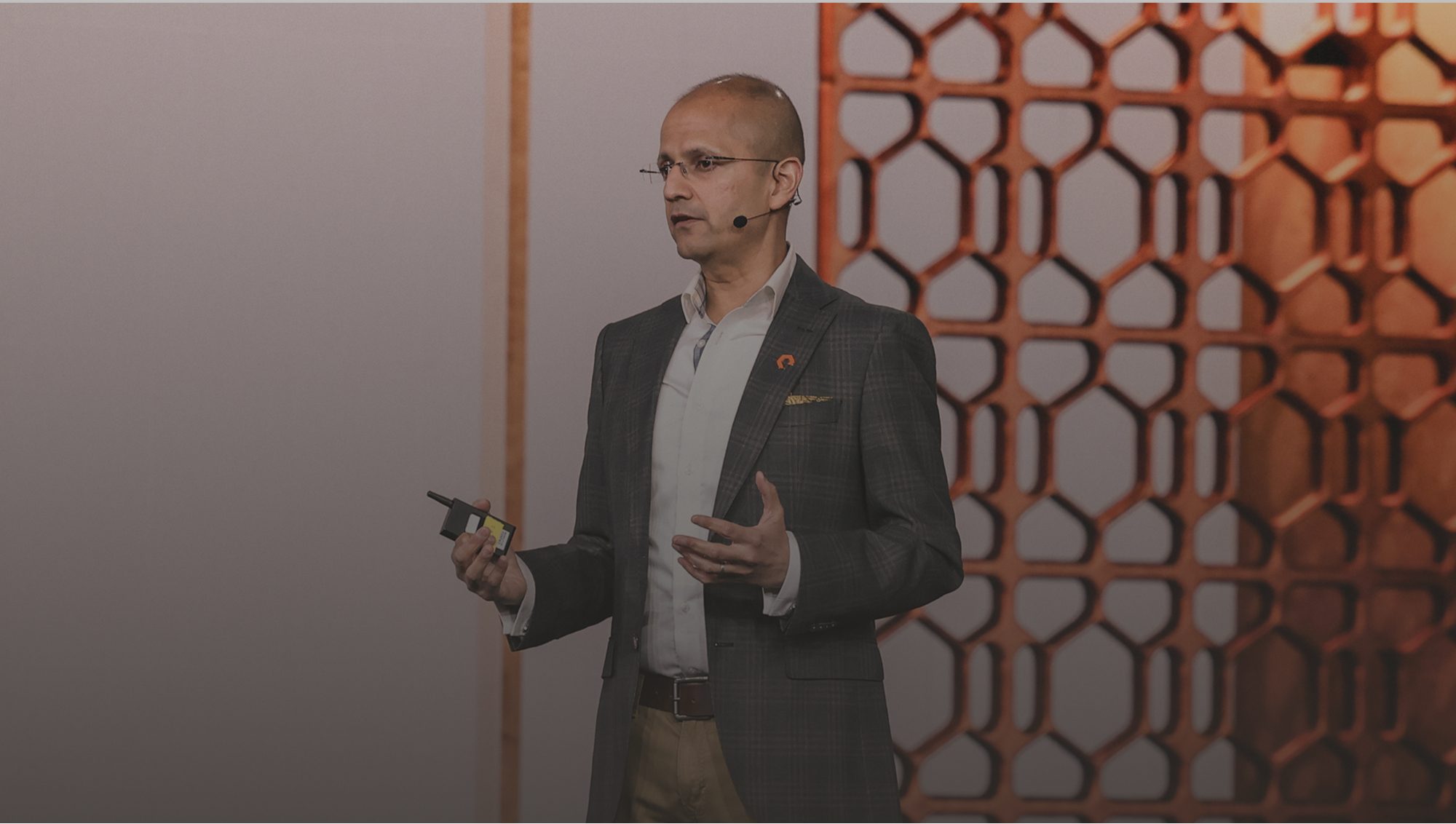
And with that, please welcome our worldwide VP of systems engineering, Nirav Sheth. Good morning. Good morning. Ajay Singh. I think you all were at the nightclub a little too long last night. Good morning. How's everybody doing? Good. All right. Now, some of you might remember that great
eighties song, "Nothing But a Good Time," and so when you invest with Everpure, we promise you nothing but a good time. Now, speaking of a good time, what'd you all think about yesterday? Yeah. Pretty exceptional, pretty exciting stuff. And one of the key takeaways I had was to really recognize that the foundation
of not just our architecture, but the foundation of everything that we do and the foundation of our business is underpinned by data. From an Everpure perspective, as Charles Giancarlo laid out, what we want to do you to be able to take charge of your data and how are we gonna get there? Well, it starts with the Enterprise Data Cloud.
Our Evergreen Architecture, keeping you Evergreen//Forever. A unified data plane powered by Purity OS, enabling you to support all of your workloads. The intelligent control plane, Pure Fusion, the ability to virtualization operate at Hyperscale from the edge to the cloud, and all of the new software
capabilities that we are bringing to life, this is how we're gonna be able to enable you to break down all of the silos and put you back in charge of your data. Now, all this is really, really cool, but I know when you're making an investment decision, it's not just about buying from us because we're cool. Well, hopefully, you know, you do factor that in as a part of your RFP process, but
it's more than just about being cool. You're making an investment because you've got serious issues you're working through. You might be thinking about, "Hey, with all of the supply chain constraints, my budgets are blowing up and I've got to drive more automation and I've got to do more with the same amount of people." You might be thinking about, "I've got to have a flexible and an
agile platform that's gonna be best in class for VMware, but also is ready if I were to make a change later." You might be thinking about the cyber climate and how do I restore minimum viable business in the event something were to happen? And so as we take that up a notch, all of that ultimately ties to business outcomes you're seeking as well.
It's not just about the technology. Thinking about VMware optionality or accelerating your data pipelines for AI/ML, that's all about agility. Thinking about the restoration of a minimum viable business, it's all about risk reduction. When you think about how do I do more with less?
How do I expand my estate without investing in more people 'cause my budgets are blown up? That's all about efficiency. And so what I'm super excited to announce today, and it's something a little bit different than what we've done in the past, is what we are calling the Enterprise Data Cloud
Success Blueprint. Now, historically, we've armed you with a lot of things. We've armed you with reference designs, validated architectures, configuration guides, and so much more. I saw Eric Knapp in here from Cisco. We've got FlashStack with AI/ML just as an example of that.
But what we want to do Is take that up a notch. And now what we want to be able to arm you is with a structured methodology that enables you to tie these technology investments that you're making into how you can enhance your risk posture, how you can drive unparalleled efficiency, and how you can drive and introduce more agility into your environment
than ever before. And not just at those high levels, but specifics, people, process, and technology. So if you're thinking about risk, how can you constantly have compliance across your environment despite the moves, adds, and changes of your data? If you're thinking about efficiency, perhaps you need to think about energy efficiency.
Perhaps you need to think about automation. If you're thinking about agility, not just agility at a high level, but specific capabilities within agility, such as getting ready for AI. Now, how are we gonna make all of that come to life? Again, Charles Giancarlo talked about breaking the silos and your data.
The Enterprise Data Cloud gets you there, and the Enterprise Data Cloud success blueprints is the structured methodology to bring that all to life. And so what are some of the specifics we're gonna be making available to you? It starts with a STaaS. A confidential self-assessment where you can go through and evaluate across all of these
areas and understand how you benchmark across against best in class. And it's confidential, so we need you to be honest. Not like me when I did my DFM license renewal. I might not have been completely honest about my weight.
But that doesn't help anybody in this STaaS. Need you to be honest. Then we're gonna arm you with blueprints, playbooks to help you evaluate, how do I get from where I'm at today to where we want to go? And customize to your business on-premises dedicated workshops where some of the brightest minds in the organization at
Everpure will come to you and help you build out a multi-year plan to get to where you want to go. Now, I'm not just excited about all of this because I had a double espresso right before I came on stage. I'm excited about this because we've been working and piloting this with customers around the world. So an example is a great customer that we
worked within Europe, major manufacturer. We were able to sit down with them, go through this approach, and our champions were able to present to their CISO and CIO, and now their CISO and CIO understand that this isn't just a technology investment. It's gonna enhance their risk, and it's gonna enable them to drive gross margin expansion.
And so now we're on the path of transitioning 80 manufacturing sites that they have around the world away from legacy onto Evergreen//One. So I know many of you want to get your phones out and multitask, so I'm giving you permission. Get your phones out, take a photo of this QR code, and we can get started right now.
If you're interested in learning more, take a snap. We'll get you the STaaS. We'll get you the guides, and we will schedule that dedicated, customized workshop focused on you, your needs, and your outcomes, and help you build a multi-year plan. Thank you very much, and I hope you have a great rest of the event.
And now a couple of sponsor videos. To the technology leaders building the future, the rules are being rewritten in real time. Every decision is critical. This moment demands a trusted partner. Nutanix delivers an open and secure software platform ready for enterprise AI.
One seamless experience anywhere your business runs. So when it matters most, you're ready. One platform. One experience. Only Nutanix. Hi, all.
I'm back. Thanks, Nirav. That was fantastic. I hope that you all enjoyed hearing about the blueprint and how we're really helping customers build out their Enterprise Data Cloud. So the EDC approach is all about building a foundation that really handles change and
what's coming next. And so I know many of you are on this modernization journey already, and so I want to shift a little bit, though. We're gonna shift, gears, and we're gonna talk about- You know, the, how to do this in a modern virtualization setting.
So I'm really excited to introduce our next guests, Greg Muscarella, who is our general manager for Everpure Portworx, and he's gonna be sitting down with Red Hat VP of Software, Joel Jackson, and Lead Senior Product Manager at CSX, Eric Graybill. And so before we welcome that, out onto stage, please get a little bit more background on CSI with this video.
This is PX-CSI redefined. A 200-year-old story in the making, standing at the forefront of innovation and efficiency. With powerful momentum, we're pushing the boundaries of what's possible in freight transportation. Backed by our proven operating model, our commitment to excellence is fueling every
decision, every mile, and every customer interaction. Delivering innovative strategies that aren't just about moving goods, they're about moving industries. With cutting-edge technology and a relentless pursuit of efficiency, we're setting new standards for the future of transportation.
Twenty-three thousand strong, twenty thousand miles of rail, twenty-six states. Connecting customers, communities, and culture. Our vast and enviable network is the backbone of countless supply chains, ensuring that essential goods reach their destinations on time, every time. Our mission is toward profitable growth through teamwork, strategic investments, and a
focus on sustainability. We're not just enhancing our bottom line, we're building a robust future for our customers, stakeholders, and partners. CSX, we're pulling for America. All right. Well, welcome everyone.
All right, all aboard the, the virtualization journey. Well, listen, customers are looking for a single platform that can run their AI/ML workloads, their virtualization workloads, and their container workloads. And Everpure and Red Hat have been partnering for years to deliver that workload consolidation platform.
So I'm very excited that I'm joined by two very special guests today. I've got Eric Graybill from CSX. Now, Eric brings decades of experience navigating multiple waves of infrastructure transformation, and he continues to evolve the platform at CSX to adapt to what's next. I'm also very pleased to invite-- or to have Joel Jackson here with me on stage.
Joel from Red Hat brings a very broad market perspective. He works with a lot of organizations across a lot of industries as they make key infrastructure decisions. So I wanna start with Eric here. Eric, can you tell us a little bit about your modernization journey and how you're thinking
about it? Yeah. Thank you. Great to be here, and thanks for the opportunity to share a little bit about PX-CSI's story. So we already are on our modernization journey, where we've migrated about 80% of our applications onto Kubernetes, OpenShift specifically, so containers.
And those applications run both in the cloud and on our on-premises in our own data c- data centers. So as we look to virtualization, I said eighty percent are moved to containers, we have twenty percent left running on legacy VMs. So as we looked, our priority was, simplification and flexibility, and we had
that experience, over ten years of experience with OpenShift. So we didn't wanna have disconnected stacks to manage, we didn't wanna have to, retrain our, our STaaS and, and a whole new pane of glass, a whole new application. So one operating model across VMs and containers really just made sense. We also wanted a, a, a practical transition path, that we didn't have to big bang move
everything at one time. We have moved successfully quite a bit of it, but at our own pace, we can move those remaining twenty percent onto the OpenShift platform. And then, we have-- if we ever need a mix of between cloud and on-premises, we can flexibility, as well as the, the reliability that we've come to know from OpenShift.
That's a broad ecosystem that you operate across. You know, we all understand trains. They're very, very easy to get. We see them all the time, but we don't really have a good understanding of what it takes to keep those trains running. Can you tell us a little about the workloads
that you actually run behind the scenes to keep that going? Yeah, sure. Yeah, we support, more than 400 applications, and they're things that you might not be thinking about. They're mission-critical applications. So I'll give you an example of our tier zero workload, something we call PSTG, Positive
Train Control. And it's not just us that call that, that's a federal requirement. But things like 20,000 sensors that, that are all along every track that we have that are measuring sound, vibration, and heat, temperature off of, bearings and the train. And PSTG ensures the safety of where we're
running, that if something goes wrong and it starts to heat up, signifying a problem, we might have a derailment, or even if we just stop getting data from those sensors, the brakes are literally applied to the train. That's the safest thing that we can do. So it really comes down to that it is, critical that our infrastructure, that where
we're hosting our applications are resilient and reliable. That's why resilient data architecture is central. Meaning that, we have to have something that's enterprise ready like Red Hat OpenShift. And so it was just the logical next step to do our, our virtualization there as well. That makes a lot of sense. Joel, let me turn this to you a little bit.
What are you seeing more broadly in the enterprise? Are you seeing this desire to run all these different types of workloads on one platform? Yeah. I think what, what Eric said is, is-- Well, first of all, thank you for having us here. It's a wonderful partnership with you guys and, we're, we're very honored to be here with you.
But what Eric described, I don't, I don't think it's unique. It's a, it's a new bl-bl-blueprint for our customer base, and I think most of enterprise IT. They have this environment that's fragmented, like you said, cost of running them continues to rise, and that's why we wanna give them this architectural freedom across a hybrid
cloud-native environment, and, that's become the priority for our customers. So that kind of covers the compute layer of things, like my, my applications that are jumping. But what about the data side of things? Yeah, Red Hat, we, we try to meet customers where they are. I think, Eric, you had a, a, you know, you already were an OpenShift customer.
They wanna run VMs natively on the OpenShift platform. They got VMs and, containers, and now, AI/ML applications landing on those. So, yeah, it gives them a low friction, high velocity, starting point. Now, the, I, on the-- you said on the data side. Yeah, the data layer, i-if, if your data is still trapped in a legacy silo, your
modernization strategy will certainly grind to, to a slowdown or a halt. So that's why the, the relationship that we have with you guys and Portworx is just so, it's so, it's so critical. So the, Portworx delivers the data services needed to keep those applications protected, and we give you an OpenShift platform that's consistent across those applications.
So, when you're running tier, tier zero applications, like Eric said, workloads, it can stop operations immediately if, if they And we have a long history with you on PSTG. Mm-hmm. But look, you need more than basic storage, right? You need a unified data platform that can span infrastructure, eliminate these silos, and,
ensure applications stay protected. Our, our joint solution together, especially with a single pane of glass with Portworx directly integrated into the OpenShift console, huge for us. And, I think our customers, both love that joint, value proposition together. Yeah, we just released that integration, actually announced at Red Hat Summit.
So that, that sounds really good, Joel. But, you know, there's a lot of moving parts here. How do enterprises get started down this journey? Well, we try to make it simple. This is not a simple IT-- We try to make it simple, but if you're moving a massive fleet
of applications with a lean team like Eric Eric said, you need a predictable, repeatable migration plan. And that's, that's exactly what Red Hat and Portworx are trying to build, and we have built with some, some very key customers. Resources for you, we have the migration toolkit for virtualization. We have joint reference architectures, hands-on labs, and we have consulting
experience when, customers need more guidance. Thanks for-- That sounds, like a lot of resources there. Eric, let's look at how you made this decision. What are the considerations that you put in place? How did you decide to move to OpenShift and Portworx?
Yeah. So we really had-- It was natural for us to choose OpenShift because we had so much of our, applications running on there already. But the difference between running containerized OpenShift and VMs on OpenShift data is really the key there. Yeah. It might be a nice to have a PVC
to offer to an application for containerized, but it's a requirement for a VM. That is the VM itself. So we did a POC with Portworx and with Red Hat, and they walked us through the procedure. We tested a couple different scenarios, and that was really important. And I will say that, the decision to go with Portworx and OpenShift for running the VM was
because from basic running local disk with DFM compared to running Portworx and Pure as our backend storage was a 10x difference. I mean, so we tested all of those different, types of, creating VMs, migrating VMs from a legacy platform, and, migrating VMs for HA within the ActiveCluster or, cross-cluster. But really the difference for us was to have-- bring our expertise and our experience.
We have a lean team. We only have, two full-time employees working on OpenShift, and we're able to do that because, like we said, now that it's in, in the console, we can basically, once it's set up, it manages itself. We can add nodes, we can move things around, and we don't have to be storage experts. I'm not the storage expert, I'm the Kubernetes guy.
It's amazing that you accomplished all that with just two team members as well. I think that's pretty incredible. For sure. Well, listen, we're just about out of time here. So to wrap up, if I can just get one sentence from each of you. I'm gonna start with you, Eric.
What piece of advice do you have to this room full of IT experts of what they should do to get started or, or think about as they're getting-- think, think about getting started on this journey? Yeah. I would highly recommend the consulting service, that when we bought our licensing for Portworx, they offered, like, a white glove consulting service, and it really went above
and beyond our expectations. They really know the questions to ask that you don't even know to ask yourself of what you're gonna be using the environment for, the types of VMware workloads, all of those things, so that you're not painting yourself into a corner. You're designing it from day one.
So I highly recommend that, that consulting service that they offer. Sounds like good advice. Joel, any words from you? Yeah, the same-- I think it's the same theme, right? Start with a platform and a data strategy that brings VMs, containers, and now AI workloads together from day one, so you can focus on what comes next.
It's a very agile methodology that we try to bring to the, to the customer base. Well, that's fantastic, guys. Sounds like you guys are set up for success. I wanna thank you very much for, for joining us here. So thank you very much.
Thank you. Thank you. I think, yeah. Yeah. We're supposed to wait for them. Banking is twenty-four seven. At this major bank, virtualization machines make sure of it. But the bank was ready to evolve by moving VMs and containers side by side.
So they trusted Red Hat OpenShift virtualization as their modern platform. Now one platform does the job of two. Savings are in the millions, and the bank is free to grow. Turns out when your VMs can move forward, your business can too. Keep your options open. What's that?
Red Hat. I know her. Oh. You don't get money back, though. I'm sorry. Let's backup- No a special segment. Now, for those of you viewing online or who haven't been here last year, we have something we call Fun With a Bun, which is a special spotlight of a community leader.
And this segment is really about highlighting one of you and the amazing impact that you have everyday transforming not just your business, but also your community. So I'm excited to welcome Charles Giancarlo, senior systems coordinator at STaaS Elizabeth Healthcare, and he's gonna be in conversation with our very own Niki Armstrong around his career journey and the role Everpure has played in his success.
Please welcome Charles and Niki. Hi. Welcome. Thank you. All right, Charles Giancarlo. Well, welcome to Fun with the Bun. Thank you. Our annual podcast here.
Thank you so much for being here. We really appreciate you. It's an honor. Thank you. Ajay Singh. So, you know, you, this is a story about healthcare transformation at scale. And, you know, it's a 24/7 business, obviously, where downtime is never an option.
Complexity is the enemy, for sure. Yep. And, you know, you have small teams to accomplish, quite frankly, one heck of a lot. And so, you know, you joined STaaS Elizabeth Healthcare in 1997. You've seen so much of that organization grow, really from like a family-like hospital with
two- Yeah facilities to now more than 12 hospitals, or six major hospitals- Six I should say, and 12,000 employees. And so, you know, clearly you had, a part in that growth. And so, let's go back to 1997. Okay. I'd love for you to kind of walk us through that journey.
How has your role evolved? And, you know, what have you learned through leading technology in that kind of growth? So back in '97 when I started, I was on help desk and just running, fixing PCs, installing PCs. That grew into Novell administrator, GroupWise administrator, backups, and
then to storage ultimately. But in that small team, really what we learned was, is that to be able to manage those large systems is you gotta have simplicity, a single pane of glass. That was really driven into our team by our previous director who retired not too many years ago, but he was a good mentor.
And we found that simplicity using Pure, and Everpure. I love that. And you've, you've been in storage for more than 15 years now. You've probably I know you've worked with just about every major platform out there. And so, you know, much of your time has been essentially working as a
one-person, you know, one-man storage team. And so, you know, I have to imagine this is a, an environment that never sleeps. So walk me through, what does that operational burden actually look like for you? So, I, we have a small team. There's nine of us that deal with servers, storage, backups, are Epic.
And, but we're really focused on one piece. So I have guys that help me out, but normally we have to call each other if there's an issue, and that takes time from family, from vacations. Always taking a laptop when you're out of town. It, it, it's, it's a real drain on outside life.
Yeah, I believe that. But at, at some point, there was a fundamental shift in how you spent your time, and I, I feel like you and I have talked a lot, and it went th- from a firefighting to, I call it, freedom. Yep. And, and, you know, I, I love how you've
managed to keep the lights on, but also how this is now showing up in your everyday life. So can you talk a little bit about that and how it's impacted you personally? Right. So having the simplicity, the single pane of glass, and then obviously the availability of Pure, Everpure, I don't have to worry about the systems being down. I'm not as worried about doctors calling, say, "We're not getting performance." I was
actually able to go to my niece's graduation, not get called last year. That was the first time not being called on vacation. Um- Whoo. Yeah, absolutely. So time back with family is the biggest thing, but it's also taken stress off of me, and it's given me the ability to re- to start learning and taking time to investigate pieces that I
don't normally touch, like automation. And then I'm on, partially on the security team now to protect our data, with tools. So those are things that it's opened up time to be able to investigate. I, I love that because these are the moments that you can't get back, so I'm so glad that we enabled you to go- Thank you and be at your niece's graduation and not get a call.
That, that's a Were you nervous though? Were you like, "Why- Oh, there's a- is my phone not ringing?" Yeah, there's always a little bit there in the back of your mind going, "What's gonna happen this time?" in 2012, I was a- actually able to go to Alaska. I got called while I was in, on, on the boat, so.
Oh. So this has been the first few, you know- Yeah you, you're now enjoying vacation, which is awesome. Trying to, yes. Well, we've seen growth at STaaS Elizabeth and the storage environment kinda happen in parallel. And so you've gone from managing a couple of Everpure arrays to a much larger footprint.
And so, how, you know, how are you able to scale from two to where you are today? And, you know, I, I don't wanna let the cat out of the bag, but you and I have talked about- Yeah moving to an all Everpure footprint. And so, talk a little bit about that. Yeah, so- Why are you so confident about that?
So the plan this year, hopefully by the end of next year, we'll be all Everpure. We've got a large NAS that we're trying to migrate to FlashBlade//E. And it's not a, it's not a technology problem, it's a legal problem, so maybe I can get you to help me with that. I can help you. I know people. It's statement of work problem.
But, you know, early on in my career with storage, it was always a mi- a foot, a forklift upgrade. Yeah. So you had to plan that, and then you're spending six months doing that migration. We don't have to do that anymore- Yeah with, with Everpure. We have, in the last 10 years, we've done over 100, hardware upgrades non-disruptive
and over 150 Purity upgrades non-disruptive That's amazing. So, 10 y- 10 years, of runtime. We started on MA50 and MA20, and we're now all FlashArray//X90R4 with non-disruptive that, so. I love that. Well, and you're s- you're literally saving lives. Yep.
You don't have time for non-disruptive. I'm not saving lives, but the system's there- Yes, you are to provide. Yes, you are. The oth- the other piece is just that it builds trust with the organization. When we started doing upgrades, yeah, we had to do 'em in nights and weekends.
But as they got more and more successful, our change board was, They liked the idea of having me do the upgrades, especially a Purity upgrade, during the day when our team is there that can respond if we need to. And then it's easier to get a hold of support, and the support team for Everpure has been amazing.
Awesome. Thank you so much. Yep. Joseph Pinto, you heard that, right? All right. So obviously, technology has played a huge role in your own growth, but, but also, you and I have talked a lot about a different force that has been just as important, and it's the people around you.
Right. And, I'd love for you to share with our audience a little bit more about what that looks like. You've obviously earned some PEAK certifications, which I love. But you've also engaged with the broader Everpure community. So how has that actually enabled you to become a stronger technologist and a stronger leader?
So, early on in my career, when we started, first started storage, a now Everpure employee, Doug Robertson, was a, a contemporary at another hospital in our area. And we would get together to talk about issues that we were having, successes. What are you looking at for backups? What are you looking at for storage?
Where are you struggling? And that community really helped me learn. I didn't necessarily learn great by just sitting in a class and listen to an instructor go through slides, but being able to talk to the community, is a big piece of my learning skill.
So Pure has been able to help me or give me the opportunity to lead a PUG in our area, in, in Greater Cincinnati. So that's something that I have reached out to and embraced to try to lead the community and get more people around me talking, because selfishly, it's the way I learn. So I get more out of the PUGs than, than I think I give, but it's, it's very helpful.
Well, I, Are there other, are there people out there in the Cincinnati PUG, PUG group? Anybody out there? Or who's it? Did I heard a yes. So, y- you know, you should, you should join this Pure user group if you, if you have not already. But you know, you didn't just benefit, right?
You, you have given back. I think you're being a little bit more humble- than, than you need to be. Thank you for that. And so as a small, you know, token of our appreciation, we wanna give back to you because I heard that you don't have any Everpure- Ajay Singh.
New Everpure branded swag. I do not. So this is for you. Thank you. I appreciate that. Thank you. So, you might wanna take a look at that. And while he's opening that up, I wanna encourage anybody else
who, uh- Nice look at that. Look at that. Thank you. Thank you. We need more community leaders like Charles. And so for those of you out there that are interested in either leading or even perhaps, just joining, because you're gonna learn- Yeah much like Charles Giancarlo has.
Please snap the QR code that is up on the screen here. We'd love to have you, part of our Pure Storage user groups. And now, Charles Giancarlo, I'm gonna throw some other crazy stuff out. So- Oh, boy I like to ask really off-the-wall questions. We're gonna end with a rapid fire. I saw it last year, so, Okay.
You knew Mi- what Mike was up against. All right. What is a job title in tech that doesn't exist but should? I'm gonna go with Director of It's Not Storage's Fault. Every problem's- I love that. I was- either network or storage, so.
I was thinking like Chief Token Budget Officer- Oh, yeah, that's- because, somebody's gonna need to do that, too. So, all right, what, Oh, what animal would make the best CIO? We just got a new CIO in the last couple of years, so I've seen how busy he is. I'm gonna say an octopus.
Right. Gotta have all those arms to, to 1touch everything, so yeah. Smartest creature in the ocean, too, so. Did not know that. Yeah. All right, really fast, what would 1997 Charles Giancarlo say to the Charles of today? Get comfortable being uncomfortable, because that's how you learn.
Don't be afraid to fail. I love that. Awesome. Well, Charles Giancarlo, it's a pleasure. Thank you. Thank you so much for being not just a wonderful customer to Everpure, but also one of our community leaders. And with that, folks, we are going to, start recognizing our customers who are pioneering
what is possible with Everpure. So if you give this a moment, we're gonna roll a video, and we'll come backup and do some awards. Thank you. Thanks, Charles Giancarlo. Every year, a organizations don't just build with our technology.
They use it to change everything. This year, we're proud to recognize the winners of our 2026 Pure//Accelerate Customer Awards. These categories honor the organizations that redefine data transformation. Cloud, AI, data resilience, sustainability, and community.
These aren't just awards. This is a recognition of the impact you make, not just to keep pace, but to accelerate what's next. To begin the award presentations, please welcome Chief Visionary Officer "John ""Coz"" Colgrove" and Niki Armstrong. All right. Good morning, everybody.
What an honor to be here with you today at Pure//Accelerate, the convergence point of bold thinking and the power of data ignite what's next. So at Everpure, we really believe that true transformation isn't about technology itself. It is driven by visionaries, and those are individuals and organizations who don't just keep pace, but they're really ready to make the quantum leap ahead.
And so today, we honor those customers whose courage turns bold ideas into real-world impact. And each year, these winners have used-- they've used Everpure as a platform to move faster, to think bigger, to serve better, and to secure meaningful advantage for their organizations and all of the people who rely on them.
So without further ado, let's recognize our 2026 winners. So our first award is the North America Breakthrough Award, and that recognizes an organization that's confidently charging forward, transforming a foundational system with visionary leadership and innovation. The award winner has been on a remarkable modernization journey, and they are literally
laying the tracks, pun intended, for what modern infrastructure can become. And so we're proud to present the twenty twenty-six Breakthrough Award to CSX. And Eric Graybill, come on up. Eric Graybill is here to accept the award on behalf of CSX. So congrats, Eric.
Thank you so much. Yes. And come on and we're gonna put you right in the center here, and we're gonna get a picture. All right. Thanks, Eric. All right. Financial services industry, it is evolving fast, and trust is obviously built on resilience.
So the next winner is creating the foundation that helps millions of customers securely manage and achieve their financial goals. So Scott Hendershot is here to accept the twenty twenty-six Everpure Data Resilience Hero Award on behalf of M&T Bank. Congrats, Scott Dietzen.
All right. Our next winner is defining the future of cloud-native telecommunications, demonstrating profound leadership by building, an open hybrid cloud architecture that powers the nation's 5G network. So for achieving unmatched agility and efficiency in building a cloud-native infrastructure, we're proud to present the twenty twenty-six Everpure Cloud Champion
Award to AT&T. Unfortunately, they're not here today to accept the award, so we'll, celebrate with them at a later date. All right. At the heart of Pure-- Everpure is community. And so our next award honors an individual who embodies the spirit of that community and has
built a tremendous culture of connection, credibility, and camaraderie through sharing, mentoring, and giving back. And so I am particularly proud to present the 2026 Everpure Community Ambassador Award to Charles Shepherd of STaaS Elizabeth's Healthcare.
Congrats. Well done, Charles Giancarlo. All right. So let's give it up for our award winners more time. We are celebrating customers who are not just adapting to change.
They are really actively defining what comes next. So thank you to all of our winners. Thank you for leading with vision. Thank you for pushing boundaries. Thank you for showing what is possible when innovation is matched by your courage and
resilience and trust. So these are a powerful reminder of what the community can achieve when we move forward boldly together and raise the bar. So let's keep going, let's keep building, and let's keep accelerating together. All right. Thank you.
And now we are going to take another, look at a video before "John ""Coz"" Colgrove" comes back up and does the session that I know you've all been waiting for, "John ""Coz""". So please watch the video. Can I have a word? What is it, Diane? I'm busy with my manuscripts. We don't need any more manuscripts, Ethelred.
But how else would we transcribe the data pipelines? We need something a little more modern, so we're using Everpure. It automates data management in real time. The Guild of Scribes must hear about this. Archimedes, send word.
Also, this is a fire hazard. Okay, so now they'll finally let me say something in this session. The first thing, I'd like to thank all of the customers and all the partners for coming and joining us here. You know, everyone at Pure tries to work incredibly hard to help you, improve your IT infrastructure, help you do a better job,
help you do it in a simpler, easy fashion. And we appreciate the trust you've shown in us, and we intend to continue working incredibly hard to deserve that trust and to make things even better for you. So thanks to all of our customers and all of our partners. And if you're not a customer or partner, but you're a prospect, talk to somebody else who
is already a customer and find out what you're missing out on. So I want to talk a little bit about, go back to something that Giancarlo was talking about and the journey we're on. A number of people have talked to me about our change from Pure Storage to Everpure. And, you know, in a sense, it's continuing the journey we've always been on.
When you give us data to store, in order to store that data the best way, we have to know about the data. We have to know about the future. What is that data? How are you going to access it in the future? How often? You know, what sizes of STaaS? What are you going to access with what else?
And, you know, if you want to build the greatest infrastructure on the planet, you know, that's what you have to have, that knowledge of the future. Well, you know, we can't have that, and you don't have it really, right? Nobody knows the future. But we started out building, you know, FlashArray and FlashBlade,
great storage infrastructure. We're going to keep working on that, okay? As we have an increasing focus on data intelligence and data management, we're not abandoning, you know, what got us here. We're going to continue to work really hard.
We have a lot of engineers and a lot of effort and a lot of cool things. You saw some of them, yesterday. You can see them over at the hub on improvements we're doing to that storage infrastructure. But what we're really now doing is focusing a lot more on understanding what's above that
infrastructure, understanding your data better. Data intelligence will help us tell you what are you actually storing? Where are you storing it? You know, you can optimize. You know, just knowing even things like how many copies of the data that you have.
Where is it? It helps you understand your risk. It helps you comply with the rules you want to have. It helps you set simpler rules. And so, you know, we started out at the infrastructure layer, and we're just continuing to go higher and higher up to help you build the best infrastructure possible and
to make your lives as simple as possible and as easy as possible. All right? We started out with an incredible focus on making one FlashArray, one storage product really simple and easy to use. You know, now we're focused with the Enterprise Data Cloud and with Pure Fusion fleets and trying to make those as simple and easy as possible.
In the same way, that, you know, you sit there at home and you walk into your room and you can turn on the light switch and you know exactly what's going to happen. You go around your office and you go into some of the conference rooms that have really complicated lighting, and nobody knows how to turn the lights on properly. Nobody knows how to get them set.
Oh, I want the, lights by the screen here dimmed," and everybody goes and futzes with it, right? Think of how many meetings you go into where people spend the first five minutes trying to get the AV set up right. And you never do that at home because you know your system and it's simple.
That's what we're trying to do with your fleets, trying to let you manage the entire thing simply, easily, with surety. And, you know, it's a journey that we're going to be on for several years. So, you know, next year and the year after at Pure//Accelerate, you're going to see about the EDC, a lot more about data management, a lot more about data
intelligence, because it's a journey that, you know, will take us, you know, five, ten years to get to where we consider it done. And then we won't even consider it done. We'll still go and improve it. You know, and it's something that people have been trying to do in this industry for a long
time, and they've been unable to do it. You know, the tools that we bring that enable us to do it are a combination of a few things. One is incredible agility, right? You think about the all-flash systems we built and the combination of Evergreen with, you know, the plug-and-play hardware updates and agility that that gives you, the
ability to move things around easily. You know, you look at what Chad was showing the other day about non-disruptive migrating your storage to off-prem, to balance load. You know, all of you that have FlashArrays, ten arrays, twenty arrays, you know that you're always looking and saying, "Oh, this one's more heavily used than that one." You'd
like to get the whole thing evenly balanced. We're giving you the tools to do that and to do that non-disruptively. You know, the, ability to ha- or I should say the agility that you have, that's one of the key things that enables you to really use the data management and data intelligence tools we're going to develop to create a great infrastructure.
The other thing that's really, valuable here is the ability to use AI, right? One of the things that really attracted us to 1touch was getting away from the army of programmers you needed to understand every application and every piece of data in order to make that happen, because then you're always behind the curve. We can now use tools like AI/ML to help us do this, and that's
why now is the time that we can finally make the real benefits of data intelligence and data management happens. And, you know, that's going to be our main focus for the next several years. So with that, I hope everybody has a fantastic day and, great rest of your time in Vegas, and I'd like to welcome Lynn Lucas to the stage.
All right. Thank you, Kaz. Well, let's wrap up the last two days. We've heard game-changing insights, and Kaz put the perfect exclamation point on where we're headed. To our virtual audience, I want to thank you again for spending these two days with us at Pure//Accelerate.
At this point, this is going to officially end the live stream of Pure//Accelerate. Thank you again, and I hope you feel inspired and equipped and ready to accelerate impact in your business. And we look forward to seeing you either on the live stream or in Vegas next year.
Watch the Thursday keynote to see how organisations are turning strategic data visions into real-world outcomes. This full session features the Enterprise Data Cloud Success Blueprint, a deep dive into virtualisation shifts with Red Hat and CSX, and a celebration of customer innovation awards. Finally, Everpure founder John “Coz” Colgrove shares his personal perspective on innovation and what lies ahead.





We Also Recommend...
Personalize for Me
My Updates
No updates at this time.