
20:25 Webinar
The Vision for the New Data Dynamic
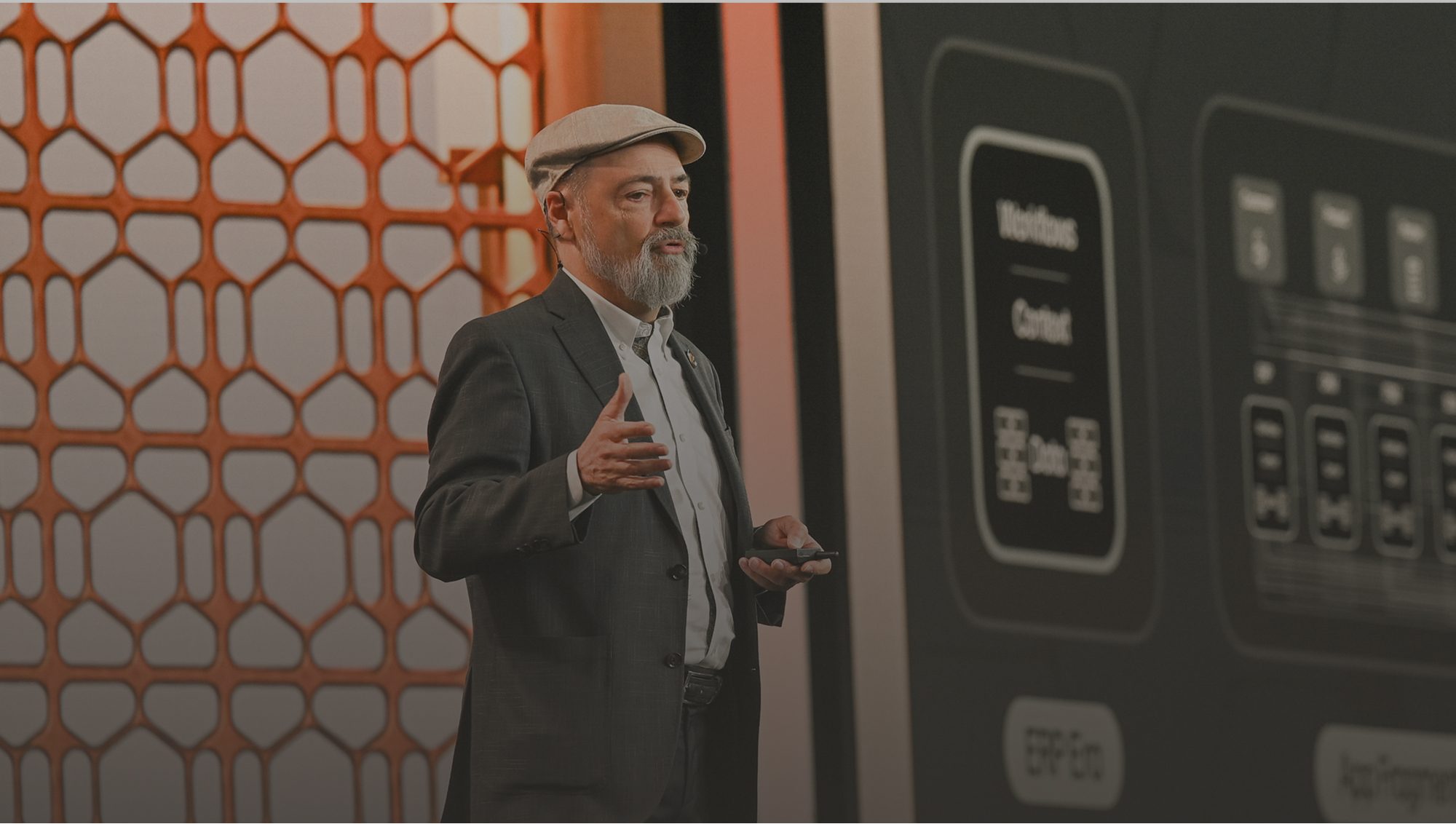
Everpure CEO, Charles Giancarlo shares the vision behind the New Data Dynamic and what it means for modern data management.
This webinar first aired on 17 June 2026
Click to View Transcript
So great to see you all. Welcome, ladies and gentlemen. Welcome, Pure fans. Really appreciate you coming in, spending your time with us, putting in all of the-- all the effort it takes to get out here.
I hope you're staying cool, while you're out here. I really look forward to t-today's conversation. I actually think this is gonna be something that perhaps you didn't expect. It's gonna be very different. We're going off into some very new areas, ergo the name, to EverPure, and I'm looking forward
to telling you all about it. But let's just start with a little bit of a review of this past year and where Pure is today. I think you've bet on the right horse now that we're in a betting area. We are growing just incredibly.
We, had our first billion-dollar Q1, which was a major milestone for us. Thank you. Almost fifteen thousand customers. ARR now, which represents our subscription services, thank you very much for, for being part of that, at two billion dollar run rate. we have doubled the number of Fusion customers.
Raise your hand if you've started using Fusion in your arrays. Thank you. That's about, that's about correct. So we doubled that quarter over quarter, okay? From six hundred to twelve hundred. Our goal is to get half of our customers or more on Fusion this year.
We'll talk a little bit more about that later. in addition to that, I wanna talk about something, though, you know, a bit more serious, and we'll just spend a, a minute on this. But I know how difficult it's been for all of you. we started seeing our costs rise back in December, and we made a, a very,
important decision at Pure. We decided that we couldn't raise prices on you unless we shared in part of the pain. To give you a sense, these little, lines here represent, the, cost increase that we had in NAND. NAND in the last, about six months, six or seven months, has risen between six and eight
hundred percent. Think about that, six to eight times just in the last six to eight months. Consequently, we've had to raise prices. Our overall costs, f- to produce one of our products has increased over three hundred percent.
and we raised later, and we've kept and held onto our contractual commitments with you, and that, that is really our promise. We've had to raise prices, but we are operating today at the low end of our gross margin range that we've ever-- the lowest end of our gross margin range, range that we've ever operated. And we'll continue doing that for as long as
prices con- or costs continue to rise. We want to be able to share the pain with you. So thank you for sticking with us. I apologize for the industry as a whole. We'll eventually get through this.
Unfortunately, it's probably gonna take a little bit of time. So, you know, we've worked both with our partners, and with our customers who are ordering with us to make sure that this is as painless as it can possibly be. So I just wanted to put that out in the open because we know how much trouble and how much pain this is causing you.
All right. Let's go, though, to what the industry is doing. So there's a dead heat now for who's, at the, leadership of Flash, with Pure in, in a, in a dead heat. But actually, as of, Q1, we now ship more, Flash than really anyone else, and it's
interesting where this is going. This has allowed us since our founding to now have about fourteen percent, of the overall total storage-- enterprise storage share, total sh- including hard disk and everything. So, you know, very, very significant. And as you can see, we're gaining at the expense of, everyone else.
And you might say, "Well, why is this? How, how can you do it, and why do we think that this is something that can continue?" Well, as of last year, we now invest more in data storage, research, and development than every one of our competitors, no matter how big. Every single one of them invest less in storage, research, and development.
For a very simple reason, we came into this market with a differentiator, and that differentiator was we thought data storage was high technology, and every other vendor thought it was a commodity. And we've constructed the company around that simple concept. We really focus on R&D, so we out-invest.
This year, we will ship more Flash or as much Flash as all of our competitors combined. Think about that. That's what leadership is really about. And we are really the only ones growing. This year, we grew thirty-five percent-- or this quarter, we th- grew thirty-five percent year over year, and we believe that's accelerating.
So very exciting. And you've rewarded us with an eighty-four net promoter score. Again, customer fo- first is our first principle, and we want to make sure that you, or that we provide you a great product, but more importantly, that we're a great partner to you as we go forward. And not just you, but Gartner has also, honored us with their top score,
you know, for, data storage arrays. And now, with a new m-measurement, this is brand new, we are also in their top quadrant for what they basically called an integrated service offering, which is our storage as a service, offering. So very powerful.
Okay, so now I wanna switch gears on you. And actually, this is the surprise. I'm not gonna talk to you about data storage. I wanna talk to you about your data. So your data is held inside the applications that you operate, whether those are
traditional apps or they are analytics apps, and now increasingly, they are AI agents. But the way that we as an industry have always structured, that is the IT industry, the way we've structured our data is that the data is created by, used by, and managed by the application itself, right?
It is secondary to the application. It is trapped in the silo. And as these, as these applications have grown, those silos have grown. So let's understand how we got here. It started with a, a very pure concept.
That concept was there would be one application to control all of the enterprise's environment. It started with ERP maybe twenty-five, even thirty years ago. And ERP held the promise that all the data would be held in the ERP system. The ERP system would provide your finances, they would provide your insights into sales,
it would control your manufacturing processes and all your, inputs so that you could price products. And this is how, it would do invoicing, quoting, payments. So the idea was there'd be one application to control them all. But then over the last thirty years, this started to fragment, mainly because vendors
came along that, that had the concept of managing the workflow for specific functions, for the sales function, for the HR function, for the finance function. And it was very useful for efficiency, right? And not only that, it was very useful for selling because now you could do departmental sales rather than IT sales by the vendor.
And it, and it really made workflow easy for, for workers, and so it proliferated. But as it did so, each of these apps needed connections to other apps so it would have the right data to be able to work on. Today, though, it's fragmented further because in order to get almost anything really useful done, like understanding what a customer is or putting together a quote or an invoice,
understanding how your product structure affects all these different, groups, like the sales group or the finance group or the manufacturing group, it requires connection to all of these environments. And a lot of your teams spend their time reconciling the fact that the data is different in each of these, environments, right?
The definition of customer in ERP is different from the de- definition of customer in your, in your CRM or in, y- your Workday Or sorry, the, the, s-- the ServiceNow environment. So it's fragmented the data and furthermore, it's fragmented the context. So what have we done since then?
What we've done is we built analytics that would give us a much more holistic understanding of all this data in all these different systems, and it would go out to the ERP or the CRM system. And then, of course, in order for it to be able to transform the data, we built data warehouses.
And then as we wanted to bring in unstructured data, we built data lakes and built context around the data lakes and added agents, et cetera. And so this allowed us to get reports that made sense of all the different data in the different environments. Okay, so that was the next step in the journey. And now what are we talking about?
We're talking about agents. Now, when the agent is contained inside one of these, workflows or SaaS environments, let's take a CRM for instance, it could provide you some insight into the data in the CRM. But what it couldn't do, if it was buried inside CRM, is put together data that is also in some of the other apps to make w- even greater sense of it.
So to really allow AI agents to be useful, they have to exist above the individual applications themselves. And then again, w- we're looking at, okay, we need connections to all the applications. So this was the next era, if you will, or this is the era that we're living in. So you have all these different eras, and I might ask you, what aligns them?
What is the common theme in all of these different architectures and structures? Well, one theme is that every one of your vendors wants all of your data. All your AI, new AI vendors, they want all your data. All your analytics vendors, they want y- all your data. Every one of your SaaS vendors, they want all of your data.
How many vendors are you gonna give all your data to? It's just not v- not a viable solution, is it? Every new application has fragmented your data so that the definition, again, of customer, let's say, is different in each one of you. The definition of product is different in every one of them.
And this creates problems when you wanna use AI or agents because you don't have a single source of truth. So w- we do think there is an answer to this, and the answer is different than the way we construct networks today or the way we construct IT to- today, which is application-centric. What we do today is application-centric, but if you fragment your ac- your applications,
you get a fragmented understanding of your own environment. So we think that the answer to this is that instead of the apps themselves connecting to all of your data, that we need to construct A context map. We need to understand the data itself. We need to understand the context of each of the data s- systems, each
of the data environments. And then what we need to do is we need to create shared context of how these different data sets, w- w- how they, cooperate with one another, what the, what the connections are between the same definitions in the, different data sets, right? Think of this as a universal data intelligence universalizing across your enterprise where
you understand the con-- not only the context of individual data sets but how those data sets relate to other data sets as well. And when you create this universal, data intelligence, this context graph, you do a number of different things. One is it reduces the number of data integrations that you need to do.
That's a lot of work by a lot of your teams. We believe it reduces the number of data copies that you will need to make. So reduces your costs, reduces your, attack surface for cyber, right? And we believe it crea-- it, it's going to reduce or increase rather your data coherence. It'll allow you to get better insights from your data.
But we think on a slightly longer term basis, this is a fundamental rearchitecture of the way we think about creating IT environments, you know, our own IT environments. And this is something that we are actually doing within Pure in our IT environment. And what that is is creating what we call data primacy.
So what is data primacy? We start with this again assuming a, a shared context across all of our different environments. But now we extract the data from these different environments. And we don't just extract it now, we have to change it.
We have to ch-- create an environment where we have sources of truth or systems of record. And what is a source of truth? What is a system of record? It depends. Each enterprise will have their own, but it's, it, it is based on the, the fundamentals of your company's business.
So for us, it's customer. That is, what is a customer? Every aspect of the customer. You know, not just who's the buyer but who are the influencers, who, where, where, who, pays the bills, right? Their finance organization.
Who do you ship to? Where are the a-- where are the location of the assets? It includes product or product main. It includes an asset main. So the fundamentals of your business as a source of truth, a system of record that is highly governed because y- entropy happens.
You wanna make sure it is always a source of truth. And now when you do this and you have the context between these different sources of record, then you are in charge. And what happens is as, as opposed to the workflows, your SaaS, environments, as opposed to them controlling the data and owning the data and having complete, control of the
context, now you're in charge of the data. You own the data. You own the context between the data. And the workflows just either read from or write to that data under governance. That gives you incredible optionality. So, and that's-- when I talk about apps, it doesn't really matter in this case whether
it's an app, whether it's analytics, whether it's agents. They work the same way off of your data and off of your context. So let's look at the two different ones. You have application centric and you have data primacy as two different architectures that you pursue in your IT environment.
What's the difference? Well, the way we're going now is just not sustainable. We cannot continue to have continued data fragmentation, because data fragmentation, you know, confuses AI agents. Instead, what you want is a coherent, view, a coherent repository of the
sources of truth inside your organization. Secondly, in the case of, of app centric, you have duplicate definitions of the same thing. And again, you'll have garbage in, garbage out if customer means something different in these different, environments.
Instead, you build a semantic knowledge graph based on sources of truth inside your organization. You make the data primary, not the application. And so what that means is that, you don't have these brittle handoffs that every time one of the application suites changes, it changes the answer that you might get.
It changes the definition. It breaks all the linkages. Instead, you have plug-and-play apps, gives you optionality because again, you have a source of truth. You have, context that you've defined. You know, and on and on and on.
You don't have fragmented context. You have coherent, context. You have coherent data, right? And then you can build a policy-first framework, for how you govern that data. And you force your workflows to match your governance rather than, rather than the
workflows breaking the governance. So I think you get it. You know, in the case of app centric, any change by the vendor changes the relationships among the, the context or the meaning. That does not happen, in the case of data primacy. Okay, so we have-- let's assume that we go down this path of data primacy.
It's what we're doing within Pure inside our own IT organization. How does that relate to the rest of what we provide you? How does that relate to the storage? Well, again, the systems of record is data, right? It is data sets. and the apps are-- you still have apps.
You still have a lot of them. And those apps of course have copies. they have copies for the purpose of, of, reliability, of backup, et cetera. You have copies, because of agents and analytics. You have a lot of data.
Each All, all of that data requires different types of storage capability. And as of today, before Fusion, every array had to be configured, and it had to be managed. Had different if you have multi-vendor, you have different GUIs, you have different, characteristics, way of, of being able to manage it.
Well, we solved the data problem by taking the data, creating a single s- system based on purity that can manage any type of workload at any performance level, from l- low cost to high, to high performance. And we've taken this concept where you have to, program each array separately, and we've created Fusion. This unified control plane where you can just
define how you want a certain set of data, a data category, to be managed, and it can be managed across all of the arrays automatically. And that's what we call, you know, the EverPure platform. You So you put this all together now. You have a platform that can manage data and data sets at the data level.
You create your own sources of truth and your own, systems of record. And then you create your own, context and shared context acri- a- across them. And you have a system that is much more automated, much more coherent, that you can manage at scale. And this is what we at Pure are bringing, bringing you. So first 10 years of our life, we focused on
simplifying your array. Over the last five years, we brought in Fusion to simplify your fleet overall. Now we have unified the management of this environment. And what our next challenge is, I think, not just as Pure but as an industry, is to help you to be able to unlock the power of your data.
Minds blown? I'll take that as a yes. Thank you. thank you very much.
Charles Giancarlo outlines the strategic vision for the New Data Dynamic and explains how Everpure is helping organisations navigate change across data, infrastructure, and innovation.



Personalize for Me
My Updates
No updates at this time.